Educational journalism, not medical advice. Every claim here is checked against its cited sources by editor Timothy Bunce — a health writer, not a physician. It isn’t specific to your situation: for health decisions, talk to your own clinician. How we work →
Some links in this article are affiliate links. If you buy through one, The Beachside Reader earns a commission at no extra cost to you. It never changes which products we pick, or what we say about them. Full affiliate disclosure →
The 60-second version
Swapping meat for a plant-based alternative moves cholesterol markers in the direction the marketing implies, but less reliably than the aisle suggests. A pooled analysis of eight publications from seven randomised trials in 369 adults found LDL cholesterol 0.25 mmol/L lower when plant-based meat alternatives replaced meat; in a sensitivity analysis limited to the four mycoprotein trials the reduction was larger (0.37 mmol/L), so the pooled figure is not evenly distributed across product types Fernández-Rodríguez 2025. A crossover trial in which people ate at least two servings a day of Beyond Meat products for eight weeks found LDL cholesterol 10.8 mg/dL lower than on animal meat Crimarco 2020, while a parallel-design eight-week trial in 89 adults that made LDL cholesterol its primary outcome found no significant change in the lipid profile Toh 2024. Both trials were industry-supported: the crossover by an unrestricted gift from Beyond Meat, the parallel trial by Pinduoduo Incorporated. Sodium is a per-product question: intake rose in the analogue group in the parallel trial Toh 2024 but total sodium was similar across phases in the crossover Crimarco 2020, and a shelf audit of 137 products found only 4% eligible for a low-sodium claim Curtain 2019. Judge the swap on the nutrition panel, not the packaging.
The plant-based meat aisle asks shoppers to hold two ideas at once. The first is that replacing meat with peas, soy or fungal protein is the obvious health upgrade. The second, arriving from a different corner of the same conversation, is that these products belong to the category of ultra-processed food people are being told to eat less of. The researchers behind one of the direct comparisons described that tension in their own paper: growing consumer popularity coupled with rising critiques of the products' ultra-processed composition, against what they called a paucity of data on which to evaluate those critiques Crimarco 2020.
What a Shelf Audit Measured
The most concrete description of the category comes from a cross-sectional product audit rather than a trial. Two researchers collected nutrition-panel information and Health Star Ratings from 137 plant-based meat substitutes across four metropolitan Sydney supermarkets in 2019 — 50 burgers, 10 mince products, 29 sausages, 24 chicken substitutes, 9 seafood substitutes and 15 others Curtain 2019. It is a snapshot of one country's shelves, and it measures panels rather than outcomes, but it is the reason the phrase "plant-based meat" is close to useless as a nutritional label.
Sodium ranged from 58 to 1200 mg per 100 g, and only 4% of products would have been eligible for a low-sodium claim, while none carried one Curtain 2019. Compared with their meat equivalents, the plant-based products were generally lower in kilojoules, lower in total and saturated fat, and higher in carbohydrate, sugars and dietary fibre. The kilojoule difference reached statistical significance in sausages and mince, and the fat difference in burgers and sausages, so the advantage is directional across the category rather than uniform within it Curtain 2019.
Two findings from the same audit cut the other way, and the packaging does not carry them. The plant-based products contained less protein than the meat comparators, significantly so for burgers and mince (P < 0.001), with sausages close to the line (P = 0.081). And fortification was the exception: 24% of products carried added vitamin B12, 20% added iron and 18% added zinc Curtain 2019. The authors' reading of their own averages is not the reassuring one. They concluded that the products lack equivalence with similar meat products, that this is a limitation for vegetarians, vegans and meat-eaters alike who may fall short of key nutrients, and that sodium is an issue for the category Curtain 2019.
The Crossover Trial, and Who Paid for It
One direct comparison is SWAP-MEAT, a randomised crossover feeding trial run at Stanford. Thirty-eight adults were randomly assigned to the intervention arms and 36 completed both phases with complete data — 67% women, mean age 50 ± 14 years, BMI 28 ± 5 kg/m². Each ate at least two servings a day of plant products for eight weeks and at least two servings a day of animal products for eight weeks, in randomised order, and was instructed to match all non-study foods as closely as possible between the two phases Crimarco 2020.
During the plant phase, LDL cholesterol averaged 109.9 mg/dL against 120.7 mg/dL on animal meat, a difference of 10.8 mg/dL (P = 0.002), and body weight was 0.9 kg lower (78.7 versus 79.6 kg, P < 0.001) Crimarco 2020. Trimethylamine-N-oxide, the gut-microbiome metabolite the trial was designed around, was lower overall on the plant phase (2.7 ± 0.3 versus 4.7 ± 0.9 µM, P = 0.012) Crimarco 2020. The authors' own conclusion was that the plant products improved several cardiovascular disease risk factors, including that metabolite, with no adverse effects on risk factors, and that plant-based meats offer a potentially healthy alternative given recommendations to reduce red meat intake Crimarco 2020.
The metabolite result carries a qualifier the authors flagged themselves. There was a significant order effect (P = 0.023): the difference was concentrated in the 18 participants who ate the plant phase second (2.9 versus 6.4 µM, P = 0.007) and was not statistically significant in the 18 who ate it first (P = 0.23) Crimarco 2020. Their explanation runs opposite to the intuitive one. They suggest the plant-first group may have suppressed trimethylamine-producing gut taxa, leaving less trimethylamine-N-oxide to produce when the meat phase came second — a carryover from the plant diet blunting the contrast, not a residue of the meat diet sharpening it Crimarco 2020.
Two features of the design belong in any honest summary. The plant products tested were Beyond Meat's, supplied by the company and distributed at the research facility, and the trial was supported by an unrestricted research gift from Beyond Meat to Stanford University; the paper records that the remaining authors reported no conflicts of interest Crimarco 2020. And the meat comparator was 80:20 lean-to-fat ground beef at 9 g saturated fat per burger against 6 g for the comparable Beyond Meat product — a choice the authors list among their limitations, alongside the absence of a washout period, the inclusion of chicken and fish in the animal phase, a self-selected background diet, and the 12 of 36 participants who took a break of one to seven weeks between phases. Leaner ground beef, they note, is sold at 85:15 and 90:10 Crimarco 2020. Part of the lipid contrast is therefore a property of the beef that was chosen.
What the Wider Trial Evidence Shows
The swap has also been tested in a parallel-design trial that named LDL cholesterol in advance, and the results are less tidy. An eight-week parallel-design randomised controlled trial in Singapore assigned 89 adults at elevated risk of diabetes to substitute fixed quantities — 2.5 servings a day — of either plant-based meat analogues (44 participants) or the corresponding animal-based meats (45 participants) for their habitual protein-rich foods, keeping the rest of the diet steady. LDL cholesterol was the primary outcome. There were no significant effects on the lipid-lipoprotein profile, LDL cholesterol included Toh 2024.
That trial did move other markers. Diastolic blood pressure was lower in the plant-based group (P for interaction = 0.041), while glycaemic homeostasis was better regulated in the animal-based group. The authors concluded that an eight-week plant-based-analogue diet did not show widespread cardiometabolic benefits compared with a corresponding meat-based diet, and that nutritional quality is a key factor for next-generation products Toh 2024. It carries industry support of its own, and the disclosure is worth stating as plainly as Stanford's: the trial was supported by Pinduoduo Incorporated (HongKong Walnut Street Limited), and a corrigendum was published for the sole purpose of elaborating that the senior author reports partial financial support from that firm, which the corrigendum describes as an agricultural research firm. The same statements record that no products evaluated in the study were obtained from Pinduoduo and that it had no role in study design, study conduct, laboratory analyses, data collection, management and interpretation, or the writing, reviewing and approval of the manuscript Toh 2024. What distinguishes it from SWAP-MEAT is not independence but design: a parallel rather than crossover structure, LDL cholesterol prespecified as the primary outcome, and an Asian cohort selected for elevated diabetes risk rather than generally healthy volunteers.
Pooling the trials helps. A systematic review and meta-analysis searching databases to July 2024 combined eight publications from seven randomised controlled trials in 369 adults, with mean ages across trials ranging from 24 to 61 years, all substituting plant-based meat alternatives for meat. LDL cholesterol fell by 0.25 mmol/L (95% CI −0.42 to −0.08; I² = 65.8%; seven studies), total cholesterol by 0.29 mmol/L (95% CI −0.52 to −0.06; I² = 64.8%; six studies) and body weight by 0.72 kg (95% CI −1.02 to −0.42; I² = 0%; five studies), with no significant changes in HDL cholesterol, triglycerides, blood pressure or fasting glucose Fernández-Rodríguez 2025.
The composition of that pooled effect matters more than its size. In sensitivity analyses restricted to mycoprotein-based alternatives, the LDL reduction was larger (0.37 mmol/L, 95% CI −0.61 to −0.13; four studies), so the lipid signal is substantially attributable to fungal-protein products rather than to the pea and soy patties most shoppers are choosing between Fernández-Rodríguez 2025. That is an inference from a sensitivity analysis rather than a formal test of difference between product types, and it should be read as one. The authors' framing is measured: substituting these products for meat for up to eight weeks lowered total cholesterol by 6%, LDL cholesterol by 12% and body weight by 1% in adults without cardiovascular disease; the products may help people transition to a plant-based diet; and long-term studies are needed to evaluate cardiometabolic effects Fernández-Rodríguez 2025.
A separate line of evidence supports the general shape of the swap without touching manufactured products at all. A meta-analysis of 36 randomised trials in 1,803 participants compared diets containing red meat with diets that replaced it. Against high-quality plant protein sources — defined as legumes, soy and nuts — red meat produced lesser decreases in total cholesterol (weighted mean difference 0.264 mmol/L, 95% CI 0.144 to 0.383) and in LDL cholesterol (0.198 mmol/L, 95% CI 0.065 to 0.330) Guasch-Ferré 2019. The comparator did the work. Against fish, red meat produced greater decreases in LDL cholesterol (−0.173 mmol/L, 95% CI −0.260 to −0.086) and in HDL cholesterol; against carbohydrate, greater decreases in triglycerides. Against all comparison diets combined there were no significant differences in total, LDL or HDL cholesterol, apolipoproteins A1 and B, or blood pressure, and the triglyceride difference had a confidence interval touching the null (0.065 mmol/L, 95% CI 0.000 to 0.129) Guasch-Ferré 2019. The authors concluded that substituting red meat with high-quality plant protein sources, but not with fish or low-quality carbohydrates, leads to more favourable changes in blood lipids and lipoproteins Guasch-Ferré 2019 — a conclusion about whole plant foods, not analogues.
Sodium: The Per-Product Catch
Sodium is the number that varies most across the audited category, and the Singapore trial turned the shelf observation into an intake finding: dietary sodium increased in the plant-based-analogue group, alongside dietary fibre and potassium (all P for interaction < 0.001), while dietary trans-fat increased in the animal-based group Toh 2024. Substituting analogues for meat, in that trial, moved sodium in the wrong direction for the people who made the swap.
The crossover trial measured intake too, and it came out the other way. SWAP-MEAT tabulated daily sodium from the study products and from all other sources separately, and reported that intakes were similar during the two phases in terms of products, non-products and total sodium; the authors treated that similarity as the explanation for the absence of any blood-pressure difference between the phases Crimarco 2020. So the direction across the two trials is discordant rather than consistent, and the discriminator is not the patty alone but what the rest of the diet does around it. A swap made into a diet whose other components stay fixed can raise total sodium; a swap made into a diet whose other components are deliberately matched need not.
How much that matters depends on the whole diet rather than one food. In the DASH-Sodium trial, 412 adults were randomly assigned to eat either a control diet typical of intake in the United States or the DASH diet; within their assigned diet, each ate high, intermediate and low sodium levels for 30 consecutive days each, in random order. The trial recruited adults with systolic pressure between 120 and 159 mmHg and diastolic pressure between 80 and 95 mmHg, so this was not an unselected population Sacks 2001. Cutting sodium from the high to the intermediate level lowered systolic pressure by 2.1 mmHg on the control diet (P < 0.001) and by 1.3 mmHg on the DASH diet (P = 0.03); going from intermediate to low produced further reductions of 4.6 mmHg (P < 0.001) and 1.7 mmHg (P < 0.01) respectively Sacks 2001. Because diet was randomised between participants and sodium level within them, those two columns describe separate groups rather than the same people eating both diets.
No single patty carries a blood-pressure number of its own from that trial. But the audited sodium spread — 58 to 1200 mg per 100 g, with only 4% of products low in sodium Curtain 2019 — is large enough that the choice between two boxes in the same freezer cabinet is a real one, and it is visible before buying.
Saturated Fat and the Comparator Problem
The instinct that a formulated patty must be the saturated-fat problem is not what the audit found: averaged across the category, plant-based products were lower in total and saturated fat than their meat equivalents, significantly so for burgers and sausages Curtain 2019. But the comparator has to be named for that to mean anything, and the SWAP-MEAT authors put the other side plainly: compared with fresh, minimally processed foods, many plant-meats are relatively high in saturated fat and sodium Crimarco 2020. Lower than a supermarket sausage and higher than a bowl of pulses can both be true of the same product.
Saturated fat earns the attention because it is one of the few dietary variables with long randomised outcome trials behind it. A Cochrane review included 15 randomised controlled trials — 16 comparisons, 56,675 participants — all with interventions lasting at least 24 months. Reducing saturated fat intake cut combined cardiovascular events by 17% (risk ratio 0.83, 95% CI 0.70 to 0.98) across 12 trials and 53,758 participants, with substantial heterogeneity (I² = 67%) and moderate-quality evidence on the GRADE scale Hooper 2020. The same review found little or no effect on all-cause mortality (RR 0.96, 95% CI 0.90 to 1.03) or cardiovascular mortality (RR 0.95, 95% CI 0.80 to 1.12), both moderate quality, and no evidence of harmful effects from reducing saturated fat Hooper 2020. Subgrouping did not suggest significant differences between replacing those calories with polyunsaturated fat or with carbohydrate, and data on replacement with monounsaturated fat and protein were very limited Hooper 2020. The instruction that survives is unglamorous: keep the number down, and do not shop for a fashionable replacement oil that the review declined to rank.
The Ultra-Processed Objection
The processing objection is not a straw man, and it is one the trial authors accept on the facts: most plant-meat products meet the NOVA criteria for ultra-processed foods, as their paper states Crimarco 2020. What follows from that classification is where the argument gets thinner.
The population-level evidence is observational. In the NutriNet-Santé cohort, 105,159 French adult volunteers recorded their diets through repeated 24-hour records — 5.7 per participant on average — and over a median 5.2 years of follow-up there were 1,409 cardiovascular events. Each absolute increment of 10 percentage points in the share of ultra-processed food in the diet carried a hazard ratio of 1.12 for overall cardiovascular disease (95% CI 1.05 to 1.20), with incidence of 277 per 100,000 person-years among the highest quarter of consumers against 242 among the lowest Srour 2019. The associations held after adjustment for saturated fat, sodium and sugar intakes, fibre and a healthy dietary pattern, but the authors state that causality cannot be established from this single study and that residual confounding cannot be excluded Srour 2019. Their own worked examples of ultra-processed foods run to packaged breads and buns, packaged snacks, confectionery and desserts, sodas, nuggets and other reconstituted meat products, instant noodles and ready meals; plant-based meat substitutes do not appear on that list Srour 2019.
The mechanistic evidence is a small inpatient trial. Twenty weight-stable adults were admitted to the NIH Clinical Center and randomised to two weeks of an ultra-processed diet immediately followed by two weeks of an unprocessed diet, or the reverse, with meals matched for presented calories, energy density, macronutrients, sugar, sodium and fibre, and instructions to eat as much or as little as they wanted. Energy intake was 508 ± 106 kcal/day greater on the ultra-processed diet (P = 0.0001); participants gained 0.9 ± 0.3 kg on it and lost 0.9 ± 0.3 kg on the unprocessed diet Hall 2019. That trial tested whole diets of convenience food, with no analogue arm and no product-level comparison, so extending it to one patty is an inference rather than a finding Hall 2019.
Where Whole Legumes Come In
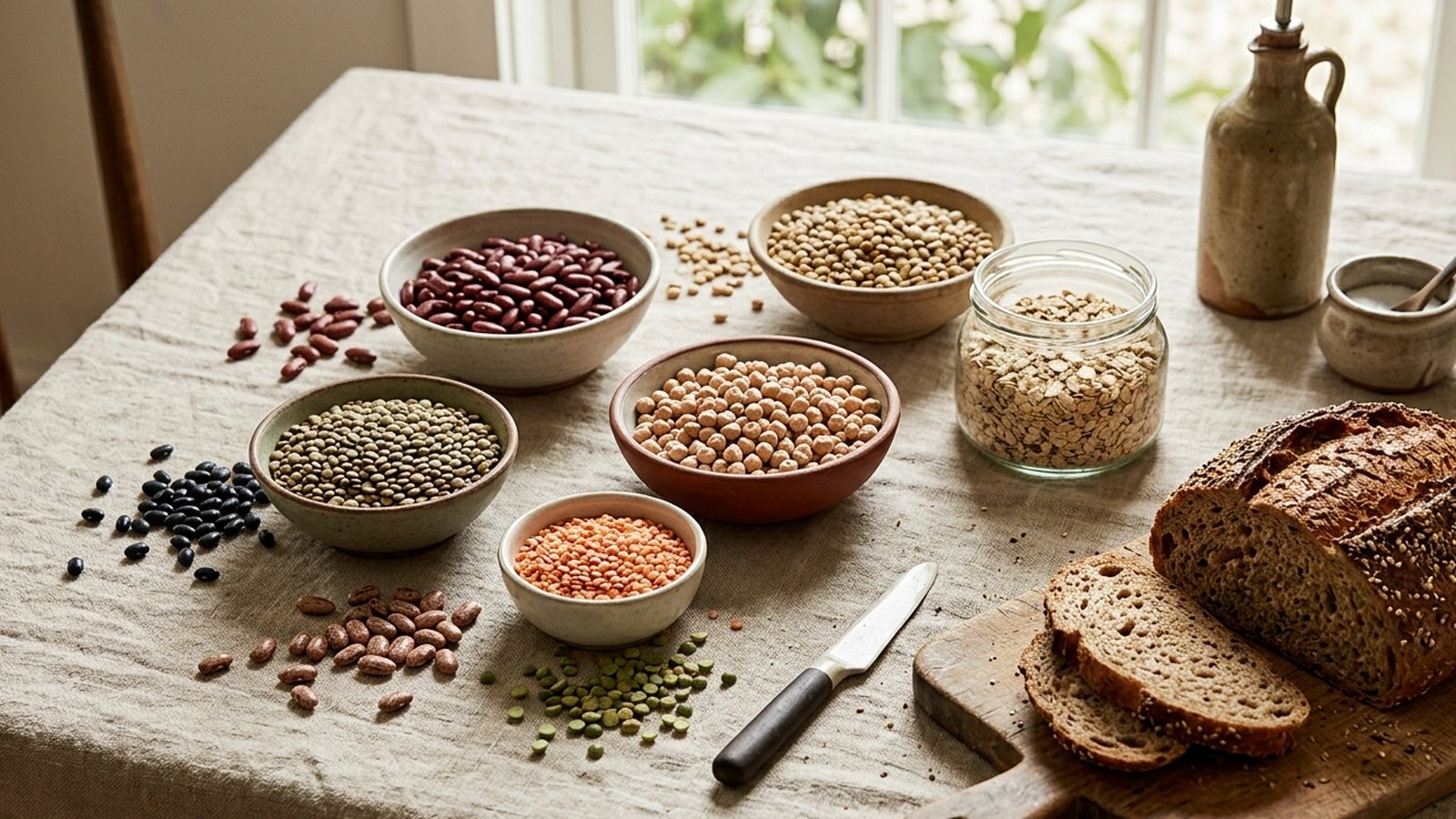
The third column rarely appears in the marketing. A systematic review and meta-analysis of 26 randomised trials in 1,037 participants, each at least three weeks long and compared against isocaloric diets containing no pulses, found that diets emphasising pulses at a median dose of 130 g a day — about one serving — lowered LDL cholesterol by 0.17 mmol/L (95% CI −0.25 to −0.09) Ha 2014. The same analysis found no treatment effect on apolipoprotein B or non-HDL cholesterol, and the authors asked for trials of longer duration and higher quality to verify the result, noting that heart-health guidelines had stopped short of ascribing specific benefits to this kind of intervention or had graded the beneficial evidence as low Ha 2014. The 130 g is a median across trials rather than a prescribed dose.
Fibre is the other axis, and here the analogues do well rather than badly: the audited category ran higher in dietary fibre than its meat equivalents Curtain 2019, and fibre intake rose in the group that swapped in the Singapore trial Toh 2024. What the audit cannot tell a reader is how any single product compares with a bowl of cooked pulses, because it measured manufactured substitutes only Curtain 2019.
The cost of the legume option is convenience and culinary distance: a bowl of lentils does not do what a burger does at a barbecue, which is precisely the gap these products were engineered to fill. For readers weighing how much protein a legume-forward diet delivers, our guide to getting enough protein from plants covers the quantity and amino-acid questions, and pulses sit near the centre of the eating pattern described in our explainer on what the Mediterranean diet evidence actually shows.
How to Read the Panel
Four numbers settle most of this at the freezer door, and none of them are on the front of the box.
Sodium per 100 g. Compare across brands rather than against fresh meat. Within the audited plant category the range ran from 58 to 1200 mg per 100 g, with only 4% of products eligible for a low-sodium claim Curtain 2019, and substituting analogues for meat raised sodium intake in an eight-week trial Toh 2024, though a crossover trial that matched non-study foods found similar total intakes across its two phases Crimarco 2020.
Saturated fat per 100 g. The category averaged lower than its meat equivalents, significantly so in burgers and sausages Curtain 2019, but an average is not a promise about the box in your hand, and reducing saturated fat is the variable with long randomised outcome evidence attached Hooper 2020.
Fibre per serving. The audited category ran higher in dietary fibre than its meat equivalents Curtain 2019, and this is one of the few axes where these products have a straightforward advantage over meat.
Fortification. If the swap is replacing most of the meat in a diet rather than an occasional burger, added B12, iron and zinc on the panel matter, and in the audited sample only 24%, 20% and 18% of products respectively carried them Curtain 2019. The audit's own authors treat that as a non-equivalence problem Curtain 2019.
The Verdict and Its Limits
"Healthier" turns out to be the wrong shape of question. On LDL cholesterol, the pooled short-term trial evidence favours substituting these products for meat by about 0.25 mmol/L, with the effect leaning on mycoprotein products rather than pea and soy patties Fernández-Rodríguez 2025; the Beyond Meat-supported crossover found a 10.8 mg/dL advantage against 80:20 ground beef Crimarco 2020; and the Pinduoduo-supported eight-week trial that made LDL cholesterol its primary outcome found no significant change Toh 2024. That reads as a modest average effect and an unreliable one in any individual case, and neither direct comparison was free of commercial interest.
On sodium the reliable finding is the spread on the shelf, not a consistent intake effect: the two trials that measured intake disagree, because whether a swap raises total sodium depends on what the rest of the diet is doing, and the size of any penalty is a per-product question a reader can answer on the panel Curtain 2019 Toh 2024 Crimarco 2020. On processing, the classification is a useful heuristic for a whole diet and a poor instrument for judging whether one item is worse than the specific thing it replaced Hall 2019.
The trials cited here measured blood markers and short-term intake over eight weeks or less, not decades of disease outcomes, and the cohort evidence cannot isolate the effect of a single product category Srour 2019. A plant-based analogue is a defensible substitute for a meat patty on cholesterol markers over eight weeks, and cooked pulses carry randomised LDL evidence of their own Ha 2014 — but none of the evidence cited here put the two in the same trial, so the ranking between them is not something this page can settle. That is a narrower claim than the packaging makes, and it is the one the evidence cited here supports.
Frequently asked questions
Are plant-based burgers healthier than beef burgers?
It depends which marker you ask about. A pooled analysis of eight publications from seven randomised trials in 369 adults found LDL cholesterol 0.25 mmol/L lower when plant-based meat alternatives replaced meat; in a sensitivity analysis limited to the four mycoprotein trials the reduction was larger, 0.37 mmol/L, so the pooled figure is not evenly distributed across product types (Fernández-Rodríguez 2025). A crossover trial supported by an unrestricted gift from Beyond Meat found LDL cholesterol 10.8 mg/dL lower on the plant phase and lower trimethylamine-N-oxide (2.7 versus 4.7 micromolar), though that metabolite difference was order-dependent and was not statistically significant among participants who ate the plant phase first (Crimarco 2020). A parallel-design eight-week trial in 89 adults at elevated diabetes risk, with LDL cholesterol as its prespecified primary outcome, found no significant change in the lipid profile; it was supported by Pinduoduo Incorporated, and a corrigendum was published to elaborate that the senior author reports partial financial support from that firm (Toh 2024). On sodium, a shelf audit of 137 products found only 4% eligible for a low-sodium claim (Curtain 2019).
Do plant-based meat alternatives raise sodium intake?
It depends on the rest of the diet. In an eight-week parallel-design randomised trial, dietary sodium increased in the group that substituted plant-based analogues for meat, alongside fibre and potassium (Toh 2024). A crossover trial that tabulated sodium from the study products and from all other foods separately reported similar intakes across its plant and animal phases, and linked that similarity to the absence of any blood-pressure difference (Crimarco 2020). A shelf audit of 137 plant-based meat substitutes found sodium ranging from 58 to 1200 mg per 100 g, with only 4% of products eligible for a low-sodium claim and none carrying one (Curtain 2019). Comparing brands on the panel is the practical response.
Do plant-based meats have less saturated fat than meat?
On the audit's category averages, yes: plant-based options were generally lower in kilojoules and in total and saturated fat than their meat equivalents, with the fat difference significant for burgers and sausages (Curtain 2019). Measured against fresh, minimally processed foods rather than processed meat, the picture reverses — many plant-meats are relatively high in saturated fat and sodium (Crimarco 2020). Reducing saturated fat cut combined cardiovascular events by 17% (risk ratio 0.83, 95% CI 0.70 to 0.98) in a Cochrane review of trials lasting at least two years, though the same review found little or no effect on all-cause or cardiovascular mortality (Hooper 2020).
Does it matter that these products are ultra-processed?
Most plant-meat products meet the NOVA criteria for ultra-processed foods (Crimarco 2020). Higher ultra-processed intake tracked with more cardiovascular disease in an observational cohort of 105,159 adults, where each absolute increment of 10 percentage points of dietary share carried a hazard ratio of 1.12, and the authors state that causality cannot be established from that study (Srour 2019). A controlled inpatient trial found people ate 508 kcal more per day on an ultra-processed diet than on a matched unprocessed one, but it tested whole diets of convenience food with no analogue arm (Hall 2019).
Are lentils and beans a better swap than a plant-based patty?
No trial cited here compared the two directly, so this page cannot rank them. What can be said is that pulses carry randomised evidence of their own: a meta-analysis of 26 trials in 1,037 participants found that diets emphasising pulses at a median 130 g a day lowered LDL cholesterol by 0.17 mmol/L, though effects on apolipoprotein B and non-HDL cholesterol were not observed and the authors called for longer, higher-quality trials (Ha 2014). On sodium and processing, whole pulses have the advantage. The trade-off is convenience, which is what the analogues exist to solve.
References
Crimarco 2020Crimarco A, Springfield S, Petlura C, et al. A randomized crossover trial on the effect of plant-based compared with animal-based meat on trimethylamine-N-oxide and cardiovascular disease risk factors in generally healthy adults: Study With Appetizing Plantfood—Meat Eating Alternative Trial (SWAP-MEAT). The American Journal of Clinical Nutrition. 2020;112(5):1188-1199. doi:10.1093/ajcn/nqaa203 View source →Curtain 2019Curtain F, Grafenauer S. Plant-based meat substitutes in the flexitarian age: an audit of products on supermarket shelves. Nutrients. 2019;11(11):2603. doi:10.3390/nu11112603 View source →Toh 2024Toh DWK, Fu AS, Mehta KA, Lam NYL, Haldar S, Henry CJ. Plant-based meat analogs and their effects on cardiometabolic health: an 8-week randomized controlled trial comparing plant-based meat analogs with their corresponding animal-based foods. The American Journal of Clinical Nutrition. 2024;119(6):1405-1416. doi:10.1016/j.ajcnut.2024.04.006 (a corrigendum elaborating the funding statement — partial financial support to the senior author from Pinduoduo Incorporated / HongKong Walnut Street Limited — was subsequently published: doi:10.1016/j.ajcnut.2024.06.012) View source →Fernández-Rodríguez 2025Fernández-Rodríguez R, Bizzozero-Peroni B, Díaz-Goñi V, Garrido-Miguel M, Bertotti G, Roldán-Ruiz A, López-Moreno M. Plant-based meat alternatives and cardiometabolic health: a systematic review and meta-analysis. The American Journal of Clinical Nutrition. 2025;121(2):274-283. doi:10.1016/j.ajcnut.2024.12.002 View source →Guasch-Ferré 2019Guasch-Ferré M, Satija A, Blondin SA, et al. Meta-analysis of randomized controlled trials of red meat consumption in comparison with various comparison diets on cardiovascular risk factors. Circulation. 2019;139(15):1828-1845. doi:10.1161/CIRCULATIONAHA.118.035225 View source →Sacks 2001Sacks FM, Svetkey LP, Vollmer WM, et al. Effects on blood pressure of reduced dietary sodium and the Dietary Approaches to Stop Hypertension (DASH) diet. New England Journal of Medicine. 2001;344(1):3-10. doi:10.1056/NEJM200101043440101 View source →Hooper 2020Hooper L, Martin N, Jimoh OF, Kirk C, Foster E, Abdelhamid AS. Reduction in saturated fat intake for cardiovascular disease. Cochrane Database of Systematic Reviews. 2020;(8):CD011737. doi:10.1002/14651858.CD011737.pub3 View source →Srour 2019Srour B, Fezeu LK, Kesse-Guyot E, et al. Ultra-processed food intake and risk of cardiovascular disease: prospective cohort study (NutriNet-Santé). BMJ. 2019;365:l1451. doi:10.1136/bmj.l1451 View source →Hall 2019Hall KD, Ayuketah A, Brychta R, et al. Ultra-processed diets cause excess calorie intake and weight gain: an inpatient randomized controlled trial of ad libitum food intake. Cell Metabolism. 2019;30(1):67-77.e3. doi:10.1016/j.cmet.2019.05.008 View source →Ha 2014Ha V, Sievenpiper JL, de Souza RJ, et al. Effect of dietary pulse intake on established therapeutic lipid targets for cardiovascular risk reduction: a systematic review and meta-analysis of randomized controlled trials. CMAJ. 2014;186(8):E252-E262. doi:10.1503/cmaj.131727 View source →