The 60-second version
Long-haul flights combine prolonged sitting in a cramped position, mild dehydration from cabin air, jet lag, and (less commonly) increased deep vein thrombosis risk. The 2011 Watson et al. and 2012 ACCP DVT-prevention guidelines converge on a few clear findings: flights of 4+ hours carry a small but real absolute VTE risk (about 1 in 4,656, rising with duration; case-control data put long-haul travel's relative risk at roughly 3x baseline overall); simple in-flight movement is the recommended precaution — the guideline found no evidence that hydration itself lowers clot risk, though staying hydrated isn't harmful Watson 2011. The 2009 Eastman & Burgess jet-lag review and broader chronobiology literature show strategic light exposure and (sometimes) melatonin substantially accelerate phase realignment after time-zone changes. Practical playbook: pre-flight mobility 5–10 min; in-flight movement every 60–90 min; aisle seat for long flights when possible; compression socks for >6 hour flights or higher-risk travellers; destination-time light exposure and meal timing on arrival. This article covers the actual evidence on flight-related risks and the practical protocol.
Educational journalism, not medical advice. Every claim here is checked against its cited sources by editor Timothy Bunce — a health writer, not a physician. It isn’t specific to your situation: for health decisions, talk to your own clinician. How we work →
Some links in this article are affiliate links. If you buy through one, The Beachside Reader earns a commission at no extra cost to you. It never changes which products we pick, or what we say about them. Full affiliate disclosure →
What flights actually do to the body
- Sustained sitting: typical 4–14 hours of flexed hips and minimal lower-extremity movement.
- Cabin dehydration: 5–15% relative humidity vs ~40% indoor baseline.
- DVT risk: small but real elevation. Most affects long-haul (8+ hour) flights.
- Cabin pressure: equivalent to ~2400 m altitude; mild hypoxia.
- Time-zone disruption: 1+ time zone changes affect circadian system.
- Sleep disruption: cabin noise, light, position make sleep onset harder.
DVT considerations
- Healthy travellers, 4–hour flight: small risk increase, mostly ignorable.
- Healthy travellers, 8+ hour flight: ~3x baseline risk.
- Higher-risk individuals (recent surgery, pregnancy, hormonal contraception, cancer, prior DVT, age 65+): substantially elevated risk; consult clinician for prophylaxis.
- The 2012 ACCP guidelines recommend in-flight movement and hydration for low-risk; compression stockings and possibly anticoagulation for high-risk.
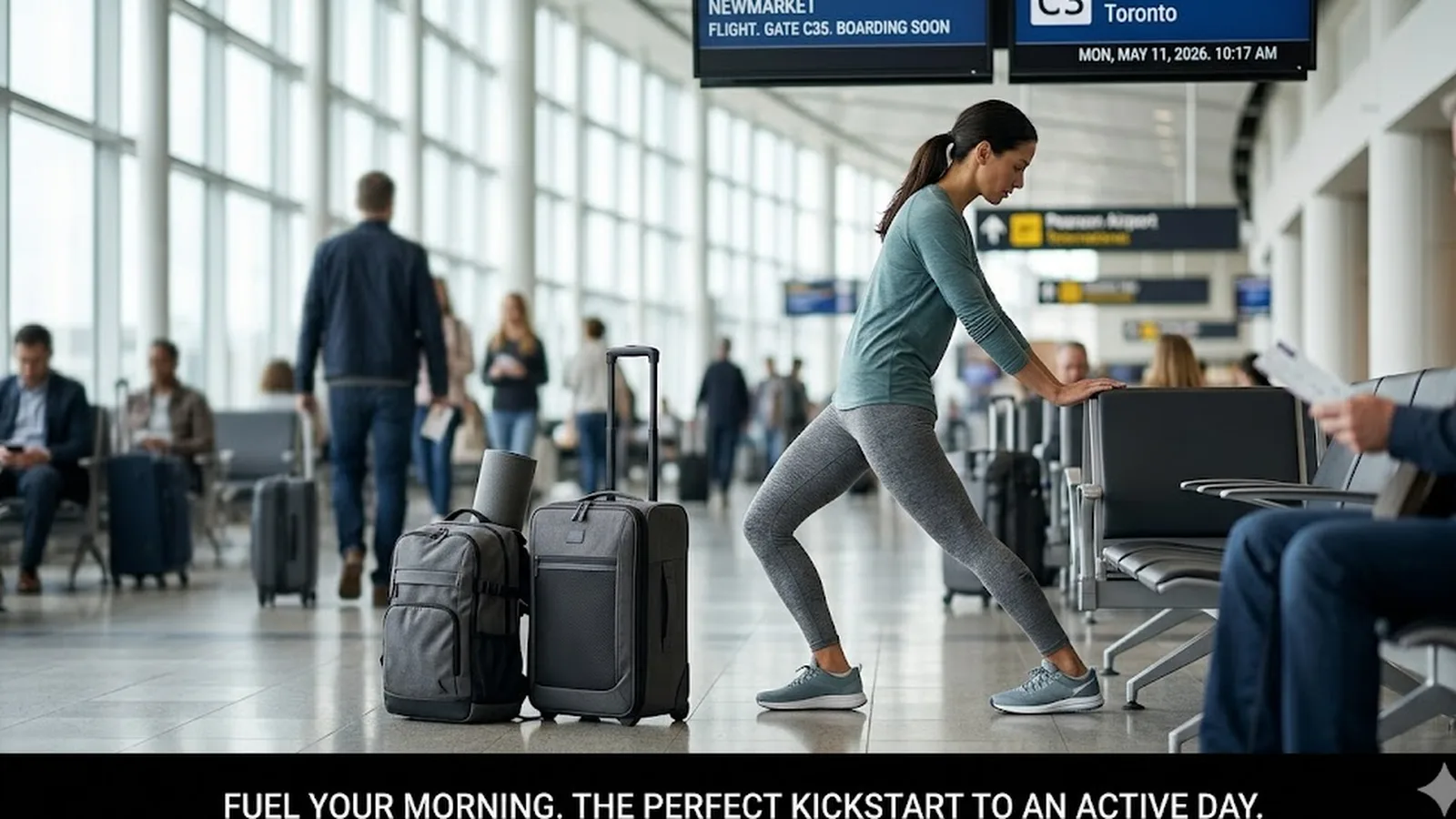
Pre-flight mobility (5–10 min)
- Hip flexor stretch (kneeling lunge): 30 sec each side.
- Standing thoracic extension: 30 sec.
- Cervical retractions: 10 reps.
- Calf raises: 20 reps to wake up the calf-pump.
- Glute squeezes + 10 hip bridges if floor space.
- Walking 5 minutes in the gate area before boarding.
The calf-pump matters
The calf muscle is the “peripheral heart” that returns venous blood from the legs. Sustained immobility eliminates calf-pump activity, which is the proximate cause of flight-related DVT risk. Even subtle calf activation (alphabet exercise, ankle pumps, calf raises in seat) substantially reduces stagnation. Do them every 30–60 minutes during the flight.
In-flight protocol
- Aisle seat preferred for long flights — easier to stand and walk.
- Walk to bathroom or back of cabin every 60–90 minutes.
- Ankle pumps and alphabet exercise: “trace the alphabet” with each foot, hourly.
- Calf raises in seat: 20 reps, hourly.
- Hip flexor relief: stand and stretch when seat-belt sign is off.
- Hydration: water continuously, less alcohol.
- Compression socks (15–20 mmHg) for flights over 6 hours, or for higher-risk travellers.
Post-flight recovery
- Walk 10–15 minutes within an hour of landing.
- Continue hydration; alcohol minimal first 24 hours.
- Mobility flow (similar to pre-flight) at hotel.
- Light training the day after, especially walking.
Jet lag tactics
- Eastward flights (advance phase): harder. Morning bright light at destination, possibly small dose melatonin (~0.5 mg) at destination bedtime for first 3–5 nights.
- Westward flights (delay phase): easier. Stay outside in afternoon/evening light at destination.
- Meal timing: eat on destination schedule from arrival.
- Avoid napping over 30 minutes on arrival day; pushes circadian re-alignment back.
- Sleep on destination schedule from first night, even if it means staying awake longer than feels natural.
Common myths
- “Long flights cause DVT.” They elevate risk modestly; absolute risk in healthy travellers stays low. Risk is real but contextually small.
- “Aspirin prevents flight DVT.” Limited evidence in low-risk travellers. Movement and hydration are first-line; clinically high-risk travellers may need formal anticoagulation.
- “Compression socks are uncomfortable and unnecessary.” Modern medical-grade compression (15–20 mmHg) is comfortable and reduces measurable lower-leg edema even in healthy fliers.
- “Jet lag adjusts in a day.” Wrong. Roughly 1 day per time zone for full circadian re-alignment without intervention. Light strategy and structured sleep accelerate this.
Practical takeaways
- Long flights mildly elevate DVT risk; in-flight movement and hydration substantially reduce it.
- 5–10 minute pre-flight mobility flow + walking before boarding sets up a smoother flight.
- In-flight: walk every 60–90 min; ankle pumps and calf raises hourly; continuous hydration.
- Compression socks for 6+ hour flights or higher-risk travellers.
- Eastward flights: morning light at destination + small-dose melatonin at destination bedtime.
- Westward flights: afternoon/evening light at destination.
- Eat and sleep on destination schedule from arrival.
Frequently asked questions
Do I need compression socks for a 4-hour flight?
Probably not for healthy travellers. The 2016 Cochrane review found high-quality evidence that compression stockings produce a substantial reduction in symptomless DVT — from roughly 10 per 1,000 travellers down to 2-3 per 1,000 — plus less leg swelling, but the absolute risk without stockings is still low enough that most healthy people can reasonably skip them on shorter flights. For 6+ hour flights or higher-risk travellers, they're worth using.
Should I take aspirin before a flight?
Probably not without a clinician recommendation. The evidence for aspirin preventing flight DVT in low-risk travellers is limited. Movement and hydration are first-line. Clinically high-risk travellers (recent surgery, prior DVT, cancer, pregnancy, hormonal contraception) should consult their clinician about formal anticoagulation prophylaxis.
How do I beat jet lag fast?
Light exposure on destination schedule is the strongest tool. Eastward flights: morning bright light at destination plus possibly small-dose melatonin (0.5 mg) at destination bedtime for first 3 to 5 nights. Westward: afternoon/evening light at destination. Eat and sleep on destination time from arrival; don't take long naps the first day.
How often should I get up during a long flight?
Every 60 to 90 minutes if possible. Walk to the bathroom, stretch in the back of the cabin, do calf raises in the aisle. The calf muscle pump is what returns venous blood from the legs; sustained immobility is the proximate cause of flight DVT risk. Even subtle calf activation in the seat (ankle pumps, alphabet exercise) substantially helps.
Is the cabin air really that dehydrating?
Yes, modestly. Cabin humidity is typically 5 to 15 percent vs about 40 percent indoor baseline. Dehydration accumulates across long flights. Drink water throughout (not just at meal service); skip alcohol on long-haul flights. Most travellers under-drink during flights and feel worse on arrival than they would with adequate hydration.
References
Watson 2011Watson HG, Baglin TP. Guidelines on travel-related venous thrombosis. Br J Haematol. 2011;152(1):31-34. View source →Kahn 2012Kahn SR, Lim W, Dunn AS, et al. Prevention of VTE in nonsurgical patients: Antithrombotic Therapy and Prevention of Thrombosis, 9th ed: ACCP Guidelines. Chest. 2012;141(2 Suppl):e195S-e226S. View source →Eastman 2009Eastman CI, Burgess HJ. How to travel the world without jet lag. Sleep Med Clin. 2009;4(2):241-255. View source →Philbrick 2007Philbrick JT, Shumate R, Siadaty MS, Becker DM. Air travel and venous thromboembolism: a systematic review. J Gen Intern Med. 2007;22(1):107-114. View source →Clarke 2016Clarke MJ, Broderick C, Hopewell S, Juszczak E, Eisinga A. Compression stockings for preventing deep vein thrombosis in airline passengers. Cochrane Database Syst Rev. 2016;9(9):CD004002. View source →Herxheimer 2002Herxheimer A, Petrie KJ. Melatonin for the prevention and treatment of jet lag. Cochrane Database Syst Rev. 2002;(2):CD001520. View source →Burgess 2003Burgess HJ, Sharkey KM, Eastman CI. Bright light, dark and melatonin can promote circadian adaptation in night shift workers. Sleep Med Rev. 2002;6(5):407-420. View source →Hu 2006Hu Y, Block G, Norkus EP, Morrow JD, Dietrich M, Hudes M. Relations of glycemic index and glycemic load with plasma oxidative stress markers. Am J Clin Nutr. 2006;84(1):70-76. View source →Bagshaw 2019Bagshaw M, Illig P. The aircraft cabin environment. Travel Medicine. 2019:429-436. View source →Waterhouse 2007Waterhouse J, Reilly T, Atkinson G, Edwards B. Jet lag: trends and coping strategies. Lancet. 2007;369(9567):1117-1129. View source →