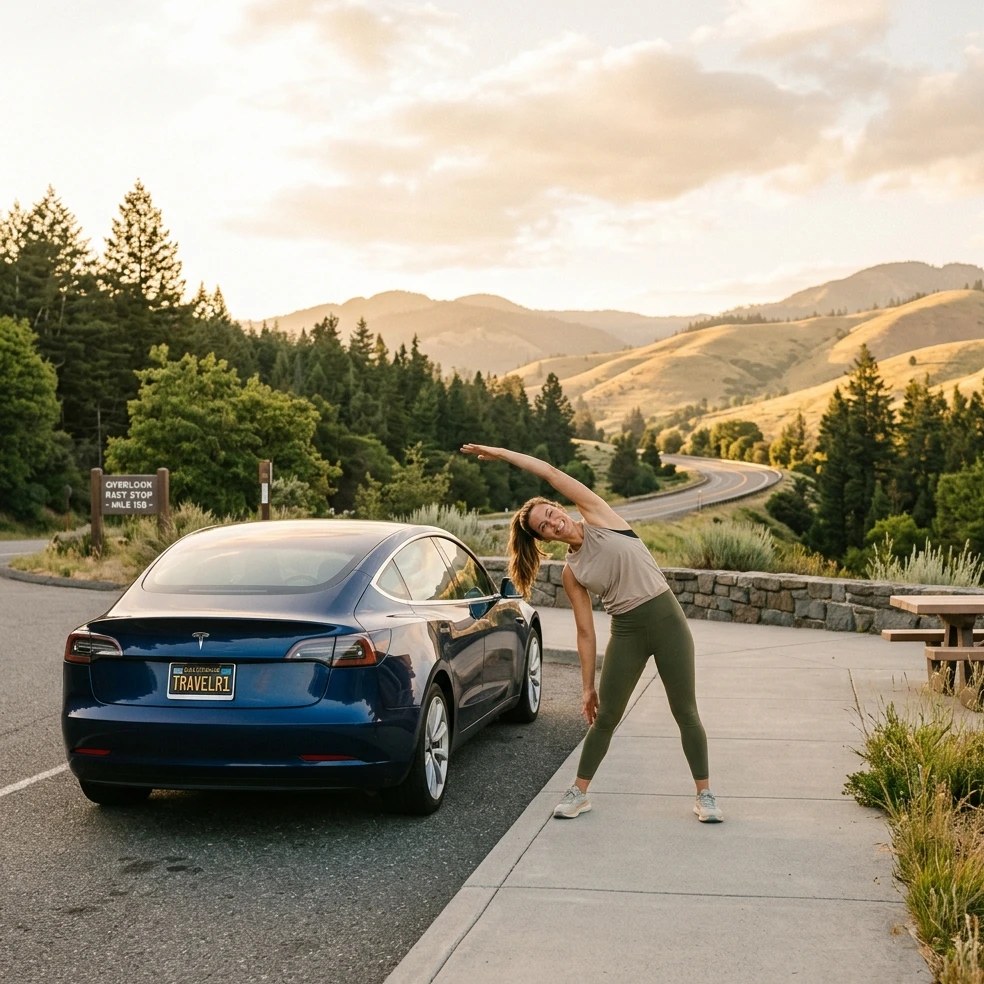
The 60-second version
Long road trips combine prolonged sitting, vehicle vibration, and dehydration in ways that consistently produce post-drive stiffness, headaches, and minor musculoskeletal complaints. Occupational-driving research links combined sitting, vehicle vibration, and awkward posture to elevated back-pain risk Lis 2007, and a 2018 review of workplace break interventions found moderate-quality evidence that active breaks with postural change ease pain and discomfort, though the overall evidence on breaks is still mixed Waongenngarm 2018. On that basis, 2–3 minute movement breaks every 90–120 minutes are a reasonable, evidence-informed way to limit post-drive symptoms. The honest practical points: gas-station and rest-area stops are perfect break opportunities; a 3–4 minute stretching flow targeting hip flexors, thoracic spine, and neck addresses the dominant patterns; hydration and post-arrival movement matter as much as the during-drive stretching. This article covers the specific stretches with reasonable evidence, a practical 3-minute gas-station flow, and the post-arrival movement protocol that prevents next-day stiffness.
Educational journalism, not medical advice. Every claim here is checked against its cited sources by editor Timothy Bunce — a health writer, not a physician. It isn’t specific to your situation: for health decisions, talk to your own clinician. How we work →
Some links in this article are affiliate links. If you buy through one, The Beachside Reader earns a commission at no extra cost to you. It never changes which products we pick, or what we say about them. Full affiliate disclosure →
What long drives do to the body
Sitting in a car combines the same stressors as office sitting plus vibration:
- Hip flexor shortening from sustained 90° hip flexion.
- Forward head posture, neck tension from steering position.
- Glute under-recruitment and lower back tightness.
- Thoracic flexion (rounded shoulders, slumped posture).
- Calf and ankle tightness from foot positioning.
- Dehydration from cabin air and limited fluid intake.
- Disc fluid redistribution from sustained spinal load.
The 2007 Lis et al. review and follow-ups document elevated low back pain rates in occupational drivers; recreational long drivers experience smaller but real symptoms over multi-day trips Lis 2007.
The 90-minute break protocol
Stop every 90–120 minutes. A 2018 systematic review of workplace break interventions found moderate-quality evidence that active breaks with postural change ease pain and discomfort Waongenngarm 2018, though the overall evidence on break effectiveness remains mixed and no specific break-minute dose has been established as optimal. For road trips:
- Plan stops every 90 min minimum, more if towing or in tight cargo positions.
- Target 5–10 minutes per stop including bathroom, hydration, and stretching.
- Don’t skip stops to “make better time” — the next-day cost outweighs the time saved.
The 3-minute gas-station flow
Step out of the car. Walk for 30 seconds (around the vehicle, into the store). Then:
- Hip flexor stretch (kneeling lunge or standing knee-back stretch): 30 seconds per side. Use the side of the car for balance if needed.
- Standing thoracic extension: hands behind head or at chest level, gentle backward bend. 20–30 seconds.
- Neck rolls + chin tucks: 5 slow neck rolls each direction, 10 chin tucks. 30 seconds.
- Calf stretch: hands against car/wall, one leg back. 20 seconds per side.
- Hip circles + glute squeezes: 10 hip circles each direction, 10 glute squeezes. 30 seconds.
- Trunk rotations: 10 each side, gentle. 20 seconds.
Total: ~3 minutes. Pair with bathroom break and hydration. Repeat at every stop.
The post-arrival walk
The single highest-leverage intervention for post-drive recovery: a 10–15 minute walk within an hour of arriving. Restores circulation, mobilises stiffened tissues, and prevents the deep compounding of stiffness that produces next-day soreness. More valuable than any single stretching session.
Hydration during long drives
Dehydration is consistently underrated as a cause of road-trip headaches and fatigue. Practical:
- Drink water throughout the drive, not just at stops. Target ~250 mL/hour.
- Yes, you’ll need bathroom stops. The breaks are good.
- Caffeine is fine but not as a replacement for water.
- Avoid heavy meals during driving; large meals + sustained sitting worsen post-meal sleepiness.
Cab setup adjustments
- Seat at ~100° recline (slightly back from upright).
- Lumbar support filling natural curve, not aggressive.
- Steering wheel position: arms slightly bent, not fully extended.
- Mirror positions: minimise neck rotation needed.
- For passenger: similar plus footrest if available.
Common myths
- “Just power through — you’ll stretch later.” Cumulative stiffness compounds; intervening at stops is much easier than fixing post-arrival.
- “Driving doesn’t need warmup.” The first hour after starting tight is when neck and shoulder discomfort develops fastest. A 2-minute pre-drive mobility flow helps.
- “Caffeine fixes drive fatigue.” Acutely yes; caffeine is no substitute for breaks, hydration, and movement.
Practical takeaways
- Stop every 90–120 minutes for 5–10 minutes; do a 3-minute mobility flow at each stop.
- Hip flexor + thoracic + neck + calf + trunk rotations covers the major patterns driving stiffens.
- Hydrate continuously; ~250 mL water per hour during driving.
- 10–15 minute walk within an hour of arrival prevents most next-day stiffness.
- Cab setup matters: seat ~100° recline, lumbar support, comfortable steering reach.
- Avoid heavy meals during driving; pair caffeine with water.
Frequently asked questions
How often should I stop on a long drive?
Every 90 to 120 minutes minimum. A 2018 systematic review of workplace break interventions (Waongenngarm 2018) found moderate-quality evidence that active breaks with postural change ease pain and discomfort, though the overall evidence on break effectiveness is still mixed and no specific break-minute dose has been established as optimal. Plan stops anyway; the downside is minimal and the potential upside is real.
Does the gas-station stretching actually help?
Yes, modestly but reliably. The driving literature consistently shows movement breaks reduce post-drive symptoms more than any in-cab adjustment. Three minutes of targeted stretching at each stop, sustained across a multi-hour trip, prevents most cumulative stiffness.
What about driving with a passenger who can take over?
Switching drivers helps because both passengers stretch during transitions. Use the swap as a forced break opportunity. Even if alone, simulating the swap (longer break, full mobility flow) at the midpoint of a long drive makes a meaningful difference.
Should I stretch before getting in the car?
Brief mobility before a long drive helps. 2 to 3 minutes of hip openers, thoracic extension, and neck mobility starts the drive in a better position. The morning of a road trip is also when sleep-related stiffness is highest.
Are seat cushions worth packing for road trips?
Quality cushions reduce ischial pressure and modestly improve comfort. The marginal benefit is real but not dramatic. Hydration, breaks, and stretching matter more. If you have ongoing back issues, a quality cushion plus consistent breaks is the durable solution.
References
Lis 2007Lis AM, Black KM, Korn H, Nordin M. Association between sitting and occupational LBP. Eur Spine J. 2007;16(2):283-298. View source →Waongenngarm 2018Waongenngarm P, Areerak K, Janwantanakul P. The effects of breaks on low back pain, discomfort, and work productivity in office workers: a systematic review. Appl Ergon. 2018;68:230-239. View source →Robb 2007Robb MJ, Mansfield NJ. Self-reported musculoskeletal problems amongst professional truck drivers. Ergonomics. 2007;50(6):814-827. View source →Magnusson 1996Magnusson ML, Pope MH, Wilder DG, Areskoug B. Are occupational drivers at an increased risk for developing musculoskeletal disorders? Spine. 1996;21(6):710-717. View source →Hagg 1990Hägg O, Wallner A. Facet joint asymmetry and protrusion of the intervertebral disc. Spine. 1990;15(5):356-359. View source →Kresal 2015Kresal F, Roblek V, Jerman A, Mesko M. Lower back pain and absenteeism among professional public transport drivers. Int J Occup Saf Ergon. 2015;21(2):166-172. View source →Alperovitch 2010Alperovitch-Najenson D, Santo Y, Masharawi Y, Katz-Leurer M, Ushvaev D, Kalichman L. Low back pain among professional bus drivers. Isr Med Assoc J. 2010;12(1):26-31. View source →Daneshmandi 2017Daneshmandi H, Choobineh A, Ghaem H, Karimi M. Adverse effects of prolonged sitting behavior on the general health of office workers. J Lifestyle Med. 2017;7(2):69-75. View source →