Educational journalism, not medical advice. Every claim here is checked against its cited sources by editor Timothy Bunce — a health writer, not a physician. It isn’t specific to your situation: for health decisions, talk to your own clinician. How we work →
Some links in this article are affiliate links. If you buy through one, The Beachside Reader earns a commission at no extra cost to you. It never changes which products we pick, or what we say about them. Full affiliate disclosure →
The 60-second version
Fortification is ordinary food technology: a manufacturer blends protein in, and the grams are declared on the Nutrition Facts panel. Whether declared grams match assayed grams is a laboratory question, and this article does not assess it. The question it does ask is the size of the dose. Every per-serving figure the documents cited here recommend sits at 20 grams or above: the International Society of Sports Nutrition's position stand recommends 20 to 40 grams per serving for athletes, and the PROT-AGE group recommends 25 to 30 grams per meal for older adults. Individual trial arms went lower, down to 5 and 10 grams, and that is where the evidence thins rather than where it turns supportive of small servings. Whether more than 20 grams adds anything is actively contested, and the contest runs against small servings rather than for them: one trial found 40 grams beat 20 after whole-body resistance exercise, and another found 100 grams beat 25. What is not in dispute in this evidence is the direction of the comparison. A few added grams is far smaller than any serving these documents nominate, and one trial found the same daily total chopped into 10-gram instalments did measurably less work than the same total in 20-gram instalments.
In the supermarket aisles I shop in, protein claims now turn up on bottled water, popcorn, coffee creamer, instant oatmeal, pancake mix and cookies. That is my own observation from the shelf rather than a market statistic, and it is not an accusation. Fortification is unglamorous food technology: a manufacturer blends in whey protein isolate, milk protein concentrate, soy or pea isolate, and the result is declared on the Nutrition Facts panel. This article does not test whether declared grams match measured grams — that is a laboratory question and a separate one. It asks the question the front of the package is designed to stop you asking: how big is that serving, next to the servings the research actually studied?
What The Dose-Response Trials Measured
The process protein marketing implicitly invokes is muscle protein synthesis. Two acute trials in the evidence cited here fed graded doses and measured it. In the first, six healthy young men reported to the laboratory on five separate occasions, performed an intense bout of leg-based resistance exercise, and then drank 0, 5, 10, 20 or 40 grams of whole egg protein in randomised order, with synthesis measured over four hours by a labelled-leucine infusion Moore 2009. Synthesis displayed a dose response and was maximally stimulated at 20 grams, leucine oxidation rose significantly at the 20- and 40-gram doses, and the authors conclude that 20 grams of intact protein is sufficient to maximally stimulate synthesis after resistance exercise Moore 2009. Two features of that trial deserve stating up front rather than in a footnote. Six participants is a very small sample. And the exercise was leg-based only, a detail that turns out to matter a great deal. The published abstract reports the shape of the curve and the 20-gram maximum rather than dose-by-dose comparisons, so this article does not cite it for what 5 or 10 grams did.
The second trial recruited 48 resistance-trained young men, who ate a standardised high-protein breakfast of 0.54 grams per kilogram of body mass, performed unilateral leg exercise three hours later, and then drank 0, 10, 20 or 40 grams of whey protein isolate, with myofibrillar synthesis measured over the following four hours Witard 2014. Against no protein, synthesis rose 49 per cent with 20 grams and 56 per cent with 40 grams, while 10 grams produced no additional stimulation (P > 0.05); phenylalanine oxidation and urea production rose with 40 grams. The authors conclude that 20 grams is sufficient for maximal stimulation in the rested and exercised muscle of roughly 80-kilogram resistance-trained young men Witard 2014. Note the prior meal: these doses did not land on an empty stomach, which is one reason this trial's null at 10 grams and the egg-protein trial's description of a graded curve are not straightforwardly in conflict with one another.
The International Society of Sports Nutrition's position stand — a critical review, not a trial and not a meta-analysis — translates that literature into a per-serving recommendation of about 0.25 grams of high-quality protein per kilogram of body weight, or an absolute dose of 20 to 40 grams, for athletes seeking to maximise synthesis, with 700 to 3,000 milligrams of leucine per dose and doses distributed every three to four hours across the day Jäger 2017. The position stand is explicit that recommendations on the optimal amount per serving are mixed and depend on age and recent training stimulus Jäger 2017.
The 20-Gram Figure Is Contested
It would be convenient for this article's argument if 20 grams per serving were a settled ceiling. It is not, and pretending otherwise would be the easiest way to mislead you. A 2016 trial gave 30 resistance-trained men — 15 with lower and 15 with higher lean body mass — 20 and 40 grams of whey in random order after a bout of whole-body resistance exercise, using the same labelled-phenylalanine tracer method with muscle biopsies, and found synthesis stimulated to a greater extent after 40 grams (0.059 plus or minus 0.020 per cent per hour) than after 20 grams (0.049 plus or minus 0.020 per cent per hour, P = 0.005) Macnaughton 2016. Total lean body mass did not appear to influence the response at those doses. The paper opens by naming the belief it is testing, that 20 to 25 grams is the currently accepted amount for maximal stimulation, and two of its authors also wrote the 2014 whey dose trial above. The methodological difference that matters is exercise volume: the two trials reporting a plateau at 20 grams used leg-only protocols, while this one worked the whole body. On that comparison the plateau looks like a property of how much muscle was trained rather than a property of digestion.
A 2023 trial pushed further. Using a quadruple isotope tracer feeding-infusion approach, it reported that ingesting 100 grams of protein produced a greater and more prolonged anabolic response — beyond 12 hours — than 25 grams, and that protein ingestion had a negligible impact on whole-body protein breakdown or amino acid oxidation rates; its authors state that the belief in a transient, capped response with excess amino acids oxidised lacks scientific proof Trommelen 2023. One co-author is an employee of the dairy company FrieslandCampina, and the paper states the company had no role in funding, data collection and analysis, or preparation of the manuscript. Disclosures run in both directions in this field: the 2018 meta-analysis discussed below carries a published competing-interests correction covering one co-author's supplement-industry advisory role, and its senior author discloses grant support, travel expenses and honoraria from the US National Dairy Council, an agency that supported trials included in that analysis.
Neither of those trials rescues the fortified snack. Both cut the other way. They are arguments that a large single serving does more than had been assumed, which widens rather than narrows the distance between a 20-to-40-gram serving and a product whose panel shows only a few added grams.
The Same Total, Chopped Finer
A small fortification has the same structure whatever category it arrives in: it scatters little amounts across the day rather than concentrating them into one serving. One trial tested that pattern directly. Twenty-four healthy trained males, each with at least two years of high-intensity resistance-training experience, were matched for body mass and randomly assigned to three groups of eight; every group performed a bout of resistance exercise and then received the same 80 grams of whey across a 12-hour recovery period in a different pattern — eight 10-gram servings every 1.5 hours, four 20-gram servings every three hours, or two 40-gram servings every six hours — with biopsies at rest and at 1, 4, 6, 7 and 12 hours Areta 2013. All three patterns raised myofibrillar synthesis 88 to 148 per cent above rest across the recovery window. The four 20-gram servings raised it a further 31 to 48 per cent above the other two patterns, and the authors conclude that 20 grams every three hours was superior to both the smaller and the larger pattern for stimulating synthesis through the day Areta 2013.
Three caveats belong with that result, and they are not decoration. It is a parallel-group design with eight men per arm, so the 31-to-48-per-cent gap rests on a thin sample. The intracellular signalling measurements ran in the opposite direction from the synthesis result, showing a hierarchy in which the two 40-gram boluses produced the largest phosphorylation response and the 10-gram pulses the smallest Areta 2013. And participants consumed nothing but the whey drinks during the 12-hour window, which is not a model of an ordinary working day. What survives all three caveats is narrow but real: the same total protein, chopped finer, did not do the same amount of work. That is precisely the arithmetic a small fortification relies on — a few grams here and a few there, accumulating into the equivalent of a proper serving — and the one trial cited here that tested the pattern did not support it.
What The Daily Recommendations Actually Say
A 2018 systematic review, meta-analysis and meta-regression of randomised trials with at least six weeks of resistance training pooled 49 studies and 1,863 participants and found that protein supplementation significantly increased one-repetition-maximum strength by 2.49 kilograms (95 per cent confidence interval 0.64 to 4.33), fat-free mass by 0.30 kilograms (0.09 to 0.52) and muscle fibre cross-sectional area by 310 square micrometres (51 to 570) Morton 2018. That paper is also the source of the most-quoted number in this whole debate: a break point at 1.62 grams per kilogram per day, beyond which supplementation added no further gains in fat-free mass. It deserves far more caution than it usually receives, and the authors supply the caution themselves. They present the segmental regression despite it not being statistically significant, at p = 0.079, with a confidence interval running from 1.03 to 2.20 grams per kilogram per day, an R-squared of 0.19, and a source dataset of 42 study arms and 723 participants rather than the headline 49 studies and 1,863 participants Morton 2018. The break-point analysis was run on fat-free mass only; there was no equivalent analysis for strength, so nothing in that paper establishes a plateau in strength gains.
The authors then draw the opposite practical conclusion from the one the number is usually recruited for. Because the interval reached 2.20, they suggest it may be prudent to recommend roughly 2.2 grams of protein per kilogram per day for people seeking to maximise resistance-training gains in fat-free mass Morton 2018. So this article does not argue that fortified snacks are pointless because you have already passed a ceiling. The recommended daily totals in the documents cited here run higher than most shoppers assume. The sports-nutrition position stand puts 1.4 to 2.0 grams per kilogram per day as sufficient for most exercising individuals, rising to 2.3 to 3.1 grams per kilogram per day to protect lean mass during a calorie deficit Jäger 2017. A review of protein in weight loss and maintenance puts its useful range at 1.2 to 1.6 grams per kilogram per day Leidy 2015.
For context rather than as a target, the Institute of Medicine's dietary reference intakes set the recommended dietary allowance for protein at 0.8 grams per kilogram of body weight per day for adults Institute of Medicine 2005. That figure is an adequacy floor derived from nitrogen-balance data, not an optimum for building muscle, and the same report sets an acceptable macronutrient distribution range for protein of 10 to 35 per cent of energy. The case against a small fortification, then, is not that your daily ledger is already full. It is that a few added grams are small relative to every serving size these documents nominate, and that the number deciding whether a product matters is a daily total the package has no way of knowing.
Grams On A Panel Are Not Interchangeable
Protein quality depends on digestibility and on amino acid profile, and both the sports-nutrition position stand and the older-adult recommendations single out the leucine content of a dose as part of what makes it effective Jäger 2017Bauer 2013. A laboratory analysis measured protein content and amino acid composition across commercially available plant-based protein isolates and found essential amino acid contents of 21 per cent for oat, 21 per cent for lupin and 22 per cent for wheat, against 43 per cent for whey, 39 per cent for milk, 34 per cent for casein, 32 per cent for egg and 38 per cent for human skeletal muscle protein Gorissen 2018. Leucine content ranged widely among the plant isolates, from 5.1 per cent for hemp to 13.5 per cent for corn, against 9.0 per cent for milk and 7.0 per cent for egg, and methionine and lysine were typically lower in the plant isolates. That study measured composition and tested no outcome in a person: its authors write only that lower essential amino acid content and a specific shortfall in leucine, lysine or methionine may be responsible for a lower anabolic capacity, and their own conclusion is that blends of plant isolates, or blends of animal and plant proteins, can closely reflect the characteristics of animal-based proteins Gorissen 2018.
One acute trial did compare isolated proteins head to head, and its design matters for an article about label grams. Three groups of six young men each performed unilateral leg resistance exercise and then drank whey hydrolysate, micellar casein or soy protein isolate matched for essential amino acid content at 10 grams — matched on amino acids, that is, not on grams of protein, so the three drinks did not contain equal protein Tang 2009. Whey hydrolysate raised mixed muscle protein synthesis about 93 per cent above casein at rest and about 122 per cent above casein after exercise (both P < 0.01), and soy also beat casein, by 64 per cent at rest and 69 per cent after exercise (both P < 0.01). Whey beat soy by 31 per cent after resistance exercise (P < 0.05); the 18 per cent difference at rest was not statistically significant (P = 0.067). The authors group whey and soy together as superior to casein, with whey ahead of soy only after exercise Tang 2009. None of that is an argument against plant protein. It is an argument against reading "18 g protein" on a front panel as a self-explanatory fact.
What The Label Rules Do And Don't Say
Both countries regulate protein claims, and neither rule says quite what shoppers assume. In the United States, the Food and Drug Administration's regulation on nutrient content claims, 21 CFR 101.54, sets "good source" at 10 to 19 per cent of the daily value per reference amount customarily consumed, and "high" or "excellent source" at 20 per cent or more of that value. The Food and Drug Administration sets the daily reference value for protein at 50 grams for adults and children of four years and older, at 21 CFR 101.9(c)(7)(iii), and calculates the declared percentage from the actual grams of protein per serving multiplied by the amino acid score corrected for protein digestibility, at 21 CFR 101.9(c)(7)(ii). That percentage declaration is optional in general and required when a protein claim is made for the product. In Canada, Health Canada's Food and Drug Regulations take a different route, using a protein rating that multiplies the protein efficiency ratio by the level of protein in a reasonable daily intake, with a rating of 20 or more required for a "good source" claim and 40 or more for "excellent source" — so portion size is built into whether a food qualifies at all.
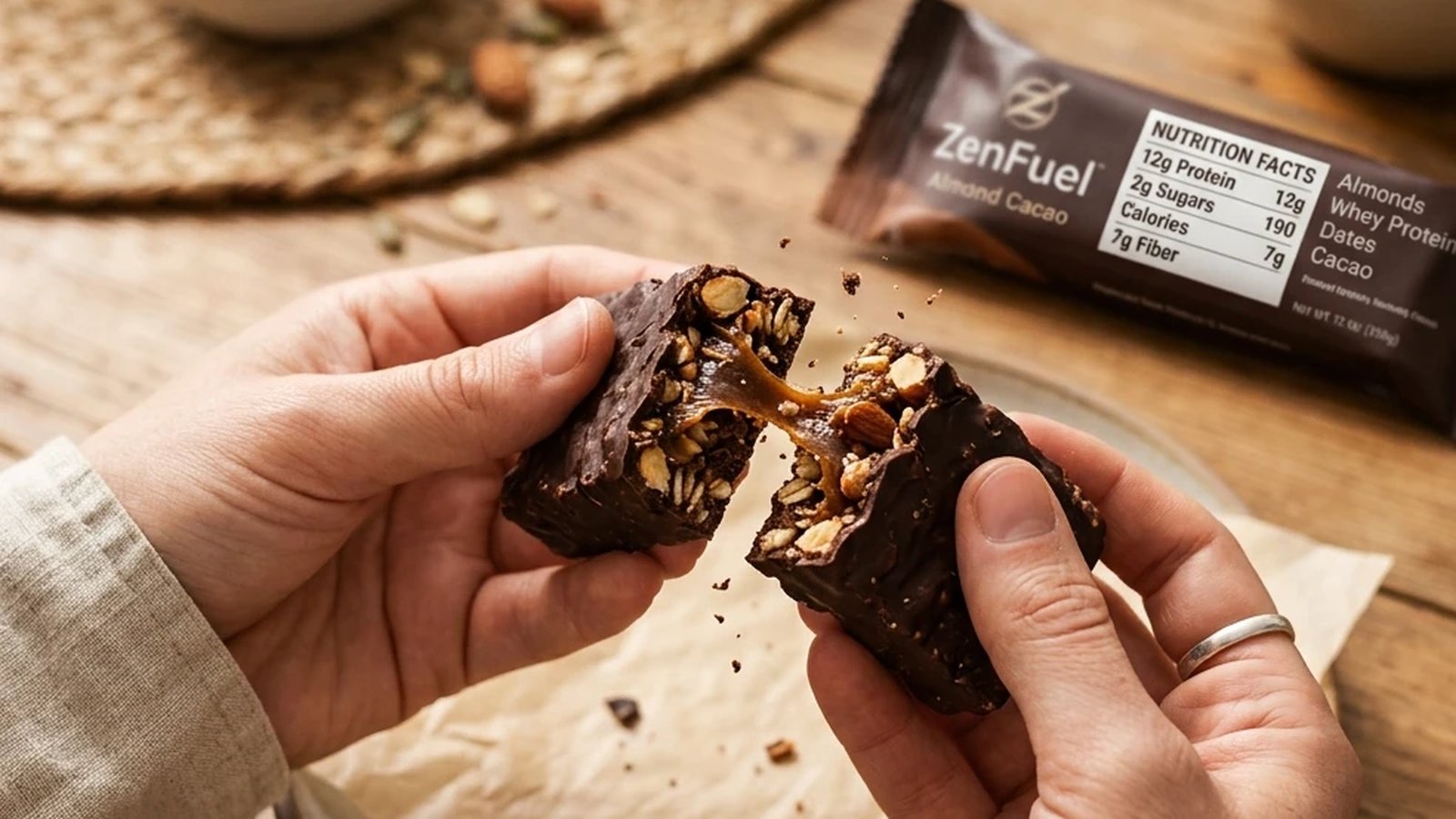
Two things follow. First, taking those American thresholds at face value, 10 per cent of a 50-gram daily value is 5 quality-corrected grams and 20 per cent is 10 grams; that is this publication's arithmetic rather than a figure printed in the regulation. Second, and more useful at the shelf: those thresholds are keyed to the reference amount customarily consumed, a regulatory reference portion that need not equal the serving size printed on the package. A shopper comparing grams against the stated serving is therefore not using the same denominator the claim threshold used. A snack can legitimately clear a claim threshold while delivering a fraction of the serving sizes the trials above studied. The discipline this calls for is the same one that makes a restaurant menu legible — reading the numbers instead of the adjectives. With bars in particular, the protein figure is rarely the only line worth checking; what else is in the wrapper often matters more.
Who These Products Genuinely Help
There is a real case for fortified foods, and it is narrower and more specific than the marketing. The clearest example in this evidence base is older adults. The PROT-AGE study group's position paper — an expert consensus document, not a trial and not a pooled analysis — recommends an average daily intake at least in the range of 1.0 to 1.2 grams per kilogram of body weight per day for people over 65, and 1.2 grams per kilogram per day or more for those who are exercising and otherwise active, delivered at a per-meal anabolic threshold of about 25 to 30 grams of protein containing roughly 2.5 to 2.8 grams of leucine Bauer 2013. Someone whose breakfast habitually lands at 8 grams has a genuine per-meal problem, and a fortified product that carries that meal to 25 grams is solving it rather than decorating it. The same paper is candid that evidence on protein quality and timing was not yet sufficient to support specific recommendations, so its leucine figure is a threshold the group proposes rather than a settled quantity.
That paper also names an explicit exception. For older people with severe chronic kidney disease, defined there as an estimated glomerular filtration rate below 30 millilitres per minute per 1.73 square metres, who are not on dialysis, it recommends limiting protein intake to 0.8 grams per kilogram of body weight per day Bauer 2013. If that describes you, the number on a package is not the relevant input; your clinician's is.
Appetite is the other case sometimes made for these products, and it needs stating precisely. A review of protein in weight loss and maintenance concluded that higher-protein diets containing between 1.2 and 1.6 grams per kilogram per day, potentially including meal-specific quantities of at least about 25 to 30 grams of protein per meal, improved appetite, body-weight management, cardiometabolic risk factors, or all three Leidy 2015. The same review reports that acute feeding trials confirm only a modest satiety effect — greater perceived fullness and elevated satiety hormones — and do not support an effect on energy intake at the next eating occasion. It also reports that longer-term studies produced limited and conflicting findings, with dietary compliance the primary contributor to the discrepancy: improvements appeared in the people who adhered to the higher-protein regimen Leidy 2015. A fortified snack that reaches 25 to 30 grams is functioning as a small meal. One that adds a few grams to popcorn is functioning as popcorn.
What This Evidence Can And Cannot Carry
The limitations belong in the open, including the ones that cut against this article. The acute dose-response evidence here rests on six men in one trial Moore 2009 and 48 resistance-trained men in another Witard 2014, both measuring a biochemical response over hours rather than muscle gained over months, both in young men, and both using isolated protein in a drink rather than protein blended into popcorn or a creamer. The 20-gram figure they produced is contingent on how much muscle was worked: after whole-body exercise, 40 grams beat 20 Macnaughton 2016, and a much larger dose again outperformed a smaller one over 12 hours in a separate trial Trommelen 2023. The feeding-pattern result comes from eight men per arm, with signalling data pointing the other way Areta 2013. The daily break point most often quoted was not statistically significant and covered fat-free mass only Morton 2018. The head-to-head protein comparison matched drinks on amino acids rather than on grams Tang 2009, and the compositional analysis of plant isolates measured composition without testing any outcome in a person Gorissen 2018. One further limit bounds what this article can claim at all, and it deserves saying plainly: none of these documents measured a commercial fortified product, and none of them assayed a package to check its declared grams against a laboratory result. The comparison drawn here is between the servings the research fed and the servings a panel states — not between a label and an assay. What that leaves standing is modest and sufficient: the serving sizes every one of these documents nominates are much larger than a few added grams.
A Five-Second Test At The Shelf
The number worth reading is grams of protein per serving on the Nutrition Facts panel, alongside the serving size the package states — remembering that the regulatory reference portion behind any front-of-pack claim need not be that same serving. Against the evidence above, three rough bands are useful. Under about 5 grams, the fortification sits below the quality-corrected amount that clears the American "good source" threshold on the arithmetic above, and far below every per-serving figure recommended in the documents cited here; price it as a flavour feature. Between roughly 5 and 20 grams the position is under-determined here. The low doses these trials fed were 5 and 10 grams of whole egg protein, whose dose-by-dose comparisons the published abstract does not report Moore 2009, and 10 grams of whey, which produced no additional stimulation over no protein in resistance-trained young men who had eaten a high-protein breakfast three hours earlier Witard 2014. Treat that band as a partial contribution to a meal you are assembling — worth something if it displaces a lower-protein choice at a similar price, worth little if you were going to eat a 25-gram meal regardless.
At roughly 20 grams or more of good-quality protein, the product sits inside the range the sports-nutrition position stand nominates per serving Jäger 2017 and approaches the 25-to-30-gram per-meal figures used by the older-adult consensus and the weight-management review Bauer 2013Leidy 2015. It is doing the job the front of the pack implies. And on the contested question of whether more than 20 grams is wasted, the honest answer is that the trial evidence cited here points both ways depending on how much muscle you have just worked, so a 30- or 40-gram serving should not be assumed to be squandered Macnaughton 2016.
Those bands are this publication's shopping heuristic rather than a finding from any single study, and they are not a clinical prescription. The verdict they support is a qualified yes with a caveat about scale. A fortified snack declares its protein on the Nutrition Facts panel, and that declared figure is the one worth reading; whether it survives a laboratory assay is a question this article has not examined. Whether that protein delivers anything to you depends on a serving size the package chooses and a daily total the package cannot see.
Frequently Asked Questions
How many grams of added protein make a fortified snack worth buying?
Read grams per serving on the Nutrition Facts panel rather than the front of the pack. The per-serving figures these documents recommend start at 20 grams: the International Society of Sports Nutrition's position stand recommends 20 to 40 grams, or about 0.25 grams per kilogram of body weight, per serving for athletes, and the PROT-AGE group recommends 25 to 30 grams per meal for older adults. Below that the picture is under-determined. The low doses these trials fed were 5 and 10 grams of whole egg protein, whose dose-by-dose comparisons the published abstract does not report, and 10 grams of whey, which produced no additional stimulation of muscle protein synthesis over no protein at all in resistance-trained young men who had eaten a high-protein breakfast three hours earlier. Treat a few added grams as a flavour and price decision, and a serving at 20 grams or more of good-quality protein as a real contribution to a meal.
Is 20 grams per serving the maximum worth eating?
No, and that is a live disagreement in this literature rather than a settled point. Two acute trials using leg-only resistance exercise reported that synthesis was maximally stimulated at 20 grams. A 2016 trial in 30 resistance-trained men using whole-body resistance exercise found synthesis greater after 40 grams than after 20 grams (P = 0.005), and a 2023 four-tracer trial found that 100 grams produced a greater and longer-lasting response than 25 grams. Exercise volume looks like the difference that matters. Either way, the finding cuts against fortified snacks rather than for them, because it makes larger servings look better, not smaller ones.
Is protein water actually useful?
It depends entirely on the grams per bottle, which is why the panel matters more than the category. A drink that adds only a few grams is scattering small doses across the day. In one trial, 24 trained men were split into three groups of eight and given the same 80 grams of whey over 12 hours after resistance exercise. All three patterns raised myofibrillar protein synthesis 88 to 148 per cent above rest, and four 20-gram servings raised it a further 31 to 48 per cent above eight 10-gram servings or two 40-gram servings. With eight men per arm, whey as the only food for 12 hours, and the signalling measurements running the other way, treat that as a caution about the pattern rather than proof about all snacking.
If I already eat plenty of protein, do fortified snacks do anything?
This article does not argue that you have passed a ceiling, because the cited recommendations for daily intake run higher than most shoppers assume. The 2018 meta-analysis usually quoted for a plateau at 1.62 grams per kilogram per day reports that break point as not statistically significant (p = 0.079), with a confidence interval from 1.03 to 2.20 grams per kilogram per day, drawn from 42 study arms and 723 participants, and applying to fat-free mass only. Its authors go on to suggest roughly 2.2 grams per kilogram per day for people trying to maximise training-induced gains in fat-free mass. The sports-nutrition position stand puts 1.4 to 2.0 grams per kilogram per day as sufficient for most exercising individuals. The case against a small fortification is its size relative to a serving, not a full daily ledger.
Does the type of protein added to a snack matter?
Composition varies, and the evidence on what that does inside a person is narrower than it looks. A laboratory analysis of commercial plant-based isolates measured essential amino acid contents of 21 to 22 per cent for oat, lupin and wheat against 43 per cent for whey and 39 per cent for milk, with leucine ranging from 5.1 per cent in hemp to 13.5 per cent in corn compared with 9.0 per cent in milk. That study tested composition only, not any outcome in people, and its authors conclude that blends can closely reflect the characteristics of animal-based proteins. In an acute trial with six men per group, where drinks were matched for essential amino acid content rather than grams of protein, whey hydrolysate and soy both stimulated synthesis more than casein, and whey beat soy after exercise (31 per cent, P less than 0.05) but not at rest (18 per cent, P = 0.067).
Do protein claims on packages mean the amount is meaningful?
They describe concentration against a regulatory reference portion. The US Food and Drug Administration's nutrient content claim rule, 21 CFR 101.54, sets "good source" at 10 to 19 per cent of the daily value per reference amount customarily consumed and "high" or "excellent source" at 20 per cent or more. At 21 CFR 101.9(c)(7), the Food and Drug Administration sets the protein daily reference value at 50 grams and calculates the declared percentage from grams per serving multiplied by the amino acid score corrected for protein digestibility. Health Canada's Food and Drug Regulations instead use a protein rating, with 20 or more required for a "good source" claim and 40 or more for "excellent source". The reference amount is not necessarily the serving size printed on the package, so a product can clear a threshold without delivering a serving the size of those studied in the trials above.
References
Moore 2009Moore DR, Robinson MJ, Fry JL, Tang JE, Glover EI, Wilkinson SB, Prior T, Tarnopolsky MA, Phillips SM. Ingested protein dose response of muscle and albumin protein synthesis after resistance exercise in young men. The American Journal of Clinical Nutrition. 2009;89(1):161-168. doi:10.3945/ajcn.2008.26401 View source →Witard 2014Witard OC, Jackman SR, Breen L, Smith K, Selby A, Tipton KD. Myofibrillar muscle protein synthesis rates subsequent to a meal in response to increasing doses of whey protein at rest and after resistance exercise. The American Journal of Clinical Nutrition. 2014;99(1):86-95. doi:10.3945/ajcn.112.055517 View source →Macnaughton 2016Macnaughton LS, Wardle SL, Witard OC, McGlory C, Hamilton DL, Jeromson S, Lawrence CE, Wallis GA, Tipton KD. The response of muscle protein synthesis following whole-body resistance exercise is greater following 40 g than 20 g of ingested whey protein. Physiological Reports. 2016;4(15):e12893. doi:10.14814/phy2.12893 View source →Trommelen 2023Trommelen J, van Lieshout GAA, Nyakayiru J, Holwerda AM, Smeets JSJ, Hendriks FK, van Kranenburg JMX, Zorenc AH, Senden JM, Goessens JPB, Gijsen AP, van Loon LJC. The anabolic response to protein ingestion during recovery from exercise has no upper limit in magnitude and duration in vivo in humans. Cell Reports Medicine. 2023;4(12):101324. doi:10.1016/j.xcrm.2023.101324 View source →Areta 2013Areta JL, Burke LM, Ross ML, Camera DM, West DWD, Broad EM, Jeacocke NA, Moore DR, Stellingwerff T, Phillips SM, Hawley JA, Coffey VG. Timing and distribution of protein ingestion during prolonged recovery from resistance exercise alters myofibrillar protein synthesis. The Journal of Physiology. 2013;591(9):2319-2331. doi:10.1113/jphysiol.2012.244897 View source →Morton 2018Morton RW, Murphy KT, McKellar SR, Schoenfeld BJ, Henselmans M, Helms E, Aragon AA, Devries MC, Banfield L, Krieger JW, Phillips SM. A systematic review, meta-analysis and meta-regression of the effect of protein supplementation on resistance training-induced gains in muscle mass and strength in healthy adults. British Journal of Sports Medicine. 2018;52(6):376-384. doi:10.1136/bjsports-2017-097608 View source →Jäger 2017Jäger R, Kerksick CM, Campbell BI, Cribb PJ, Wells SD, Skwiat TM, Purpura M, Ziegenfuss TN, Ferrando AA, Arent SM, Smith-Ryan AE, Stout JR, Arciero PJ, Ormsbee MJ, Taylor LW, Wilborn CD, Kalman DS, Kreider RB, Willoughby DS, Hoffman JR, Krzykowski JL, Antonio J. International Society of Sports Nutrition Position Stand: protein and exercise. Journal of the International Society of Sports Nutrition. 2017;14:20. doi:10.1186/s12970-017-0177-8 View source →Gorissen 2018Gorissen SHM, Crombag JJR, Senden JMG, Waterval WAH, Bierau J, Verdijk LB, van Loon LJC. Protein content and amino acid composition of commercially available plant-based protein isolates. Amino Acids. 2018;50(12):1685-1695. doi:10.1007/s00726-018-2640-5 View source →Tang 2009Tang JE, Moore DR, Kujbida GW, Tarnopolsky MA, Phillips SM. Ingestion of whey hydrolysate, casein, or soy protein isolate: effects on mixed muscle protein synthesis at rest and following resistance exercise in young men. Journal of Applied Physiology. 2009;107(3):987-992. doi:10.1152/japplphysiol.00076.2009 View source →Bauer 2013Bauer J, Biolo G, Cederholm T, Cesari M, Cruz-Jentoft AJ, Morley JE, Phillips S, Sieber C, Stehle P, Teta D, Visvanathan R, Volpi E, Boirie Y. Evidence-based recommendations for optimal dietary protein intake in older people: a position paper from the PROT-AGE Study Group. Journal of the American Medical Directors Association. 2013;14(8):542-559. doi:10.1016/j.jamda.2013.05.021 View source →Leidy 2015Leidy HJ, Clifton PM, Astrup A, Wycherley TP, Westerterp-Plantenga MS, Luscombe-Marsh ND, Woods SC, Mattes RD. The role of protein in weight loss and maintenance. The American Journal of Clinical Nutrition. 2015;101(6):1320S-1329S. doi:10.3945/ajcn.114.084038 View source →Institute of Medicine 2005Institute of Medicine, Panel on Macronutrients, Food and Nutrition Board. Dietary Reference Intakes for Energy, Carbohydrate, Fiber, Fat, Fatty Acids, Cholesterol, Protein, and Amino Acids. Washington, DC: National Academies Press; 2005. doi:10.17226/10490 View source →