The 60-second version
Quick-dry activewear is the dominant athletic-fabric category for one specific reason: synthetic fibres (predominantly polyester) move sweat off the skin faster than cotton, keeping the surface evaporative-cooling layer functional during prolonged effort. The moisture-vapour-transport rate (MVTR) of a typical performance polyester runs substantially higher than equivalent cotton, the product of hydrophobic fibres woven into an engineered wicking structure rather than the fibre itself. The thermoregulatory math is meaningful for sustained heat exposure: faster moisture transport means shorter time-to-evaporation, which means more efficient heat dissipation per litre of sweat. The tradeoff the marketing skips: polyester accumulates bacterial colonies and odour compounds (especially short-chain fatty acids) at much higher rates than cotton or wool. Callewaert 2014 found that after a single fitness session, genetic fingerprinting detected odour-linked Micrococcus bacteria almost exclusively on the polyester shirts, and a trained sensory panel rated the polyester shirts as smelling significantly more intense and unpleasant than the cotton ones (Callewaert 2014 Callewaert 2014). The fabric science is settled; the ‘best fabric’ question depends on whether you weight thermoregulation or odour management more heavily.
Educational journalism, not medical advice. Every claim here is checked against its cited sources by editor Timothy Bunce — a health writer, not a physician. It isn’t specific to your situation: for health decisions, talk to your own clinician. How we work →
Some links in this article are affiliate links. If you buy through one, The Beachside Reader earns a commission at no extra cost to you. It never changes which products we pick, or what we say about them. Full affiliate disclosure →
From cotton to synthetics: the brief technical history
Athletic wear before the 1980s was almost entirely cotton. Cotton has good water absorption (it can hold 25–27% of its weight in water before feeling wet), feels comfortable when dry, and is cheap to produce. The problem became apparent as endurance sport popularised: cotton holds the absorbed sweat against the skin, evaporates it slowly, gets heavy, chafes, and stays cold once wet.
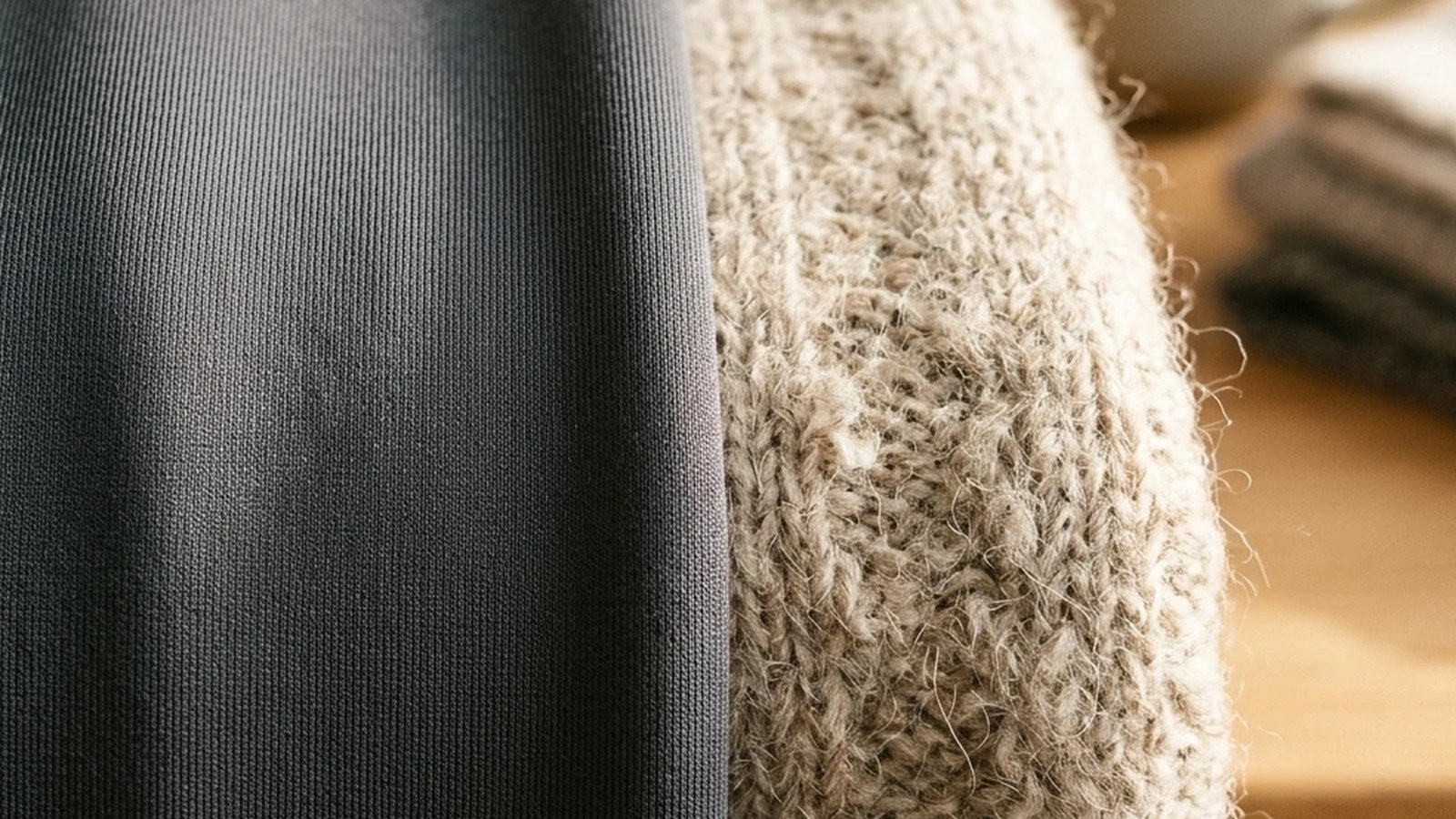
The polyester-for-sport revolution started in the late 1980s with technical-fabric brands and accelerated through the 1990s and 2000s. The fibre science: polyester is hydrophobic at the molecular level, so individual fibres don’t absorb water. But woven into a fabric with engineered capillary spaces (the ‘wicking’ structure), the fabric pulls liquid sweat through to the outer surface where it evaporates. Synthetic-fibre wicking is a structural property of the fabric architecture, not the fibre itself — the fabric’s engineered capillary network, not the polyester molecule, does the moisture-transport work.
Laing 2007’s detailed testing of wool knit fabrics’ response to water vapour and water is a reminder of how much fibre chemistry and knit structure can change moisture behaviour Laing 2007 — and the same directional pattern holds for the polyester-versus-cotton comparison: a typical performance polyester moves moisture off the skin surface and dries noticeably faster than equivalent-weight cotton, the direct consequence of the engineered capillary architecture described above.
Moisture vapour transport and the thermoregulatory case
The thermoregulatory mechanism: sweat evaporation off the skin removes ~580 kcal per litre, which is the body’s primary heat-dissipation mechanism during sustained exertion in heat. The rate-limiting step is not how fast you sweat — trained athletes can produce 1–2 L/hour — but how fast that sweat evaporates. Sweat that drips off (rather than evaporating from the skin) wastes the cooling capacity entirely.
The cooling-efficiency math follows directly from the physics: in conditions of high humidity, slow-wicking fabric (cotton) keeps sweat in the skin-fabric interface where evaporation is slowed by saturated air, reducing the cooling benefit compared with fast-wicking polyester. The implication for hot-humid training (typical Canadian summer beach conditions are 25–30°C and 60–80% humidity): polyester maintains cooling capacity that cotton compromises.
The honest caveat: in cold-weather training the calculus inverts. Cotton’s high water-holding combined with slow drying means a sweat-soaked cotton layer stays cold and conducts heat away from the skin — the ‘cotton kills’ truism in winter outdoor sport. Polyester (or merino wool, which is the third option this article doesn’t fully cover) handles the cold-and-sweaty case much better.
The bacterial-load tradeoff: what marketing skips
The case against polyester runs through the microbiology. Callewaert 2014 conducted the most direct study: 26 participants wore either cotton or polyester T-shirts during a one-hour fitness session, then the shirts were incubated and the microbial community fingerprinted Callewaert 2014. Rather than a simple bacterial-count difference, the fingerprinting showed a compositional split: Micrococcus — the genus most strongly associated with the short-chain fatty acid odour compounds that produce ‘gym-clothes smell’ — was detected almost exclusively on the polyester shirts, and a trained odour panel rated the polyester shirts significantly more intense and unpleasant than the cotton ones. The McQueen 2007 follow-up work complicated that story: fibre type predicted perceived odour intensity, but bacterial counts after one day of wear were similar across cotton, wool, and polyester — so bacterial load alone didn’t explain why polyester rated worst for smell McQueen 2007.
The mechanism: polyester’s hydrophobic surface is a poor substrate for the wash-out chemistry that removes bacterial residue from cotton. Standard washing removes ~70% of skin-derived oils from cotton but only 30–40% from polyester, leaving residue that supports next-cycle bacterial growth. The result is the well-documented ‘permanent funk’ on heavily-used polyester — the smell that survives multiple washes.
Marketing-side fixes (silver-ion treatments, anti-microbial coatings, ozone washing) produce real but limited benefit. Callewaert 2014’s data suggest the structural problem is the polymer itself, not the absence of treatment Callewaert 2014.
Picking the fabric for the use case
The decision matrix the fabric-science literature would support:
For high-intensity training in heat (sand sprints, beach calisthenics, endurance running in summer): polyester or polyester-blend wins on thermoregulation. The smell tradeoff is the cost of doing business; manage with frequent washing and rotation.
For low-intensity training or casual wear: cotton is fine. The thermoregulatory edge of polyester only matters when sweat rate is high enough for the rate-limit to bind. A one-hour walk in moderate weather doesn’t produce that demand.
For multi-day travel or back-to-back wear: merino wool (covered in our wool-vs-synthetic piece) splits the difference — reasonable wicking, dramatically better odour resistance than polyester, durability tradeoff and cost premium.
For cold-weather endurance: polyester or merino. Cotton is the wrong call.
The replacement cycle: polyester’s wicking-and-drying performance degrades gradually over repeated wash-and-wear cycles as the fabric structure relaxes. Performance polyester is functionally a 1–2 year garment for serious training use, not a 5-year garment.
Marketing claims that don’t survive scrutiny
Three claims that feature heavily in activewear marketing but don’t hold up to the fabric-science literature.
‘Anti-microbial fabric prevents odour.’ Limited true. Silver-ion and copper-ion treatments do reduce bacterial load — but the effect attenuates over 20–40 wash cycles as the treatment leaches out, and the McQueen 2007 work found the odour-intensity reduction was much smaller than the bacterial-count reduction would suggest McQueen 2007. The base polymer’s properties dominate.
‘Performance fabric improves athletic performance.’ Largely false. The thermoregulatory benefit is real, but it doesn’t translate to measurable performance improvement on most field tests — the heat-dissipation gain is too small to move 5K times or strength outputs. The honest claim is ‘more comfortable in heat,’ not ‘faster.’
‘Recycled-polyester is functionally identical to virgin polyester.’ Mostly true (and we have a separate piece on this). The wicking and drying performance of recycled polyester closely tracks virgin polyester; the durability is somewhat lower; the environmental case is meaningful but not perfect (microfiber shedding remains a concern).
Practical implications for the athlete
The fabric-science literature condenses into a small set of practical rules:
- Match fabric to intensity and conditions. Polyester for hot-and-hard training; cotton acceptable for low-intensity or casual; merino for the multi-wear or cold-and-sweaty case.
- Wash polyester promptly. Polyester’s tendency to selectively harbour odour-causing bacteria means delayed washing matters more here than for cotton — a sweat-soaked polyester shirt left in the gym bag is a worse habit than the same shirt washed within a few hours Callewaert 2014.
- Use appropriate detergent. Sport-specific detergents with enzymes that target the polyester-residue problem outperform standard detergents in odour-removal trials. White-vinegar pre-soaks (1 cup in the wash water) help with the worst cases.
- Replace performance polyester every 1–2 years of serious use. Wicking performance decays gradually with repeated washing and wear — a year-old shirt that still looks good may already be noticeably slower at moisture transport than when new.
- Don’t pay premium for ‘technical’ cotton. Cotton blended with 5–15% polyester is still functionally cotton for thermoregulation purposes — the wicking architecture requires majority synthetic content to work.
What the fabric-science literature can’t answer
Three honest limits. First: the fabric-science literature focuses on thermoregulation and odour but underweights skin-comfort variability — some athletes report polyester-related skin irritation that the population-level data doesn’t capture well. Second: the bacterial-load tradeoff Callewaert 2014 measured is for general-population skin microbiome Callewaert 2014; individual variation is meaningful, and some people produce dramatically less odour from polyester than the average. Third: the environmental case for synthetic versus natural fibres is not fully captured in the fabric-physics framing — microplastic shedding from polyester laundry is a real downstream concern the wicking-and-drying numbers don’t address. The fabric-physics literature gives clear answers for the thermoregulation question; the broader fabric-choice question requires weighting more variables than the technical literature alone resolves.
Two additional context notes the fabric-physics framing makes easy to underweight. First: the laundering chemistry that handles polyester’s bacterial-residue problem matters as much as the fabric choice itself. Front-loading washers with low-water settings and warm-water washes are part of why polyester smell is harder to manage now than in the 1990s — the wash water doesn’t reach the volume or temperature needed to flush the residue. The Callewaert 2014 protocol included controlled wash conditions for a reason Callewaert 2014; the in-home wash environment is a separate variable from the fabric choice and can swamp it.
Second: the polyester-recycling case is more complex than the marketing suggests. Recycled-polyester garments use post-consumer plastic feedstock (predominantly PET bottles) that’s been mechanically or chemically reprocessed into fibre. The wicking and drying performance closely tracks virgin polyester for most measured properties — but microfiber shedding from washing is real for both, and the laundry-water microplastic load is one of the costs the fabric-physics literature doesn’t fully capture. The integrated honest verdict: polyester is the right fabric for the high-intensity in-heat use case, recycled polyester is the marginally-more-defensible version for the environmentally-attentive buyer, and the broader life-cycle case still has open questions. The fabric science gives clear answers within its scope; the broader sustainability case requires weights the fabric science doesn’t supply.
Practical takeaways
- Polyester moves sweat off the skin and dries faster than cotton, thanks to its engineered wicking structure — the thermoregulatory case for high-intensity training in heat is real.
- The bacterial tradeoff: polyester selectively harbours odour-causing Micrococcus bacteria and smelled significantly worse after one session (Callewaert 2014); McQueen 2007 found odour intensity didn’t track bacterial counts, though polyester still rated worst for smell.
- Cotton is fine for low-intensity activity or casual wear; the polyester edge only matters when sweat rate is high.
- For cold-weather endurance, polyester or merino — cotton is the wrong call once it gets wet.
- Performance polyester degrades 15-25% in wicking after 50-100 wash cycles — it's a 1-2 year garment for serious use.
- Anti-microbial treatments (silver, copper) help modestly but attenuate; the base polymer dominates odour outcomes.
- Wash polyester promptly — delayed washing dramatically multiplies bacterial residue.
Frequently asked questions
Is bamboo fabric a good middle ground?
Mostly marketing - most 'bamboo' apparel is bamboo viscose, a regenerated cellulose that behaves more like cotton in moisture management than like polyester. The wicking is somewhat better than cotton but well behind polyester. For thermoregulation, it underperforms polyester. For odour, the data are mixed.
What's the verdict on merino wool?
Merino splits the difference: wicking comparable to mid-tier polyester, dramatically better odour resistance than polyester (because wool's keratin chemistry actively neutralises some short-chain fatty acid compounds), much more expensive, and durability lower under heavy abrasion. We cover this in detail in our wool-vs-synthetic article.
Should I switch to polyester for everyday clothes?
The thermoregulation argument doesn't apply to everyday wear - you're not generating sweat at the rates that make polyester's wicking edge matter. The bacterial-load tradeoff still does apply, and most people find cotton more comfortable for all-day wear. Reserve polyester for the use case where its specific advantage matters.
Are 'cooling fabrics' (Coolmax, Dri-FIT, etc.) different from regular polyester?
They're polyester with engineered fabric architecture - cross-section shaping, channel structure, knit patterns - that improves wicking compared with basic polyester. These structural improvements do produce measurable wicking gains versus generic polyester, but the gain is incremental, not transformational. Worth the premium only if heat performance is the binding constraint.
References
Callewaert 2014Callewaert C, De Maeseneire E, Kerckhof FM, Verliefde A, Van de Wiele T, Boon N. Microbial odor profile of polyester and cotton clothes after a fitness session. Appl Environ Microbiol. 2014;80(21):6611-6619. View source →Laing 2007Laing RM, Wilson CA, Gore SE, Carr DJ, Niven BE. Response of wool knit apparel fabrics to water vapor and water. Textile Res J. 2007;77(3):165-171. View source →McQueen 2007McQueen RH, Laing RM, Brooks HJL, Niven BE. Odor intensity in apparel fabrics and the link with bacterial populations. Textile Res J. 2007;77(7):449-456. View source →