The 60-second version
Running cadence — the number of steps per minute — has accumulated a substantial evidence base for injury prevention and running economy. Heiderscheit et al. 2011 and Schubert et al. 2014 demonstrated that increasing cadence by 5–10% from a runner’s self-selected pace reduces ground reaction forces, joint loading at the knee and hip, and stride length over-extension — all factors associated with running injury risk. The popular “180 steps per minute” prescription (originally from Jack Daniels’ observation of elite Olympic distance runners) is a useful target for some runners but not a universal rule; optimal cadence varies with running speed, leg length, and individual biomechanics. The honest summary: most recreational runners run at 160–170 spm at easy pace and benefit from increasing toward 170–180 spm; the change reduces over-striding and joint loading without requiring conscious form changes elsewhere. The protocol that works: use a metronome or music BPM at the target cadence; let the body adjust naturally over 4–8 weeks; expect modest pace adjustments as cadence shifts. Faster cadence ≠ faster pace; the two are independent variables that interact via stride length.
Educational journalism, not medical advice. Every claim here is checked against its cited sources by editor Timothy Bunce — a health writer, not a physician. It isn’t specific to your situation: for health decisions, talk to your own clinician. How we work →
Some links in this article are affiliate links. If you buy through one, The Beachside Reader earns a commission at no extra cost to you. It never changes which products we pick, or what we say about them. Full affiliate disclosure →
Why cadence matters biomechanically
Running speed = cadence × stride length. Adjusting one affects the other; trained runners increase pace primarily through cadence increases up to a certain point, then through stride length increases at higher speeds. The reverse pattern (long strides at low cadence) creates over-striding, which is associated with several injury risk factors:
- Increased ground reaction forces: foot landing further ahead of center of mass produces braking and higher peak vertical loading.
- Heel strike with extended knee: the over-stride pattern often includes ankle dorsiflexion at contact and a relatively-extended knee, increasing impact loading on knee structures.
- Increased loading rate: the rate at which force builds during contact is associated with stress fracture risk independently of peak force.
- Reduced energy storage in tendons: the stretch-shortening cycle of Achilles and plantar fascia stores less elastic energy with longer ground contact times.
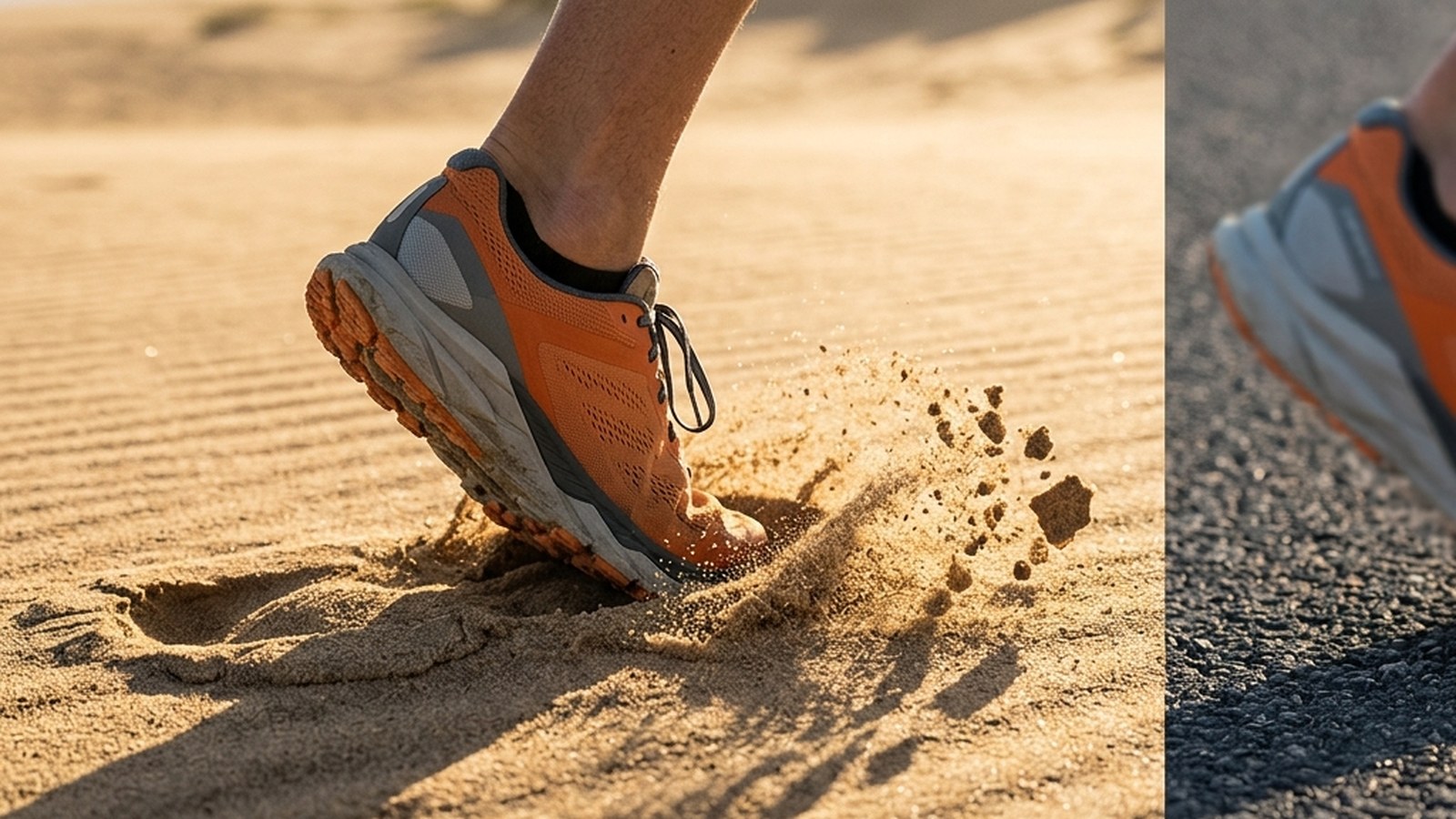
Increasing cadence at the same speed shortens stride length, reduces over-striding, and shifts the foot strike pattern toward midfoot or forefoot in many runners. The effect is particularly pronounced at slow paces (where over-striding is most common) and diminishes at faster paces (where stride length naturally extends) Schubert et al. 2014.
What the research actually shows
Knee loading
Heiderscheit 2011 found that a 10% cadence increase reduced peak hip adduction and internal-rotation moments, cut the peak knee extension moment by about 12%, and reduced energy absorbed at the knee by roughly 20–34% — the study didn’t measure knee adduction moment or patellofemoral joint loading directly, but the reduced knee-joint loading is still meaningful for runners with knee pain or patellofemoral pain syndrome Willson et al. 2014 Heiderscheit et al. 2011.
Hip loading
Similar reductions in hip joint loading with cadence increases. Particularly relevant for runners with hip pain, gluteal medius weakness, or femoral neck stress fracture history.
Tibial stress and shin splints
Lower stride length reduces tibial bending moments. Multiple studies show reduced tibial stress fracture risk markers with cadence-increase interventions.
Running economy
Mixed evidence. Some studies show modest economy improvements with cadence increases in over-striding runners; other studies show slight economy decrements when forcing higher cadence above natural preferred. Self-selected cadence often optimizes economy for individual biomechanics; small adjustments (5–10%) are typically neutral or slightly improving for economy; large adjustments can compromise economy.
Injury reduction
Multiple prospective studies have associated cadence-increase interventions with reduced injury rates over 6–12 month follow-up. The intervention works particularly well for runners with previous injury or persistent low-grade pain Napier et al. 2015.
What “optimal” cadence actually is
The popular 180 spm target comes from Jack Daniels’ observation of elite distance runners during the 1984 Olympics Daniels 2014. The number is real (most elite runners are above 180 spm at race pace) but the “everyone should be 180” framing oversimplifies. Better framing:
- Optimal cadence varies with running speed: faster pace = naturally higher cadence. A 4-minute mile runner is at ~190+ spm; a 12-minute mile shuffler may be at 150 spm.
- Optimal cadence varies with leg length: longer legs naturally produce slightly lower optimal cadence at any given speed.
- Optimal cadence is what minimizes over-striding for the individual at the speed they’re running. The metric to watch: are you over-striding (foot landing well ahead of center of mass at contact)?
Practical heuristic: at easy training pace, target 170–180 spm. At race pace, naturally drift higher. The value of the 180 anchor is that most recreational runners under-cadence at easy pace; pushing toward 180 reduces over-striding without significant economy cost.
How to measure your cadence
Watch and run apps
Most modern GPS watches (Garmin, Polar, COROS, Apple Watch fitness apps) measure and display cadence in real-time. Look for the “cadence” metric on your watch face during a run.
Manual count
Count strikes of one foot for 30 seconds; multiply by 4 to get total spm. Useful one-time check if you don’t have a watch.
Stryd or running power meters
Foot-pod-based devices measure cadence as part of broader gait metrics. Useful for runners doing serious form work.
For cadence work, the watch or foot-pod display during a run is sufficient. You don’t need precise measurement; you need the feedback to know whether you’re hitting the target.
How to change cadence
Metronome method
- Use a music metronome app or a watch with cadence-target alerts
- Set to your target cadence (e.g., 175 spm if you’re currently running 165)
- Run with the metronome for 5–10 minutes per session, gradually extending
- The body learns to match the rhythm; conscious effort drops over weeks
Music BPM method
- Find playlists with songs at your target BPM (180 BPM playlists are widely available on Spotify, Apple Music)
- Synchronize footstrikes to the beat
- Many runners find this more pleasant than metronome clicks
Strides and short faster running
- Add 4–8 strides (15–30 second pickups at 5K-3K race pace) to easy runs 1–2 times per week
- The faster pace naturally produces higher cadence
- The rhythm carries into surrounding easy running over weeks
Hill repeats
- Short uphill running (10–30 seconds) naturally produces higher cadence
- The neuromuscular pattern transfers to flat running over weeks
A 6-week cadence transition protocol
Week 1–2: Awareness
- Run as usual; use the watch to monitor your current cadence
- Note: how does cadence vary by pace? By terrain? By time-of-run (early vs. late)?
- Calculate your target: current cadence + 5–7%
Week 3–4: Introduction
- Use a metronome or music at target cadence for 10–15 minutes during easy runs
- Don’t change pace; let stride length shorten naturally
- Some early runs feel awkward; this resolves
Week 5–6: Consolidation
- Use cadence target for 60–80% of easy run time
- Faster runs (intervals, tempo) typically self-correct toward higher cadence; less explicit prescription needed
- Re-measure baseline after week 6: most runners have shifted by 4–8 spm at easy pace
Beyond week 6, the new cadence becomes the default for most runners. Some maintenance work (occasional metronome runs, regular strides) preserves the change.
When NOT to change cadence
Cadence increases aren’t universally beneficial. Don’t change if:
- You’re already at 180+ spm at easy pace: further increases produce diminishing returns and possible economy cost.
- You have no current injury history and your running is going well: don’t fix what isn’t broken.
- You’re mid-marathon training cycle: form changes are best done in build or base phases, not the 4–6 weeks before a goal race.
- You’re experiencing other form changes (new shoes, switching to barefoot/minimalist, returning from injury): one variable at a time.
- The change feels significantly compromising: 5–7% increase is the safe range; pushing to 10–15% can backfire.
Cadence in the broader form picture
Cadence is one of several running-form variables. Others include:
- Foot strike: heel, midfoot, forefoot. Cadence increases often shift heel strikers toward midfoot, but forcing the change directly is rarely productive.
- Hip extension: range of motion at the hip during push-off; affected by hip flexor flexibility and gluteal strength.
- Trunk lean: slight forward lean from ankles is the “Pose method” ideal; over-leaning produces back pain.
- Arm swing: should be relatively relaxed, with rotation primarily from shoulder; cross-body arm swing wastes energy.
- Vertical oscillation: how high you bounce during each stride; lower is generally more economical.
- Ground contact time: shorter is generally more economical at any given speed.
Cadence is the highest-leverage form variable to consciously adjust because it’s easy to measure, easy to change, and other form aspects often improve as a downstream consequence. Don’t try to change everything at once.
Practical logistics and edge cases
Wasaga-area cadence work. The Beach Drive boardwalk and Georgian Trail provide flat, predictable surfaces ideal for cadence-focused running. Watch for surface variations (sand patches, leaf litter) that prompt unconscious cadence shifts.
Treadmill cadence vs. outdoor. Treadmill running often produces slightly different cadence than outdoor running at equivalent pace (typically 1–3 spm higher). Adjust mental targets if doing cadence work on treadmill.
Trail running. Technical trail running naturally produces variable cadence (faster cadence over technical sections, lower over fluid sections). Don’t force constant cadence on trails; the variable demands are part of the activity.
Stroller running. Pushing a stroller modestly affects cadence (often produces slightly higher cadence due to gait changes). Don’t try to maintain pre-stroller cadence numbers; recalibrate to current context.
Older runners. Cadence work is particularly relevant for older runners experiencing increased injury rates. The over-striding pattern often worsens with age; reducing over-stride through cadence increases meaningfully reduces joint stress.
Beginner runners. Brand-new runners (first 3 months) often have very-low cadence (140–160 spm) at very-slow paces. Don’t force 180 immediately; let cadence drift up naturally as fitness builds. Excessive early cadence prescription can produce over-stress injuries.
Race-day cadence. Race-pace cadence is naturally higher than training cadence. Don’t use race-day to introduce cadence changes; the new pattern should be consolidated 4+ weeks before the goal race.
Practical takeaways
- Cadence at easy pace: target 170–180 spm for most recreational runners; increase 5–7% if currently below.
- Mechanism: reduces over-striding, ground reaction forces, joint loading, and injury risk markers.
- Optimal varies: speed, leg length, individual biomechanics. The 180 number is a useful anchor but not universal.
- Methods: metronome, music BPM, strides, hill repeats. The body adjusts naturally over 4–8 weeks.
- Don’t change mid-race-cycle: form changes belong in base phases.
- Cadence is highest-leverage form variable: easy to measure, easy to change, downstream effects on other form aspects.
- 5–10% increase is safe range: larger forced changes can compromise economy or produce other issues.
Frequently asked questions
Should I really aim for 180 spm exactly?
Not exactly. 180 is a useful anchor but the “optimal” varies by individual and pace. Aim for 170–180 at easy pace if you’re currently below; let race-pace cadence drift higher naturally. Don’t obsess over hitting precisely 180.
How long does it take to change cadence permanently?
4–8 weeks of consistent practice. The body learns the new rhythm; conscious effort drops over weeks. The new cadence becomes default. Some maintenance work (strides, occasional metronome runs) preserves the change long-term.
Will higher cadence make me faster?
Not directly. Speed = cadence × stride length. Increasing cadence at the same speed shortens stride; doesn’t increase speed. To run faster, you need either higher cadence at the same stride length, OR longer stride at the same cadence. Trained runners typically use both.
What about my forefoot strike or heel strike?
Foot strike often shifts naturally with cadence changes (over-striders heel-striking often shift toward midfoot when cadence increases). Forcing foot strike directly is harder and less productive than letting it adjust as cadence shifts.
Can I do this on a treadmill?
Yes — treadmill cadence work is fine. Note that treadmill cadence often runs 1–3 spm higher than outdoor cadence at equivalent pace; recalibrate mental targets accordingly. Outdoor running is typically more representative of race-day cadence.
References
Heiderscheit et al. 2011Heiderscheit BC, Chumanov ES, Michalski MP, Wille CM, Ryan MB. Effects of step rate manipulation on joint mechanics during running. Med Sci Sports Exerc. 2011;43(2):296-302. View source →Schubert et al. 2014Schubert AG, Kempf J, Heiderscheit BC. Influence of stride frequency and length on running mechanics: a systematic review. Sports Health. 2014;6(3):210-217. View source →Willson et al. 2014Willson JD, Sharpee R, Meardon SA, Kernozek TW. Effects of step length on patellofemoral joint stress in female runners with and without patellofemoral pain. Clin Biomech. 2014;29(3):243-247. View source →Napier et al. 2015Napier C, Cochrane CK, Taunton JE, Hunt MA. Gait modifications to change lower extremity gait biomechanics in runners: a systematic review. Br J Sports Med. 2015;49(21):1382-1388. View source →Daniels 2014Daniels JT. Daniels’ Running Formula. 3rd ed. Human Kinetics; 2014. View source →