The 60-second version
Running-shoe heel-to-toe drop — the height difference between the heel of the shoe and the forefoot — changes where on your foot you land and how your body absorbs impact. The peer-reviewed evidence is clearer than the marketing: higher drop (8–12 mm) biases toward heel strike and shifts load up the kinetic chain to the knee; lower drop (0–4 mm) biases toward midfoot/forefoot strike and shifts load down to the calf and Achilles. Neither strike pattern is inherently safer; injuries simply move from one tissue to another. Switching from one drop to a meaningfully different one without adaptation produces predictable injury rates — just over half of runners (10 of 19) who transitioned quickly to zero-drop shoes developed early foot stress-injury signs (bone marrow edema) on MRI within 10 weeks, versus far fewer among runners who stayed in their usual shoes (Ridge 2013). The cleanest practical conclusion: match drop to your running history and current tissue capacity; don’t change drop quickly; the shoe that has worked for years is rarely the shoe to ditch.
Educational journalism, not medical advice. Every claim here is checked against its cited sources by editor Timothy Bunce — a health writer, not a physician. It isn’t specific to your situation: for health decisions, talk to your own clinician. How we work →
Some links in this article are affiliate links. If you buy through one, The Beachside Reader earns a commission at no extra cost to you. It never changes which products we pick, or what we say about them. Full affiliate disclosure →
Why drop matters mechanically
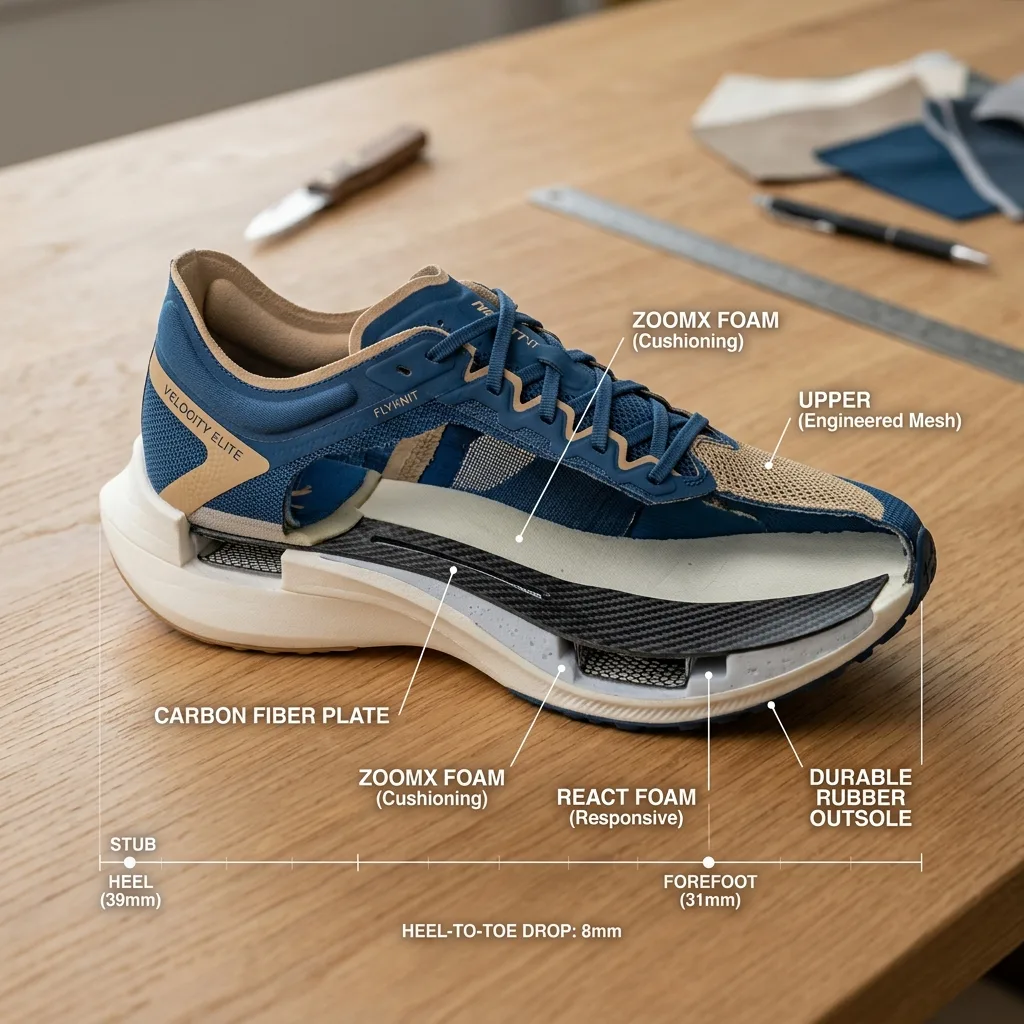
Drop is the height difference between the heel and forefoot of a running shoe’s midsole. A 12-mm drop shoe tilts the foot 12 mm higher at the heel; a zero-drop shoe is flat. The mechanical consequences:
- Higher drop (10–12 mm) raises the heel and biases the runner toward heel-striking, with peak ground-reaction force going up through the tibia, knee, and hip.
- Moderate drop (6–8 mm) — the “default” for most road-running shoes — allows variable strike pattern depending on pace and surface.
- Low drop (4–6 mm) begins to bias toward midfoot landing; the calf does more eccentric work absorbing impact.
- Zero or near-zero drop (0–4 mm) typically produces midfoot or forefoot strike; the Achilles tendon and calf bear more impact load.
The 2016 Malisoux et al. trial randomized 372 runners to standard or motion-control running shoes — both built on the same last with the same drop, differing only in pronation-control midsole features — and tracked them over a running season (6 months). The motion-control shoes produced a lower overall injury incidence than the standard shoes (17.6% vs 32.4%), with the protective effect concentrated in runners with pronated feet — a shoe-construction comparison, not a comparison across heel-to-toe drop levels Malisoux 2016.
The trial's key finding was that motion-control shoes lowered overall injury incidence compared with standard shoes, with the benefit concentrated in runners who pronate — a result specific to that shoe-construction comparison, not a test of heel-to-toe drop.
— summarizing Malisoux et al., Br J Sports Med., 2016 view source
Foot strike: heel, midfoot, forefoot
| Strike type | What you feel | Where load goes |
|---|---|---|
| Heel strike | Heel touches first; rolling motion through midfoot to toes | Tibia, knee, hip absorb impact via skeletal compression and quadriceps eccentric loading |
| Midfoot strike | Whole midfoot lands together; very brief ground contact | Distributed across calf, Achilles, and arch; less on knee |
| Forefoot strike | Ball of foot lands first; heel sometimes never touches | Calf and Achilles absorb most impact; arch participates significantly |
The 2010 Lieberman et al. study of habitually-barefoot runners (Kalenjin populations in Kenya) showed that shoeless or minimally-shod populations strongly prefer forefoot or midfoot strike, while modern Western runners with cushioned heels gravitate toward heel strike Lieberman 2010. The shoe shapes the strike, more than the runner’s biology.
Drop categories and their typical use cases
| Drop range | Typical shoes | Best for |
|---|---|---|
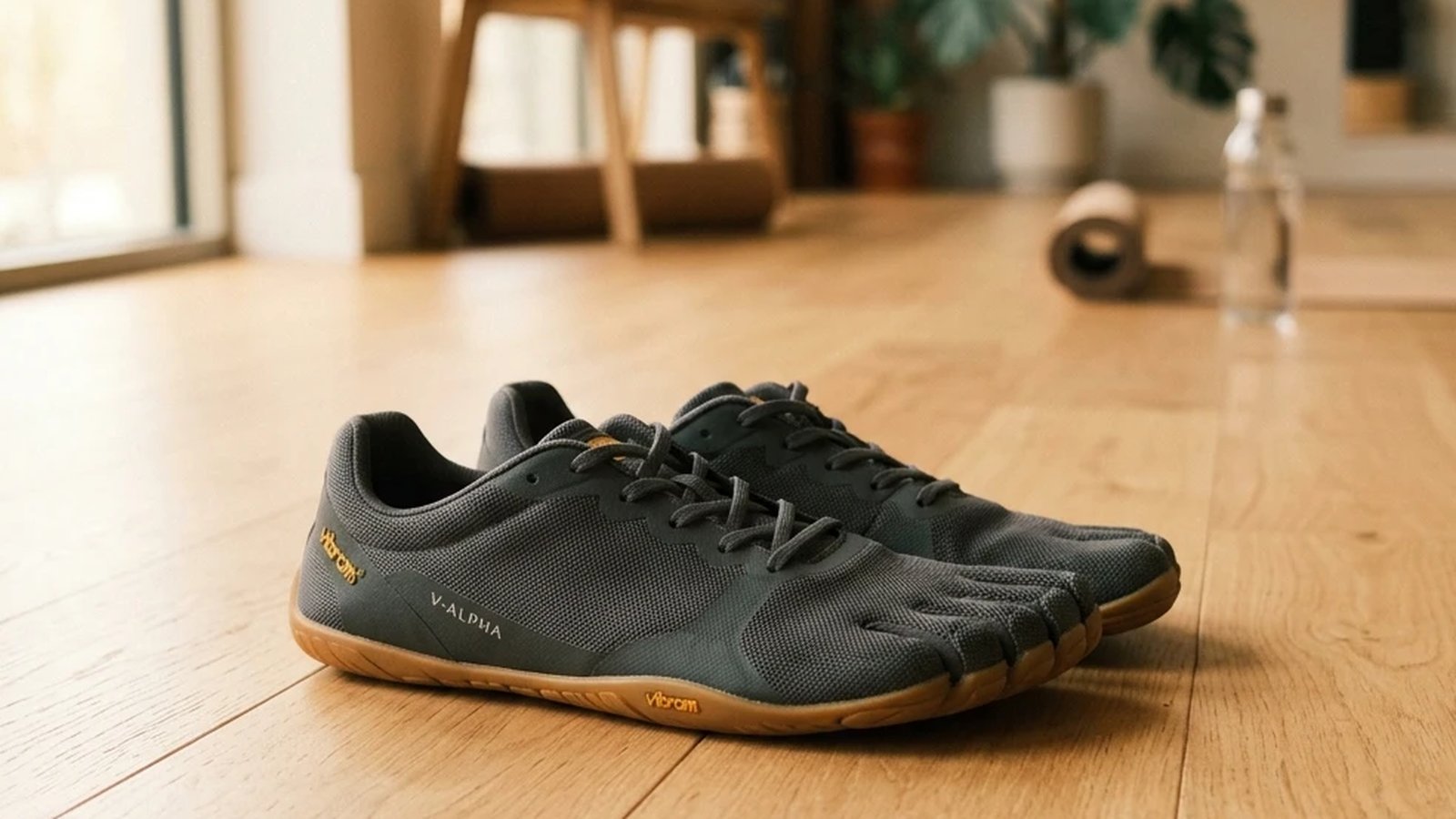
| 0 mm (zero-drop) | Altra, Vibram FiveFingers, Xero, Topo (some lines), Lems | Forefoot/midfoot-striking experienced runners; minimalist runners; treadmill walking; some lifters |
| 2–4 mm (low-drop) | Nike Free, Hoka Mach (some lines), Topo (most lines), Saucony Kinvara (newer) | Adapted runners transitioning toward midfoot; some trail runners |
| 4–6 mm (moderate-low) | Saucony Kinvara, Hoka Clifton, Adidas Adios, On Cloudflow | The growing “moderate drop” default; works for most runners |
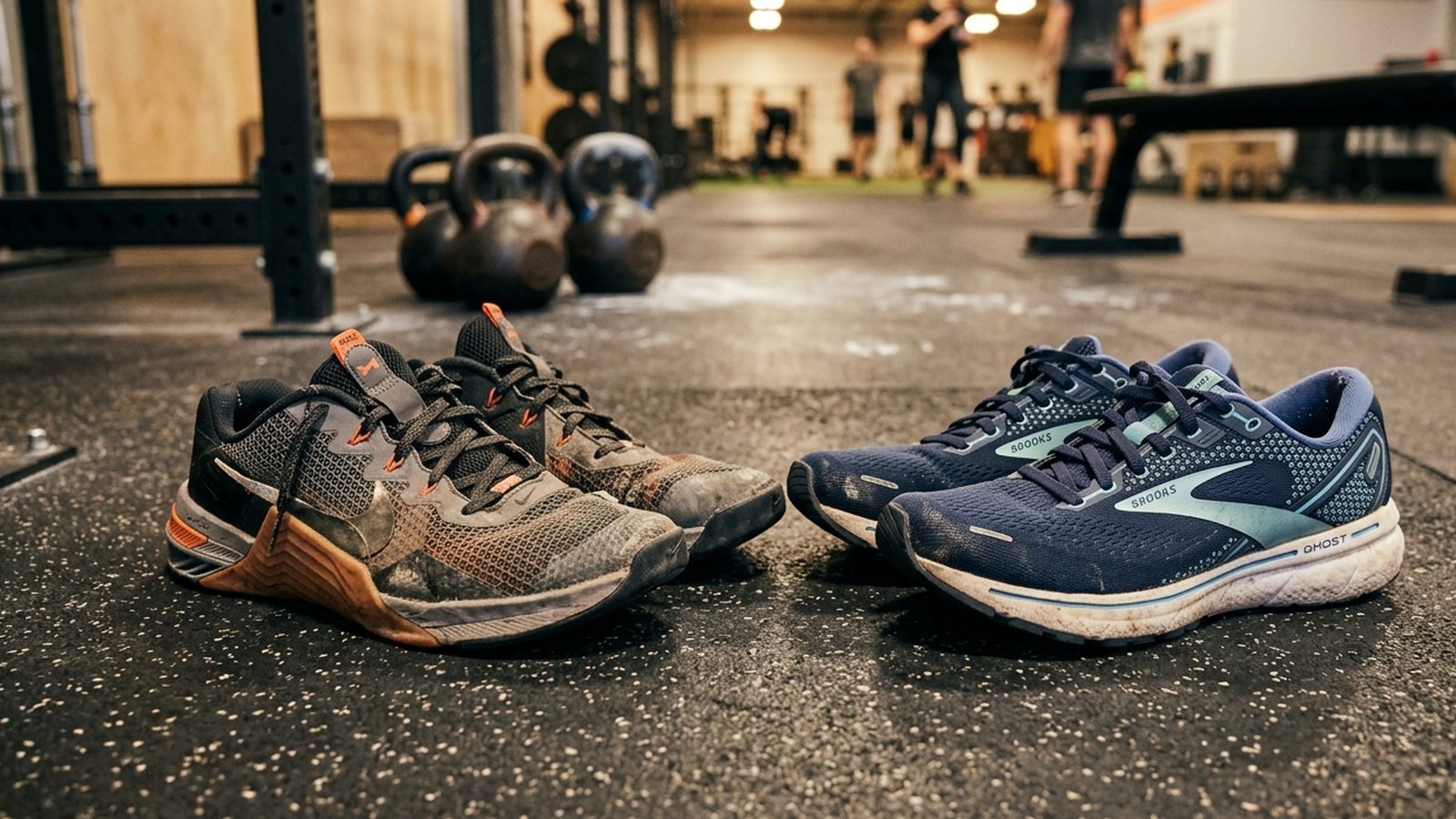
| 8–10 mm (traditional) | Asics Gel-Cumulus, Brooks Ghost, New Balance 880, Nike Pegasus | The traditional “all-purpose road shoe” for the recreational runner; heel-striker friendly |
| 10–12 mm (high-drop) | Brooks Adrenaline, Asics Kayano, some carbon-plate racers | Strong heel-strikers; runners with chronic Achilles issues; some racing flats |
| 12+ mm (very high) | Specialty racing flats, some older models | Rare; specific use cases |
Injury risk by drop
The 2013 Ridge et al. study tracked recreational runners transitioning to minimalist (zero-drop) shoes over 10 weeks. Findings:
- 10 of 19 runners (about 53%) in the minimalist transition group developed bone marrow edema in the foot on MRI by the end of the trial — an early stress-injury signal — a significantly higher rate than in the control group continuing in standard shoes Ridge 2013.
- The transition was specifically the problem, not the shoe. Long-time minimalist runners had no excess injury rate vs traditional-shoe runners.
The 2020 Sun et al. systematic review of footwear constructions and running biomechanics looked specifically at heel-to-toe drop and found the opposite of a strong transition effect: the RCT evidence it reviewed showed no significant difference in overall injury risk among different heel-to-toe drops, though the review does document specific biomechanical effects of drop — higher drop increased knee adduction, knee flexion at midstance, and stance time, while lower drop reduced tibial acceleration and initial ankle plantarflexion — and the authors called for further research to establish standardized drop-testing guidelines, not because drop showed no biomechanical effect at all Sun 2016.
Who benefits from each drop
| Profile | Reasonable drop range |
|---|---|
| New runner with no injury history | 6–10 mm; the traditional default; lots of options; forgives variable strike patterns |
| Long-time recreational runner with no injuries | Whatever you’ve been wearing; don’t fix what isn’t broken |
| Runner with chronic Achilles tendinopathy | Higher drop (10–12 mm) reduces Achilles eccentric load; combine with eccentric heel-drop rehab work |
| Runner with chronic knee pain (PFP, IT band) | Moderate to lower drop (4–8 mm) shifts load away from knee; transition gradually |
| Forefoot striker by nature | Low-to-moderate drop (4–6 mm); zero-drop possible if calf and Achilles are well-conditioned |
| Heel striker who pronates excessively | Moderate drop (6–8 mm) with mild stability features; pronation-control shoes have weak evidence (see footwear article) |
| Trail runner | Moderate (4–8 mm); some prefer zero-drop for ground feel |
| Sprint or speed work | Lower drop racing flats (4–6 mm); modern carbon-plate racers vary |
| Older adult new to running | Moderate (6–10 mm); cushioning helps; don’t chase minimalism |
| Returning from a foot or calf injury | Same drop you wore before injury; don’t change shoes during return-to-running |
Transitioning between drops
If you’re moving from a higher-drop to a lower-drop shoe (or vice versa), do it gradually. Recommended protocol:
- Weeks 1–2: wear the new shoe for short walks only; no running.
- Weeks 3–4: 1–2 short runs per week (under 5 km) in the new shoe; longer runs in the old shoe.
- Weeks 5–8: gradually increase percentage of weekly mileage in the new shoe; aim for 50/50 split by week 8.
- Weeks 9–12: full transition if no symptoms; reduce or pause if calf, Achilles, or foot soreness develops.
- Concurrent strengthening: if going from high to low drop, add eccentric calf strengthening (heel drops off a step) 3×/week during transition.
- Backtrack at any sign of injury; the transition is the risk window. The shoe alone is not.
Total transition timeline: 10–14 weeks for a meaningful drop change. The Ridge 2013 study — the only paper in this article's reference list that tracked a shoe-drop transition — found that over just a 10-week switch to minimalist shoes, 10 of 19 runners developed bone-marrow edema (an early stress-injury signal) versus far fewer in runners who stayed in standard shoes; the researchers concluded transitions need to happen more slowly than 10 weeks, which is the basis for the longer 10–14 week protocol above.
Common myths
- “Lower drop is more natural and therefore better.” Natural-foot biomechanics evolved on flat surfaces with daily walking, not in modern shoes. “Natural” doesn’t map cleanly to “better for modern road running.”
- “Higher drop causes injuries.” Higher drop redistributes load; the total injury rate is similar. Different shoes shift injury, not eliminate it.
- “Zero drop strengthens the foot.” Some evidence for foot intrinsic-muscle strength gains; but the strengthening can occur with mobility and barefoot exposure independent of running shoes.
- “You should switch to lower drop to fix knee pain.” Sometimes; the evidence is mixed. Address the underlying load capacity (gluteal strength, quad strength, training volume) before changing footwear.
- “Carbon-plate racers’ drop is what makes them fast.” The plate and foam interaction matter more than the drop in modern racing shoes.
- “Low drop is good for sprints.” Sprint shoes are a different category (spike plates, very stiff midsole); the drop conversation applies to distance running, not track sprinting.
A practical decision framework
- If you’ve been running injury-free in a particular drop, stay there. Don’t fix what isn’t broken.
- If you’re a new runner, default to 6–10 mm with moderate cushioning; lots of options; forgives strike-pattern variability.
- If you’re injured: consult a sports physiotherapist; the shoe is rarely the only or even the main variable.
- If you have chronic Achilles issues: higher drop (10–12 mm) reduces eccentric Achilles load. Combine with rehab.
- If you have chronic knee pain: lower-to-moderate drop (4–8 mm) may help. Transition gradually.
- If you want to try minimalist: do the 12-week transition. Don’t skip steps.
- Don’t buy shoes based on internet biomechanics arguments; what works on the foot in front of you matters more than what works for someone else’s gait.
A note on cushioning vs drop
Cushioning (stack height) and drop are related but distinct. A high-stack shoe (e.g., Hoka) can have low drop; a low-stack shoe can have high drop. Both variables affect mechanics independently:
- High stack: more cushioning, but less ground feel; heavier; modern carbon-plate racers go high-stack with low drop.
- Low stack: more proprioception; lighter; minimalist territory.
- The 2017 Sinclair et al. analysis found minimalist footwear produced significantly higher Achilles tendon load than maximalist footwear in recreational runners, a stack-height effect distinct from heel-to-toe drop Sinclair 2017.
The interaction is complex. For most recreational runners, drop is one variable among several; total comfort and injury history matter more than chasing a specific number.
Practical takeaways
- Drop redistributes load: high drop loads knee/shin/hip; low drop loads calf/Achilles. Total injury rate is similar across drop categories in healthy runners.
- Transitions are the injury risk, not the shoe itself. Going from high to low drop too quickly put 10 of 19 runners in the Ridge 2013 trial into early foot stress-injury territory (bone marrow edema) within 10 weeks — hence the 10–14 week gradual protocol.
- For new runners: 6–10 mm drop, moderate cushioning, forgiving of variable strike patterns.
- For experienced runners: stay in what works; don’t change without reason.
- For injured runners: physiotherapist guidance; address load capacity (strengthening, mileage) before footwear changes.
- Achilles tendinopathy: higher drop reduces eccentric load. Knee pain (PFP): lower drop may help — gradual transition.
- Minimalist transition protocol: 10–14 weeks minimum; concurrent calf strengthening.
- The shoe is one variable. Training volume, surface, strength, and recovery matter as much or more.
Frequently asked questions
Is lower drop or higher drop safer?
Neither, broadly. The Malisoux 2016 randomized trial and the Sun 2020 systematic review both concluded total injury rates are similar across drop categories in healthy runners; the type of injury simply moves. High drop loads knee/shin/hip; low drop loads calf/Achilles. The 'safer' drop is the one your tissues are conditioned for.
Can I switch from a 12 mm drop shoe to a 4 mm drop shoe?
Yes, but slowly. The Ridge 2013 study showed just over half (10 of 19 runners) transitioning fast to zero-drop developed bone marrow edema (early stress-injury signal) in 10 weeks. A 12–14 week gradual protocol — short walks first, then short runs, then increasing percentage of weekly mileage — with concurrent calf strengthening produces meaningfully lower transition-related injury rates.
My knee hurts. Should I switch to lower drop?
Maybe, but address the underlying issue first. Knee pain (especially patellofemoral pain) often correlates with weak gluteal and quadriceps muscles, training spikes, or poor cadence — not just shoe choice. Lower drop can help by shifting load away from the knee, but it's a slow transition (10–14 weeks) and works better when paired with strengthening and a physiotherapist’s assessment.
What drop should a new runner choose?
6–10 mm is the sensible default. The vast majority of road-running shoes for the recreational market sit in this range, and the strike-pattern variability that's normal for new runners is well-tolerated by moderate-drop shoes. Don't chase minimalism early; build mileage and strength first.
Are zero-drop shoes good for lifting too?
For deadlifts and low-bar squats, yes — that's exactly what minimalist lifting shoes are. For high-bar or front squats with limited ankle dorsiflexion, you'll likely prefer heel-elevated weightlifting shoes. See that article for the lifting-specific breakdown.
References
Malisoux 2016Malisoux L, Chambon N, Delattre N, Guéguen N, Urhausen A, Theisen D. Injury risk in runners using standard or motion control shoes: a randomised controlled trial with participant and assessor blinding. Br J Sports Med. 2016;50(8):481-487. View source →Lieberman 2010Lieberman DE, Venkadesan M, Werbel WA, et al. Foot strike patterns and collision forces in habitually barefoot versus shod runners. Nature. 2010;463(7280):531-535. View source →Ridge 2013Ridge ST, Johnson AW, Mitchell UH, et al. Foot bone marrow edema after a 10-wk transition to minimalist running shoes. Med Sci Sports Exerc. 2013;45(7):1363-1368. View source →Sun 2016Sun X, Lam WK, Zhang X, Wang J, Fu W. Systematic review of the role of footwear constructions in running biomechanics: implications for running-related injury and performance. J Sports Sci Med. 2020;19(1):20-37. View source →Sinclair 2017Sinclair J, Vincent H, Richards JD. Effects of minimalist and maximalist footwear on Achilles tendon load in recreational runners. Comp Exerc Physiol. 2017;13(1):61-67. View source →Daoud 2012Daoud AI, Geissler GJ, Wang F, Saretsky J, Daoud YA, Lieberman DE. Foot strike and injury rates in endurance runners: a retrospective study. Med Sci Sports Exerc. 2012;44(7):1325-1334. View source →Hamill 2011Hamill J, Russell EM, Gruber AH, Miller R. Impact characteristics in shod and barefoot running. Footwear Sci. 2011;3(1):33-40. View source →Nigg 2015Nigg BM, Baltich J, Hoerzer S, Enders H. Running shoes and running injuries: mythbusting and a proposal for two new paradigms: 'preferred movement path' and 'comfort filter'. Br J Sports Med. 2015;49(20):1290-1294. View source →Squadrone 2009Squadrone R, Gallozzi C. Biomechanical and physiological comparison of barefoot and two shod conditions in experienced barefoot runners. J Sports Med Phys Fitness. 2009;49(1):6-13. View source →Kerrigan 2009Kerrigan DC, Franz JR, Keenan GS, Dicharry J, Della Croce U, Wilder RP. The effect of running shoes on lower extremity joint torques. PM R. 2009;1(12):1058-1063. View source →Rixe 2012Rixe JA, Gallo RA, Silvis ML. The barefoot debate: can minimalist shoes reduce running-related injuries? Curr Sports Med Rep. 2012;11(3):160-165. View source →Agresta 2022Agresta C, Krieg K, Riley M. Running injury paradigms and their influence on footwear design features and runner assessment methods: a focused review to advance evidence-based practice for running medicine clinicians. Front Sports Act Living. 2022;4:815675. View source →