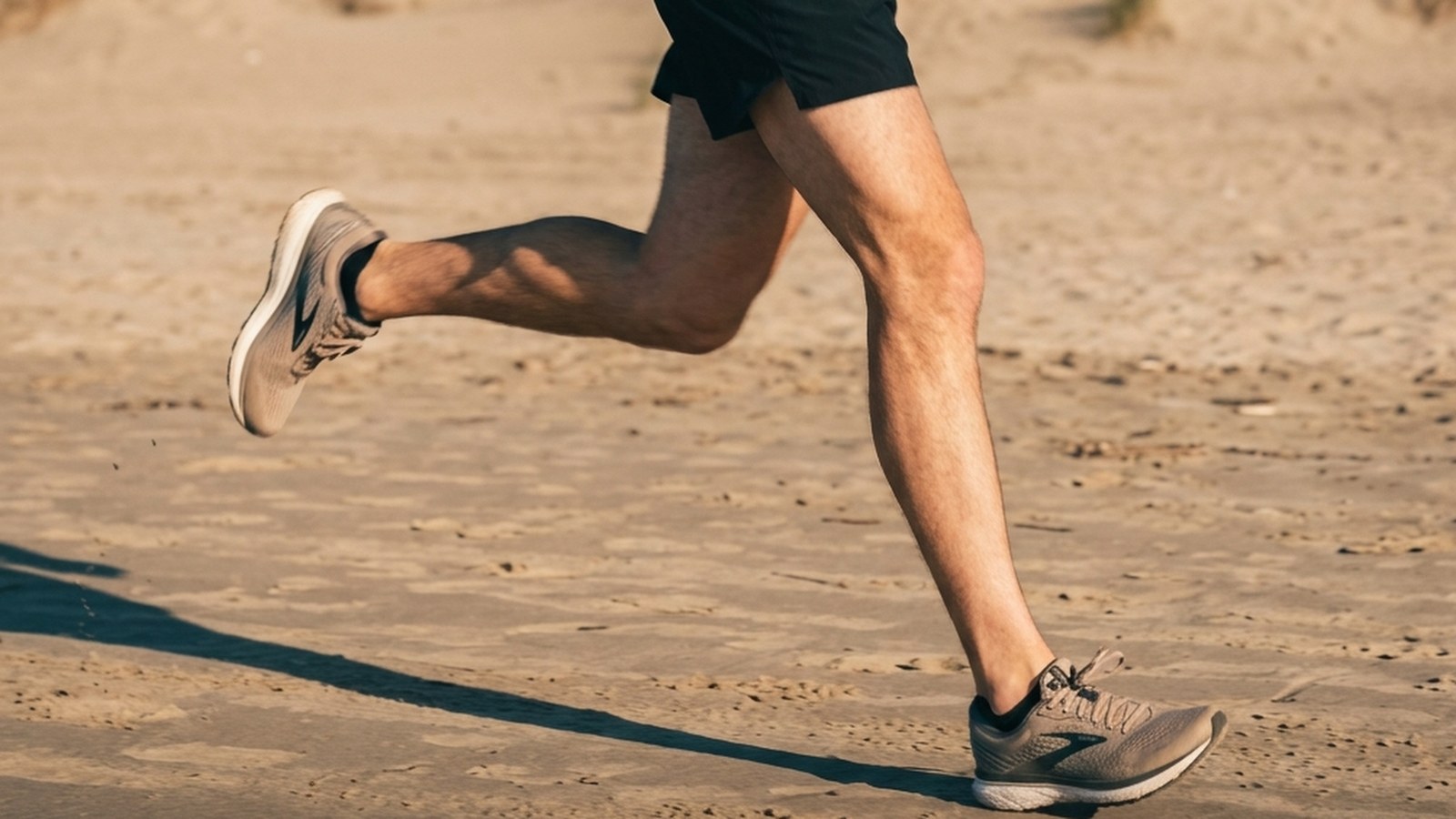
The 60-second version
Increase your current running cadence by 5-10% (typically targeting 170-180 steps per minute) and you reduce peak knee-joint loading by roughly 20% at the same speed. The biomechanics evidence is consistent across labs — Heiderscheit 2011, Lenhart 2014, Schubert 2014. The 2018 Bramah review classifies cadence retraining as one of the best-evidenced gait interventions for runner's knee. Use a metronome app, retrain over 4-6 weeks, start with 5-10 minutes per run and build. Running efficiency holds up during the adaptation — a pilot study found no significant rise in aerobic cost even as the gait changed. The active ingredient is shortening your stride so your foot lands closer to your centre of mass — less braking, lower impact, less knee load.
If you have aching knees after a run, the single highest-yield gait fix in the biomechanics literature is to increase your step rate. Heiderscheit's 2011 study at the University of Wisconsin demonstrated that bumping cadence by 10% at the same running speed reduced knee energy absorption by roughly 34% — a substantial mechanical change for what is essentially a free, equipment-light intervention Heiderscheit 2011.
That finding has been replicated and refined. The 2014 Lenhart study found the same 10% cadence increase cut peak patellofemoral joint force by 14% and stance-phase patellofemoral joint force impulse by roughly 20%. The 2014 Schubert systematic review documented consistent biomechanical effects across multiple labs. The 2018 Bramah injury-mechanism review classified cadence retraining among the best-evidenced gait interventions for runners with knee pain Bramah 2018.
Educational journalism, not medical advice. Every claim here is checked against its cited sources by editor Timothy Bunce — a health writer, not a physician. It isn’t specific to your situation: for health decisions, talk to your own clinician. How we work →
Some links in this article are affiliate links. If you buy through one, The Beachside Reader earns a commission at no extra cost to you. It never changes which products we pick, or what we say about them. Full affiliate disclosure →
The 180-spm number — useful, not magical
The familiar "180 steps per minute" target comes from coach Jack Daniels' informal observation of elite distance runners at the 1984 Los Angeles Olympics. He counted strides; the elite men and women clustered around 180-184 spm at race pace Daniels 2014. That number got canonised into a rule that does not actually have rigorous trial backing as an optimum.
Recreational runners have a much wider range. The 2014 Schubert review didn't establish a normative cadence figure at all — it's a systematic review of manipulation studies, and those studies changed each runner's stride rate by roughly 5% to 36% relative to that runner's OWN preferred baseline, precisely because the starting point varies so much between individuals Schubert 2014. There is no single magic number.
The evidence-based goal is not to hit 180. It's to increase your own current cadence by 5-10%. If you currently run at 160 spm, target 168-176. If you're at 170, target 178-187. The biomechanical benefit comes from the relative shift, not the absolute number.
Why a faster step rate reduces knee load
The mechanism is straightforward. At a given running speed, taking shorter, faster steps means each foot lands closer to your body's centre of mass instead of way out in front. Over-striding — landing your foot well ahead of your hip — creates two problems.
Braking force. When your foot lands ahead of your centre of mass, the ground reaction force has a horizontal component pointing backward, decelerating you. Your next push has to recover that lost momentum. It's wasteful, and it spikes joint loads.
Impact peak. The over-striding foot tends to land more upright and less under control. The vertical impact force at heel-strike is sharper and reaches the knee less attenuated. The 2014 Lenhart computational modelling study quantified the consequence: faster cadence at the same speed reduced patellofemoral joint force impulse over the stance phase by approximately 20%, primarily because the knee was less extended at the moment of contact Lenhart 2014.
Hafer's 2015 pilot study tracking real runners through a cadence retraining program found exactly this pattern: as step rate rose, ground contact moved closer to the centre of mass, vertical loading rates dropped, and aerobic efficiency adapted within 4-6 weeks Hafer 2015.
The runner's-knee evidence
Patellofemoral pain syndrome — the most common running injury — is mechanically a knee-load problem. The Bramah 2018 case-control review looked at gait patterns in injured versus uninjured runners and found over-striders, low-cadence runners, and runners with high hip-adduction angles dominated the injured group Bramah 2018. Cadence retraining addresses the most modifiable of those.
Willy's 2016 in-field study used mobile gait-monitoring devices to retrain cadence in runners with a history of tibial stress injury and demonstrated both a sustained cadence shift and a reduction in vertical loading rates over the following weeks Willy 2016. The intervention is not just a lab finding — it generalises to the road.
The 2014 Lenhart modelling study and its replications confirm that cadence retraining and stride-length manipulation produce reliable reductions in knee-joint loading, with the strongest indication for patellofemoral pain Lenhart 2014.
How to actually retrain cadence
The protocol that the trials use is straightforward and durable:
Step 1: measure your current cadence. Run at an easy pace for two minutes, count one foot strike for 30 seconds, multiply by 4. That's your starting point. Many GPS watches and running apps measure it automatically.
Step 2: set your target. Add 5-10% to your current value. If you're at 162, aim for 170-178.
Step 3: use an audible cue. A metronome app set to your target spm, or a music playlist at the target BPM (one foot strike per beat). The auditory cue does most of the work — you don't have to think about it.
Step 4: build gradually.
- Weeks 1-2: run with the metronome for 5-10 minutes of each run, normal pace for the rest.
- Weeks 3-4: 50% of each run with the metronome.
- Weeks 5-6: most of each run with the metronome.
- Week 7 onward: the pattern is largely automatic; drop the cue.
Keep speed the same. The point is to take shorter steps at the same pace, not to run faster.
What it feels like (the awkward weeks)
It feels strange at first. Short, choppy, less powerful. Your stride feels weak because you've stopped reaching the foot out in front of you. That's the point — the reach was the problem.
Don't expect a meaningful hit to your aerobic cost. Hafer's 2015 pilot study tracked oxygen consumption through a 6-week cadence-retraining protocol and found no significant decrease in running efficiency at the higher cadence, even as stride length and hip-loading patterns changed Hafer 2015. The gait may feel different for a few weeks; the evidence says your efficiency holds up.
If your knee pain has been persistent, you may notice early symptom relief even before the full neuromuscular adaptation is in. The mechanical change at the knee is immediate.
Beyond the knee — shins, IT-band, Achilles
The strongest trial evidence is for patellofemoral pain. The case for other injuries is reasonable but less robust.
Medial tibial stress syndrome (shin splints): over-striding contributes to high tibial loading rates. Allen's 2016 step-rate manipulation study found cadence retraining nudged runners away from heel-strike and reduced loading, mechanisms relevant to shin pain Allen 2016.
Iliotibial band syndrome: the 2014 Schubert review noted reduced hip adduction with shortened stride, plausibly relevant to ITBS, though direct outcome trials are smaller.
Achilles tendinopathy: moving away from over-striding generally reduces ankle moments and Achilles strain. Less direct evidence, but the mechanism is sympathetic.
The honest caveat: cadence retraining is part of a treatment plan for these conditions, not a solo intervention. Strength work for the hips and calves, load management, and (often) physiotherapy still matter.
Shoes don't fix it — you do
Highly cushioned, max-stack shoes can encourage heel-strike and over-striding by deadening the proprioceptive feedback that normally tightens your stride. Switching shoes alone is not a cadence intervention. Napier's 2018 work on running-related injuries in female recreational runners noted footwear as a moderate contributor to loading patterns, but cadence and stride mechanics were the bigger lever Napier 2018.
Lower-stack, more minimal shoes do tend to shorten stride and raise cadence naturally — you simply can't comfortably over-stride in them. If you're considering a shoe change, do it gradually and in parallel with deliberate cadence work, not as a replacement.
Practical takeaways
- Measure first. Find your current cadence; don't chase an absolute number.
- Target +5-10%. Add 5-10% to your current spm. For most recreational runners that lands somewhere between 165 and 180.
- Use a metronome or BPM playlist. Auditory cue does the work.
- Build over 4-6 weeks. Start with 5-10 minutes per run; expand gradually.
- Same speed, more steps. The point is shorter strides, not faster running.
- Don't expect a meaningful efficiency hit. A pilot study found no significant drop in running efficiency at higher cadence.
- If knee pain is persistent, pair cadence retraining with hip and quad strength work and a chat with a physio.
Frequently asked questions
What's the ideal running cadence?
There isn't one. The 180 steps-per-minute figure comes from Jack Daniels' 1984 Olympic observation of elites. Recreational runners' preferred cadence varies widely from person to person, and no biomechanics review has established a normative figure for it. The evidence-based goal is to increase your own current cadence by 5-10%.
Can I really fix knee pain by running faster?
Cadence isn't speed — it's step rate at the same speed. Heiderscheit 2011 showed a 10% increase in step rate at the same velocity reduced knee energy absorption by roughly 34%; Lenhart 2014 found the same change cut peak patellofemoral joint force by 14% and stance-phase joint-force impulse by about 20%.
How long does it take to change cadence?
Plan 4-6 weeks of deliberate practice with a metronome app or BPM playlist matching your target cadence. Start with 5-10 minutes per run for two weeks, then build.
Won't a higher cadence feel exhausting?
A small pilot study found that increasing cadence did not significantly reduce running efficiency, even though the gait felt different at first. Most runners realise their previous longer stride was over-striding — landing the foot ahead of the centre of mass.
Does cadence retraining help shin splints and IT-band pain?
The strongest evidence is for patellofemoral knee pain. Smaller studies and clinical reports suggest benefit for medial tibial stress syndrome (shin splints) and iliotibial band pain via the same over-striding mechanism.
Do running shoes affect cadence?
Slightly. Max-stack cushioning can encourage heel-strike over-striding. Lower-stack shoes raise cadence naturally. The cadence cue itself, not the shoe, is the active ingredient.
References
Heiderscheit 2011Heiderscheit BC, Chumanov ES, Michalski MP, Wille CM, Ryan MB. (2011) Effects of step rate manipulation on joint mechanics during running. Med Sci Sports Exerc. 43(2):296-302. View source →Bramah 2018Bramah C, Preece SJ, Gill N, Herrington L. (2018) Is there a pathological gait associated with common soft tissue running injuries? Am J Sports Med. 46(12):3023-3031. View source →Schubert 2014Schubert AG, Kempf J, Heiderscheit BC. (2014) Influence of stride frequency and length on running mechanics: a systematic review. Sports Health. 6(3):210-217. View source →Hafer 2015Hafer JF, Brown AM, deMille P, Hillstrom HJ, Garber CE. (2015) The effect of a cadence retraining protocol on running biomechanics and efficiency: a pilot study. J Sports Sci. 33(7):724-31. View source →Allen 2016Allen DJ, Heisler H, Mooney J, Kring R. (2016) The effect of step rate manipulation on foot strike pattern of long distance runners. Int J Sports Phys Ther. 11(1):54-63. View source →Willy 2016Willy RW, Buchenic L, Rogacki K, Ackerman J, Schmidt A, Willson JD. (2016) In-field gait retraining and mobile monitoring to address running biomechanics associated with tibial stress fracture. Scand J Med Sci Sports. 26(2):197-205. View source →Lenhart 2014Lenhart RL, Thelen DG, Wille CM, Chumanov ES, Heiderscheit BC. (2014) Increasing running step rate reduces patellofemoral joint forces. Med Sci Sports Exerc. 46(3):557-64. View source →Daniels 2014Daniels J. (2014) Daniels' Running Formula. 3rd edition. Human Kinetics. View source →Napier 2018Napier C, MacLean CL, Maurer J, Taunton JE, Hunt MA. (2018) Kinetic risk factors of running-related injuries in female recreational runners. Scand J Med Sci Sports. 28(10):2164-2172. View source →