The 60-second version
Throwing a football on the beach is one of the most common ‘casual’ sport activities in mixed-age family groups, and it produces disproportionate shoulder and elbow stress for the casual thrower. The reason is biomechanical: a properly executed throw transmits force through the legs, hips, trunk, and shoulder — the kinetic chain Kibler 1998 and Davis 2009 identified as the load-distribution mechanism (Kibler 1998 Kibler 1998; Davis 2009 Davis 2009). When the lower-body and trunk components are missing or poorly coordinated, the shoulder and elbow absorb the entire load. Olsen 2006’s case-control study of adolescent pitchers found that injury tracked throwing volume and fatigue — the injured group pitched more months and games per year, more innings and pitches per outing, and threw harder than the uninjured group — with no significant link to whether the pitcher had private coaching (Olsen 2006 Olsen 2006). Wilk 2009’s shoulder-mechanics work found that pitchers with a glenohumeral internal-rotation deficit had roughly double the injury rate, though the statistically significant predictor was a total rotational motion deficit greater than 5 degrees (Wilk 2009 Wilk 2009). The fix for beach football is the same fix the throwing-sport literature has been advocating for thirty years: kinetic-chain technique, scapular control, and modest volume.
Educational journalism, not medical advice. Every claim here is checked against its cited sources by editor Timothy Bunce — a health writer, not a physician. It isn’t specific to your situation: for health decisions, talk to your own clinician. How we work →
Some links in this article are affiliate links. If you buy through one, The Beachside Reader earns a commission at no extra cost to you. It never changes which products we pick, or what we say about them. Full affiliate disclosure →
What a properly executed throw actually looks like
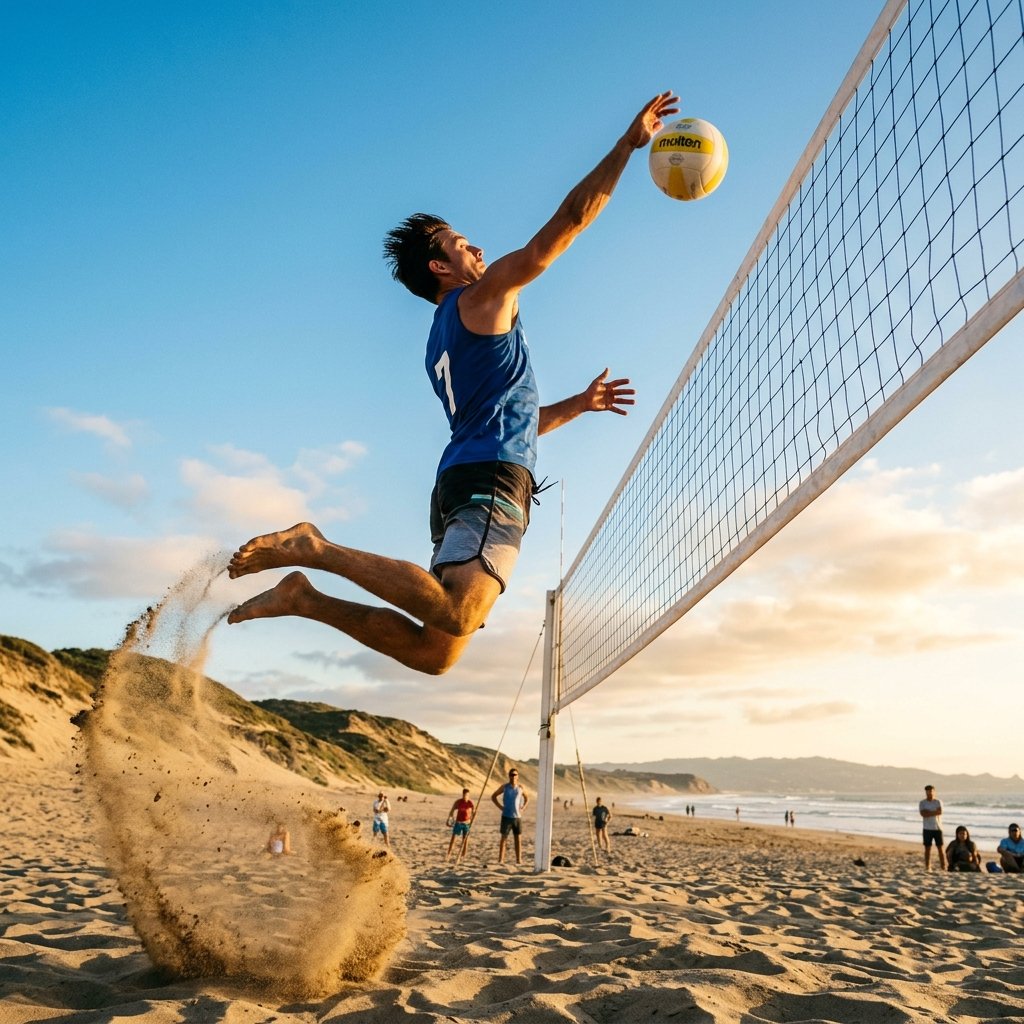
The throwing motion the biomechanics literature describes is a sequenced kinetic-chain action. Wind-up: weight shifts to the back leg, trunk rotates away from the target. Stride: the front leg steps toward the target, ground reaction force loads the back leg. Cocking phase: trunk and shoulder rotate, the throwing arm is brought up and back into the high-cocked position. Acceleration: trunk rotates forward toward the target, the shoulder internally rotates, the elbow extends, the wrist snaps the ball out. Follow-through: the throwing arm decelerates across the body, the back leg comes through.
Kibler 1998’s seminal work on the kinetic chain found that in overhead motions like the tennis serve, roughly 54% of total force is generated by the legs, hips, and trunk versus about 25% from the elbow and wrist — the shoulder functions more as a transmission link that regulates the energy than as a prime force generator (Kibler 1998 Kibler 1998). Davis 2009’s biomechanical analysis of youth pitchers supports the same principle from a different angle: pitchers who correctly executed the kinetic-chain mechanics — leading with the hips, proper arm and shoulder positioning, stride direction — produced significantly lower humeral internal-rotation torque and elbow valgus load than those who didn’t (Davis 2009 Davis 2009).
The implication for the casual thrower: the throw the body wants to make is a whole-body action. The throw the casual thrower frequently makes — arm-only, with no leg drive or trunk rotation — produces the same ball velocity by overloading the shoulder.
Why throwing volume, not coaching status, drives the risk
It’s tempting to assume casual recreational throwing is inherently safer than organized, coached throwing — but Olsen 2006’s case-control study of adolescent pitchers found that coaching status wasn’t the driver of injury risk at all (Olsen 2006 Olsen 2006). Olsen found no significant association between injury and whether a pitcher received private coaching; the injured group was instead distinguished by volume and fatigue — more months and games pitched per year, more innings and pitches per outing, and higher throwing velocity than the uninjured group.
The same pattern operates on a beach. The casual adult thrower may throw 30–100 times in a 90-minute session, with no warm-up, no technique cueing, no recovery between throws beyond the few seconds it takes the catch partner to return the ball. A 100-throw session at high shoulder load is biomechanically more stressful than a 100-throw bullpen session by a coached pitcher with proper mechanics. The casual thrower’s shoulder is not built to absorb that load.
The honest framing: ‘casual’ refers to the social context, not the biomechanical demand. The shoulder doesn’t know it’s a beach game.
Glenohumeral internal-rotation deficit and the warning sign
Wilk 2009’s work in professional baseball pitchers found that glenohumeral internal-rotation deficit (GIRD) alone was associated with roughly double the injury rate, though that difference wasn’t statistically significant; the measure that did significantly predict injury was a total rotational motion (TROM) deficit greater than 5 degrees compared with the non-throwing shoulder (Wilk 2009 Wilk 2009). GIRD is a loss of internal-rotation range at the shoulder that develops after repeated throwing, due to posterior capsule tightening. The clinical significance: when GIRD exceeds a threshold (typically 18–20° of side-to-side difference), the shoulder is disposed to a chain of events — altered scapular kinematics, supraspinatus pinching, posterior labral wear — that produces the chronic-overuse shoulder pattern.
For the casual beach thrower, this matters in two ways. First: GIRD develops cumulatively across throwing exposures, not just within a single session. A weekly beach football session over a summer can produce measurable GIRD even without an obvious acute injury. Second: GIRD is reversible early but harder to reverse late. The simple sleeper stretch (lying on the throwing-arm side, internally rotating the shoulder against gentle resistance) maintains posterior capsule mobility and prevents the cascade Wilk 2009 documented.
The behavioural cue: shoulder pain after throwing isn’t normal. The casual thrower who notices pain in the days after a beach day should investigate the throwing pattern (and possibly reduce throw volume) rather than assume the pain will pass.
The casual-thrower’s elbow: medial epicondyle stress
Football throwing produces elbow stress in addition to shoulder stress, and the elbow pattern is often the first symptom the casual thrower notices. The medial collateral ligament of the elbow is loaded heavily during the late-cocking and early-acceleration phases of the throw; the medial epicondyle (the bony prominence on the inside of the elbow) is the attachment site for the wrist and finger flexors that work hard during the throw and at ball release. Olsen 2006’s pitching-injury work identified medial-elbow pain as one of the most common acute presentations in youth pitchers, and the same pattern is visible in casual football throwers (Olsen 2006 Olsen 2006).
The mechanism is straightforward. When the kinetic-chain contribution from legs and trunk is reduced, the shoulder compensates with higher rotational velocity; the elbow then has to absorb the resulting valgus load through the medial collateral ligament. Davis 2009 found the load transfer directly: youth pitchers who executed more of five key mechanical checkpoints correctly (leading with the hips, hand-on-top position, arm in throwing position, closed shoulder, stride foot toward home plate) produced significantly lower elbow valgus load and lower humeral internal-rotation torque than those with poorer mechanics (Davis 2009 Davis 2009). The casual thrower’s elbow is taking the bill the casual thrower’s legs and trunk should have paid.
Scapular control: the underused stabiliser
Scapular control is the often-missing piece of casual throwing technique. The scapula (shoulder blade) is the moving base on which the glenohumeral joint operates; it must rotate, tilt, and elevate in coordinated patterns to position the glenoid fossa for the throwing motion. Kibler 1998 identified the scapula as the kinetic-chain link most often disrupted in symptomatic throwers, with consequences that propagate downstream (Kibler 1998 Kibler 1998).
The technical cue: scapular retraction (pulling the shoulder blade back toward the spine) at the start of the cocking phase, followed by upward rotation through the throw. The casual thrower frequently begins the throw with the scapula in protraction (rounded forward) — a pattern that reduces the available shoulder range, increases supraspinatus pinching, and propagates load downstream to the elbow. A simple cue (‘feel like you’re pulling the throwing-side shoulder blade back before the throw’) addresses the most common version of the problem.
Davis 2009’s kinetic-chain review noted that scapular-control training is one of the most cost-effective interventions in throwing-injury prevention — small technique changes producing disproportionately large reductions in downstream injury (Davis 2009 Davis 2009). The same arithmetic applies on the beach.
Warm-up and volume limits for the beach session
The throwing-injury literature converges on a consistent prescription. Warm up with low-velocity throws — 5–10 throws at 30–50% effort — before any high-velocity throwing. Limit total throw volume per session: for casual adult throwers without trained mechanics, 30–50 throws per session is the safer range, with 100+ throw sessions reserved for trained throwers with appropriate recovery between sessions. Allow 48 hours between throwing sessions to permit shoulder recovery; if pain persists, extend the gap.
The volume limits feel restrictive in a beach context where families plan to play for hours. The honest framing: the throw-and-catch game can continue for hours if the throws are short, low-velocity, and varied (some lobs, some side-arm, some wrong-handed for the dominant thrower). The shoulder load that produces injury is the high-velocity over-the-top spiral, not the gentle lob — managing the mix is the practical lever.
Wilk 2009’s broader recommendation for overhead athletes applies here as well: the sleeper stretch and basic scapular-control exercises (band pull-aparts, prone Y-T-W) take 5–10 minutes per day and meaningfully reduce the GIRD-and-overuse risk (Wilk 2009 Wilk 2009). For the casual thrower who plays through a beach summer, the prophylactic exercise is a high-leverage investment.
What technique cannot fix
The honest framing. Technique covers most of the avoidable shoulder and elbow load — perhaps a 30–50% reduction in joint stress at any given throw velocity, based on the kinetic-chain quantifications Davis 2009 and Kibler 1998 provide (Davis 2009 Davis 2009; Kibler 1998 Kibler 1998). It does not eliminate the load; high-velocity throwing is inherently demanding. Volume management is the second half of the equation. The casual thrower who throws for hours every weekend with perfect technique is still accumulating cumulative shoulder load that will eventually produce the GIRD-and-overuse pattern Wilk 2009 documented (Wilk 2009 Wilk 2009).
The case for the technique conversation is twofold. First: most casual throwers can substantially improve their kinetic-chain mechanics with 5 minutes of attention to leg drive and trunk rotation, with immediate reduction in shoulder strain. Second: the warning signs (medial-elbow soreness, persistent shoulder ache, loss of internal-rotation range) are visible early and reversible early; the casual thrower who notices and responds avoids the chronic-overuse pattern that becomes harder to address later. The throw-and-catch game on the beach can be a healthy multi-decade pastime — if the kinetic-chain biomechanics get the small amount of attention the literature has been clear they need.
Practical takeaways
- A football throw is a kinetic-chain action; Kibler 1998 found the legs, hips, and trunk generate roughly 54% of total force in overhead motions like the tennis serve. Arm-only throwing overloads the shoulder.
- Olsen 2006 found injury risk tracked throwing volume and fatigue, not coaching status — unmanaged volume, not being ‘uncoached,’ is the real risk factor.
- Wilk 2009 found a total rotational motion deficit >5° — not GIRD alone — was the statistically significant predictor of overuse shoulder injury; the sleeper stretch helps maintain both.
- The casual-thrower’s elbow (medial epicondyle pain) is often the first symptom; it reflects valgus overload from poor kinetic-chain function (Davis 2009).
- Scapular retraction at start of cocking phase is the highest-leverage single technique cue for protecting the rotator cuff (Kibler 1998).
- Volume limits matter: 30–50 high-velocity throws per session for casual adult throwers, 48 hours between sessions for recovery.
- Mix throw types (lobs, side-arm, wrong-handed) to extend playtime without accumulating high-velocity load.
Frequently asked questions
Is throwing a football really a shoulder-injury risk?
For casual high-volume throwers, injury risk is real, but Olsen 2006's case-control study of adolescent pitchers found it tracked throwing volume and fatigue, not coaching status: the injured group pitched significantly more months per year, more games, more innings and pitches per outing, and threw harder than the uninjured group, while private coaching showed no significant association with injury either way.
What is the single most useful technique cue?
Use the legs and trunk. Kibler 1998's kinetic-chain research on overhead motions like the tennis serve found that roughly 54% of total force comes from the legs, hips, and trunk, versus about 25% from the elbow and wrist - the shoulder is more a transmission link than a prime force generator; arm-only throwing overloads the shoulder. The cue: step toward the target, rotate the trunk, let the arm follow.
Why does my elbow hurt before my shoulder does?
Medial-elbow pain is often the first symptom of poor kinetic-chain mechanics. When the legs and trunk underperform, the shoulder rotates faster to maintain throw velocity, and the elbow has to absorb the resulting valgus load through the medial collateral ligament. Davis 2009 found that youth pitchers who executed more of five key mechanical checkpoints correctly had significantly lower elbow valgus load and humeral internal-rotation torque than those with poorer mechanics.
What is the sleeper stretch and why should I do it?
The sleeper stretch (lying on the throwing-arm side, gently internally rotating the shoulder) maintains posterior capsule mobility and helps limit glenohumeral internal-rotation deficit (GIRD). Wilk 2009 found GIRD alone wasn't a statistically significant injury predictor, but a total rotational motion deficit greater than 5 degrees was; the stretch takes 30-60 seconds and helps address both.
How many throws is too many in one beach session?
For casual adult throwers without trained mechanics, 30-50 high-velocity throws per session is the safer range. Total throw count can be higher if the throws are mixed (lobs, side-arm, wrong-handed) and the high-velocity over-the-top spiral is reserved for a smaller subset.
References
[1]Wilk KE, Macrina LC, Fleisig GS, et al. Correlation of glenohumeral internal rotation deficit and total rotational motion to shoulder injuries in professional baseball pitchers. American Journal of Sports Medicine. 2009;39(2):329-335. View source →[2]Davis JT, Limpisvasti O, Fluhme D, et al. The effect of pitching biomechanics on the upper extremity in youth and adolescent baseball pitchers. The American Journal of Sports Medicine. 2009;37(8):1484-1491. View source →[3]Olsen SJ, Fleisig GS, Dun S, Loftice J, Andrews JR. Risk factors for shoulder and elbow injuries in adolescent baseball pitchers. American Journal of Sports Medicine. 2006;34(6):905-912. View source →[4]Kibler WB. The role of the scapula in athletic shoulder function. American Journal of Sports Medicine. 1998;26(2):325-337. View source →