The 60-second version
If you sleep badly and your first instinct is to reach for melatonin or magnesium, the best-evidenced fix may cost nothing and have no side effects: a regular walk. A June 2026 meta-analysis of 21 randomised controlled trials (1,707 adults) found that a walking programme produced a medium-to-large improvement in self-reported sleep quality (Hedges’ g = −0.76) — and the people who slept worst to begin with improved the most Kong et al. 2026. The sweet spot was unglamorous and achievable: moderate walking, 3–5 times a week, 30–60 minutes a session, for about 12–24 weeks. Two honest caveats: the studies measured how people rated their sleep (questionnaires), not lab sleep recordings, and a walking habit is a general sleep-quality lever — not a treatment for diagnosed insomnia or sleep apnea. Within those limits, the message is refreshingly simple: before you buy anything, try walking.
Educational journalism, not medical advice. Every claim here is checked against its cited sources by editor Timothy Bunce — a health writer, not a physician. It isn’t specific to your situation: for health decisions, talk to your own clinician. How we work →
Some links in this article are affiliate links. If you buy through one, The Beachside Reader earns a commission at no extra cost to you. It never changes which products we pick, or what we say about them. Full affiliate disclosure →
What the 2026 analysis actually found
Published on 15 June 2026 in Frontiers in Public Health, the review pooled 21 randomised controlled trials — 888 people assigned to a walking programme and 819 controls — yielding 66 separate effect estimates Kong et al. 2026. Across them, walking improved subjective sleep quality with a pooled Hedges’ g of −0.76 (95% credible interval −0.99 to −0.55). In plain terms, that is a medium-to-large effect — bigger than many people expect from “just walking,” and in the same ballpark as some behavioural sleep interventions.
The authors used a Bayesian approach, which lets them put a number on how convincing the evidence is rather than leaning on a single p-value. The result was about as strong as this kind of analysis gets: a Bayes factor of roughly 8 × 10⁵ in favour of a real benefit, which statisticians label “extreme” evidence Kong et al. 2026. They also estimated a 99.97% probability that the effect is large enough to actually matter to a person, not just to a spreadsheet.
The most useful finding for real life is the moderator analysis. Baseline sleep quality was the strongest predictor of how much someone improved: the worse you sleep now, the more a walking habit appears to help Kong et al. 2026. If your sleep is already good, do not expect a walk to make it dramatically better. If it is poor, this is exactly the group the data is most encouraging about.
“Subjective” sleep — why a questionnaire still counts
Here is the caveat we will not bury: the trials measured sleep with questionnaires, chiefly the Pittsburgh Sleep Quality Index (PSQI), not with overnight brain-wave recordings (polysomnography) Kong et al. 2026. The PSQI is a validated 19-item self-report covering things like how long you take to fall asleep, how often you wake, and how rested you feel; a global score above 5 flags someone as a “poor sleeper” with good accuracy Buysse et al. 1989.
Does “subjective” mean it does not count? No — but it changes what we can claim. How you experience your sleep is the thing you actually care about, and it tracks closely with daytime mood and function. What questionnaires cannot tell us is whether walking changes the architecture of sleep — the amount of deep or REM sleep measured in a lab. So the honest summary is: walking reliably makes people feel they sleep better, the effect is sizeable, but we should not over-claim that it re-engineers your sleep stages.
It also helps to put a “medium-to-large” effect in human terms. An effect of that size is the kind of change a person tends to notice — falling asleep a little faster, waking less, and feeling more rested — rather than a subtle shift only a statistician would spot. It is not, however, a guarantee for any one individual: a meta-analysis describes the average across many people and many trials, and responses vary. Treat the number as a strong reason to try, not a promise of a specific result.
How a walk helps you sleep
Several plausible mechanisms point the same direction. The classic one is body temperature: exercise raises your core temperature, and the gradual fall afterwards mirrors the natural temperature dip that helps trigger sleep onset. There is also a deep-sleep signal — one controlled study found that exercise increased the stability of slow-wave (deep) sleep, the most physically restorative stage Park et al. 2021.
Just as important is what walking does to the wired-up, can’t-switch-off feeling that keeps many people awake. Regular activity lowers physiological and psychological hyperarousal and anxiety, which is one reason exercise is considered an effective non-drug option for disturbed sleep Kline 2014. And if your walk is outdoors in daylight, you get a bonus: bright light and physical activity each nudge the circadian clock, and morning light in particular helps anchor the timing of sleep Youngstedt et al. 2016. A morning or early-evening outdoor walk stacks two sleep-friendly signals into one free habit. (For more on the light side of this, see our piece on sunrise walks and the circadian clock.)
One nuance worth keeping: this relationship runs both ways. Poor sleep makes the next day’s walk less likely, which can become a downward spiral — so the most reliable results come from a routine, not a one-off heroic effort Kline 2014.
The dose that worked
The meta-analysis’s dose–response modelling landed on a practical target: 3 to 5 walking sessions a week, 30 to 60 minutes each, sustained for 12 to 24 weeks Kong et al. 2026. That lines up neatly with mainstream physical-activity guidance — roughly 150 minutes of moderate activity a week, which is about 30 minutes most days Sleep Foundation. The American Academy of Sleep Medicine puts it bluntly: across very large surveys, regular exercisers report markedly fewer sleep problems, and “some exercise is almost always better than none” AASM.
“Moderate” means a brisk pace where you can still talk but not sing. You do not need to jog, buy a tracker, or hit a step target — the trials that produced these results used ordinary walking. The one thing the evidence is clear about is consistency over weeks: the benefit built up over a 12-to-24-week horizon, so judging a walking habit after three nights is judging it before it has done anything.
Before you buy melatonin, magnesium, or a sleep gadget, the best-evidenced first step is free, portable, and good for the rest of you too.
Can you walk in the evening?
A common worry is that exercising at night wrecks sleep. The most rigorous data to date — a 2025 analysis of about 14,700 people across roughly four million nights — found that the problem is specifically strenuous exercise close to bedtime, not gentle movement Leota et al. 2025. Hard sessions ending within about four hours of sleep pushed sleep onset later and shortened sleep, in a dose-dependent way. The practical rule the authors suggest is to finish vigorous exercise at least four hours before bed.
The reassuring flip side: an easy or moderate evening walk is not the kind of high-intensity bout that triggered those problems. A relaxed after-dinner stroll is a reasonable wind-down for most people — just keep it gentle, and if you personally notice that any evening activity leaves you wired, shift it earlier. As always, individual response varies.
Where walking is not the answer
This is the line we will not cross. A walking habit is a sleep-quality and sleep-hygiene lever for the general population. It is not a treatment for a diagnosed sleep disorder.
For chronic insomnia, the first-line treatment recommended by the American College of Physicians is cognitive behavioural therapy for insomnia (CBT-I), not exercise and not a supplement ACP 2016. Walking can be a healthy add-on, but if you have months of trouble falling or staying asleep that is hurting your days, ask a clinician about CBT-I. For sleep apnea — loud snoring, gasping, or witnessed pauses in breathing — the issue is anatomical and respiratory; it needs diagnosis and treatment (often CPAP), and no amount of walking substitutes for that. If those symptoms sound familiar, see your doctor rather than self-managing with a fitness habit.
Practical takeaways
Pulling the evidence together into something you can start this week:
- Aim for 3–5 walks a week, 30–60 minutes, at a brisk-but-talkable pace — the dose tied to the biggest sleep gains Kong et al. 2026.
- Walk outdoors in daylight when you can to add a circadian-timing benefit on top of the activity Youngstedt et al. 2016.
- Give it weeks, not nights. The benefit accrued over 12–24 weeks; treat it as a habit, not a quick fix.
- Keep evening walks easy. Save any vigorous training for at least four hours before bed; gentle walking is fine later Leota et al. 2025.
- Expect the most if you currently sleep poorly — that is the group the data favours most Kong et al. 2026.
- Know the limits. Persistent insomnia → ask about CBT-I ACP 2016; suspected sleep apnea → see a clinician.
None of this replaces the basics of good sleep, and it will not out-perform medical care for a real disorder. But as a first move — free, portable, side-effect-free, and good for your heart, mood, and metabolism at the same time — a regular walk is about as well-supported a sleep tip as you will find. Reach for your shoes before the supplement aisle.
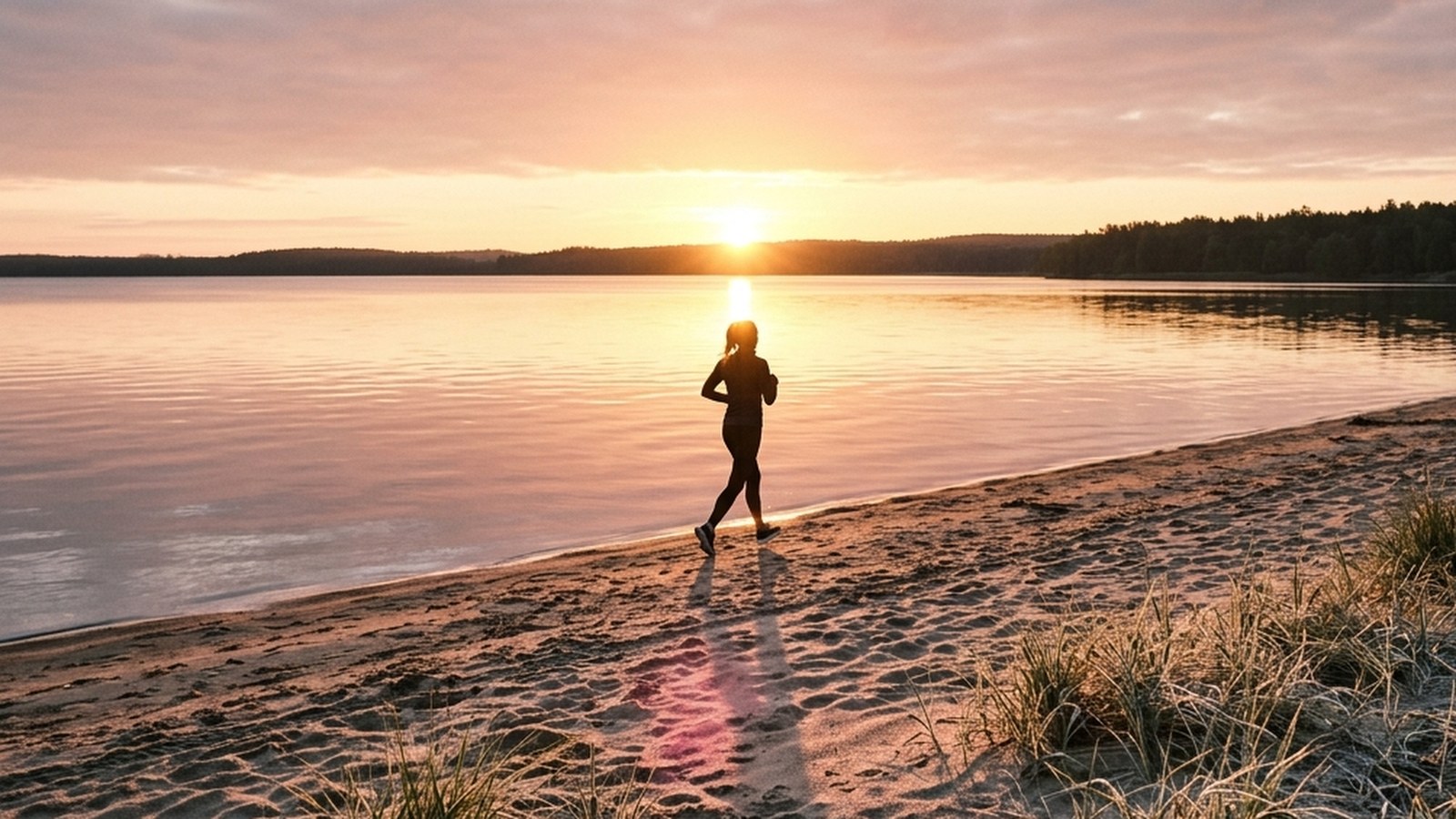
Hero photograph: an evening walk along the shore. Photo: Bulaclac Paruparu / Wikimedia Commons (CC BY 2.0).
Frequently asked questions
How much walking improves sleep?
In a 2026 meta-analysis of 21 trials, the sweet spot was moderate walking 3 to 5 times a week, 30 to 60 minutes a session, kept up for about 12 to 24 weeks. That overlaps with the general guideline of ~150 minutes of moderate activity a week.
How long until walking helps me sleep better?
Think weeks, not nights. The trials measured benefits over a 12-to-24-week period, so a walking habit is best judged after a couple of months of consistency, not after a few days.
Is it bad to walk in the evening before bed?
A gentle or moderate evening walk is fine for most people. The evidence that night exercise disrupts sleep applies mainly to strenuous, vigorous sessions within about four hours of bedtime, not to easy walking. If any evening activity leaves you wired, shift it earlier.
Can walking cure insomnia or sleep apnea?
No. Walking improves general, self-reported sleep quality, but it is not a treatment for a diagnosed disorder. Chronic insomnia is best treated with CBT-I (cognitive behavioural therapy for insomnia), and sleep apnea needs medical diagnosis and treatment. See a clinician if you have persistent symptoms.
References
Kong et al. 2026Kong X, Wang X, Li Z, Li X. “Walking and subjective sleep quality in adults: a Bayesian three-level meta-analysis with probabilistic clinical relevance assessment and dose–response modeling.” Frontiers in Public Health. Published 15 June 2026. DOI: 10.3389/fpubh.2026.1864607. View source →Kline 2014Kline CE. “The Bidirectional Relationship Between Exercise and Sleep: Implications for Exercise Adherence and Sleep Improvement.” American Journal of Lifestyle Medicine. 2014;8(6):375–379. DOI: 10.1177/1559827614544437. View source →AASMAmerican Academy of Sleep Medicine. “5 surprising facts about exercise and sleep.” aasm.org (research notes). View source →Sleep FoundationSleep Foundation. “How Can Exercise Affect Sleep?” (reviewed guidance on moderate activity, ~150 min/week, and sleep). View source →Park et al. 2021Park I, et al. “Exercise improves the quality of slow-wave sleep by increasing slow-wave stability.” Scientific Reports. 2021. View source →Youngstedt et al. 2016Youngstedt SD, et al. “Circadian Phase-Shifting Effects of Bright Light, Exercise, and Bright Light + Exercise.” Journal of Circadian Rhythms. 2016. View source →Leota et al. 2025Leota J, et al. “Dose-response relationship between evening exercise and sleep.” Nature Communications. 2025. DOI: 10.1038/s41467-025-58271-x. View source →Buysse et al. 1989Buysse DJ, Reynolds CF, Monk TH, Berman SR, Kupfer DJ. “The Pittsburgh Sleep Quality Index: a new instrument for psychiatric practice and research.” Psychiatry Research. 1989;28(2):193–213. View source →ACP 2016Qaseem A, et al. “Management of Chronic Insomnia Disorder in Adults: A Clinical Practice Guideline From the American College of Physicians.” Annals of Internal Medicine. 2016;165(2):125–133. DOI: 10.7326/M15-2175. View source →