The 60-second version
Stand-Up Paddleboarding (SUP) in Wasaga Beach is more than a recreational pastime; it is a high-fidelity stability lab for the core and posterior chain. By leveraging the dynamic surface of Georgian Bay, local athletes can develop a level of functional balance that pavement-based training cannot replicate. This guide analyzes the metabolic cost of SUP (based on Schram 2016), details the "Wasaga Stand" technique for managing shoreline chop, and provides an 8-week progression for transitioning from leisure paddling to high-intensity core conditioning. Whether you are traversing the Beach Area 1–6 shoreline or navigating the Nottawasaga river mouth, SUP is the ultimate tool for "invisible" core strength and injury prevention.
Educational journalism, not medical advice. Every claim here is checked against its cited sources by editor Timothy Bunce — a health writer, not a physician. It isn’t specific to your situation: for health decisions, talk to your own clinician. How we work →
Some links in this article are affiliate links. If you buy through one, The Beachside Reader earns a commission at no extra cost to you. It never changes which products we pick, or what we say about them. Full affiliate disclosure →
The Bay as a Balance Board: The SUP Stimulus
Most gym-based "balance" exercises utilize unstable surfaces like Bosu balls or foam pads. While useful, these tools lack the dynamic, multi-planar resistance of open water. In Wasaga Beach, the shallow shelf of the Georgian Bay shoreline creates a unique set of "micro-oscillations" in the water surface. For a paddleboarder, these oscillations demand near-continuous low-level work from the trunk muscles to maintain equilibrium. Worth noting: the same six-week study that measured clear gains in core strength found no significant change in static or dynamic balance (Schram 2016), so treat SUP as trunk-strength work rather than a balance cure.
This "continuous correction" is what makes SUP an exceptional tool for local athletes. It builds the trunk strength that carries over to the rest of your training, from the soft sand of the beach to the hard pavement of the town’s trail network.
Biomechanics of the "Wasaga Stand"
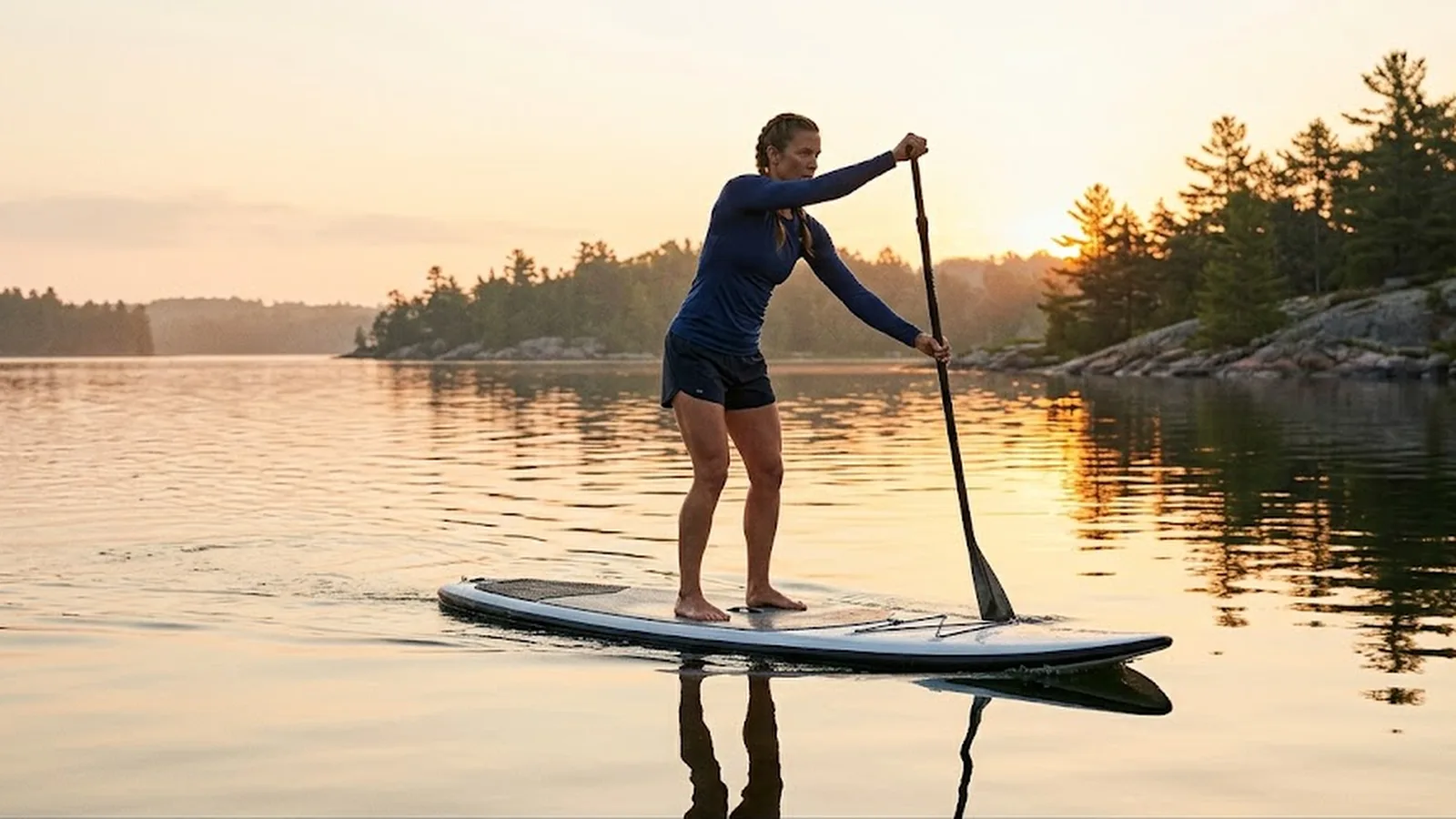
Standing on a board in the Bay is fundamentally different from standing on a river. The "Wasaga Stand" involves a specific postural alignment designed to absorb shoreline chop:
- The Athletic Ready Position: Feet are shoulder-width apart, parallel, and centered on the board’s handle. Knees are "soft" (not locked), acting as shock absorbers for the waves.
- The Tripod Effect: The paddle acts as the third leg of a tripod. When the blade is in the water, you have a secondary point of stability. This is why technique is most vulnerable *between* strokes.
- The Eye-Line: Looking at the board is a recipe for a swim. By keeping the gaze 20 metres ahead on the horizon (or the Blue Mountains in the distance), you leverage the vestibular system’s natural balance cues.
The Technical Stroke: Power from the Core
Paddling is a pulling motion that should originate in the large muscles of the torso rather than the arms. Six weeks of regular paddling measurably improved multidirectional core strength in previously untrained participants (Schram 2016). The arms should remain relatively straight, acting as "struts" that transfer the force from the water to the core.
- The Catch: Spear the blade into the water as far forward as possible without lunging.
- The Power Phase: Push down on the top handle and pull the board past the paddle using the lats and obliques.
- The Release: Exit the water at the feet. Dragging the paddle further back creates a "braking" effect and kills your momentum.
Metabolic Demands: More than a Walk
Casual SUP is often equated to a slow walk, but the data suggests otherwise. In a six-week training study, three one-hour SUP sessions per week improved aerobic fitness by about 24% and anaerobic fitness by about 42% in previously untrained participants (Schram 2016). Energy expenditure varies far too much with wind, chop and pace for a single calorie figure to be meaningful, but the aerobic stimulus is real — and it arrives without the joint loading of running.
Local Route Audit: Beach Area 1 to 6
The 14-kilometre stretch of Beach Area 1 through 6 is a long, uninterrupted paddling corridor. For scale, a national-level SUP marathon race covers a comparable 13.3–13.9 km, and competitors spent 89.3% of that race between 80–100% of age-predicted maximum heart rate, averaging about 169 bpm (Schram 2017). The distance is well within reach of a recreational paddler; paced hard, it is a genuinely demanding aerobic effort. For training purposes, we divide this into three zones:
Zone A: The River Mouth (Dynamic Current)
The area where the Nottawasaga River meets the Bay at Beach Area 1 introduces complex water movement. This is the "Technical Lab" where you can practice cross-current stability and navigating boat wakes.
Zone B: The Mid-Shoreline (Steady State)
Beach Area 3 to 5 offers the most consistent water conditions. This is the "Endurance Corridor," ideal for long, uninterrupted steady-state sessions of 5km or more.
Zone C: The Western Rocks (Navigation)
As you approach Beach Area 6, the bottom profile shifts. This requires more active navigation and shorter, more frequent strokes to maintain course against the prevailing westerly wind.The 8-Week Core Stability Progression
To maximize the fitness benefits of your SUP sessions, follow this structured progression:
| Weeks | Focus | Training Protocol |
|---|---|---|
| 1-2 | Stability Base | 30 min sessions. Focus on "Soft Knee" shock absorption. 1:1 work-to-rest ratio. |
| 3-4 | Rotational Power | 45 min. Incorporate 10 x 30-sec "Power Pulls" focusing on torso rotation. |
| 5-6 | Endurance Build | 60 min continuous. Maintain a stroke cadence of 40-50 strokes per minute. |
| 7-8 | Bay Intervals | 90 min total. 4 x 5-min high-intensity laps (paddling into wind) with 3-min drift recovery. |
Weather and the Wasaga "Fetch"
The distance over which wind blows across water is called "fetch." Georgian Bay has a massive fetch, meaning even a moderate wind can create significant waves. In Wasaga, a Northwest wind (NW) is the most challenging, creating a "quartering sea" that hits the board at a 45-degree angle. Always check the local buoy data at the Nottawasaga River mouth before launching. If whitecaps are visible from the shore, move the session into the protected river corridor. The injury data supports that caution: SUP is a low injury-rate activity overall at roughly 1.95 injuries per 1000 hours, but the rate runs from 1.41 per 1000 hours for recreational paddlers to 3.21 for competitive ones, and rough water carries about double the injury risk of flat, sheltered water (Balke 2021). That same survey found flotation and leashes are widely under-used — wear both.
Conclusion: The Ultimate Functional Gym
Paddleboarding in Wasaga Beach is a genuinely useful piece of training. It rewards an upright, engaged torso, it builds measurable trunk strength, and it delivers a real aerobic stimulus without the joint loading of running. It is also an unusually accessible sport: survey data puts the average participant at about 43 years old with a BMI around 26 (Schram 2017b), which is to say ordinary adults, not specialists. Spearing the water at dawn at Beach Area 1 is the most effective way to start your day and your fitness journey.
References
Schram 2016Schram B, Hing W, Climstein M. (2016) The physiological, musculoskeletal and psychological effects of stand up paddle boarding. BMC Sports Sci Med Rehabil. 8:32. View source →Schram 2017Schram BL, Hing WA, Climstein M, Furness JW. (2017) A performance analysis of a stand-up paddle board marathon race. J Strength Cond Res. 31(6):1552-1556. View source →Balke 2021Balke M, Fischer M, Kegler T, Höher J, Balke M. (2021) Injuries and use of safety equipment in stand-up paddle boarding. Orthop J Sports Med. 9(8):23259671211022681. View source →Schram 2017bSchram B, Furness J. (2017) Exploring the utilisation of stand up paddle boarding in Australia. Sports (Basel). 5(3):53. View source →