The 60-second version
The Nottawasaga River's upper stretch, not the river mouth at Wasaga Beach where currents genuinely funnel dangerously, is a real mapped paddling corridor the Nottawasaga Valley Conservation Authority documents in usable sections: Nicolston Dam down to Angus, and Angus onward through the Minesing Wetlands to Edenvale. Used in stages it doubles as legitimate cardio and upper-body training, because sustained paddling is a whole-body aerobic activity that can meet national moderate-intensity exercise guidelines, and calm water is exactly where a new paddler should build that base before ever pointing a bow into the log-jam-choked Minesing stretch. This guide covers the real access points and distances, a sane fitness progression from flatwater to moving current, the gear Transport Canada legally requires you to carry, and the two risks that actually matter here: cold water and log jams, not the imagined ones.
Search "kayaking Wasaga Beach" and most of what comes back points toward the beach itself or the spot where the Nottawasaga empties into Georgian Bay — exactly the wrong place to start if the goal is building fitness rather than getting into trouble. That river mouth carries a real undertow risk that has nothing to do with tides (Georgian Bay is a freshwater lake and doesn’t have them) and everything to do with current squeezing through a narrow channel against lake chop. The upper river, roughly 30 to 50 kilometres inland, is a different body of water entirely: slower, better documented, and treated by the Nottawasaga Valley Conservation Authority (NVCA) as an actual paddling route with named put-ins, not a place to be discovered by accident.
Educational journalism, not medical advice. Every claim here is checked against its cited sources by editor Timothy Bunce — a health writer, not a physician. It isn’t specific to your situation: for health decisions, talk to your own clinician. How we work →
Some links in this article are affiliate links. If you buy through one, The Beachside Reader earns a commission at no extra cost to you. It never changes which products we pick, or what we say about them. Full affiliate disclosure →
Why the upper river, not the mouth
The Nottawasaga is a 121-kilometre river that starts near Alliston and ends at Wasaga Beach, and the NVCA's own canoe route guide is explicit that the useful paddling water is the middle and upper river, not the lake outlet. For a fitness-focused paddler this is good news: the sections between Nicolston and Edenvale are current-driven but not turbulent, they're reachable from Wasaga Beach in under an hour by car, and they let you paddle the same stroke, the same distance, and the same effort level week after week — which is what actually builds a cardio base, versus a one-off scenic float. If you already paddle the bay itself for swim-adjacent training, the safe-exit judgment calls covered in our Georgian Bay swim safety and exit-protocol guide apply just as much at a river mouth as they do off the beach, which is one more reason to keep early-season fitness paddling upstream, away from that channel.
The real access points, Nicolston to Edenvale
Three points anchor the usable upper river, and none of them are secret. Nicolston Dam, off Highway 89 between Cookstown and Alliston, is the upstream put-in; it's a privately run campground with a boat launch (expect a small launch/parking fee, and confirm current rates before you go). From there down to Angus is roughly 32.5 kilometres of moving current with a series of small rapids in the upper section and 25-metre clay-and-sand river bluffs near Essa Centennial Park — current strong enough to reward some paddling experience, but without the log-jam navigation of what comes next. Essa Township's own accessible canoe and kayak launch, which opened in May 2022 beside Angus Community Park at 6 Huron Street, is free to use and makes a natural mid-route exit or a standalone put-in for a shorter loop.
From Angus, the character changes. The next 19 kilometres run through the Minesing Wetlands — a 6,000-hectare, internationally significant wetland complex — to the take-out at Edenvale Conservation Area on Highway 26 (daily and annual NVCA parking passes apply). This stretch is genuinely navigable, but the NVCA is blunt that it carries significant log jams up to a couple hundred metres long that require portaging over slippery banks, and that it is "not suitable for those who have little to no paddling experience." That warning isn't boilerplate: OPP and Springwater Fire responders used a helicopter to pull a family out of the Minesing Wetlands in June 2021 after they ran low on water and cell battery mid-paddle. That's the trip to work toward, not the one to start with.
Build the engine in stages, not one big trip
The mistake most first-time paddlers make on this river is picking the whole Nicolston-to-Edenvale run as a single outing before they know how their shoulders, forearms, and core hold up over multiple hours. A calm-water study of recreational kayakers found that two-thirds had sustained at least one paddling-related injury in the previous year, overwhelmingly shoulder strains from repetitive stroke mechanics, and that fatigue in the final stretch of a session was a specific risk window Isorna-Folgar 2021. The same study found paddlers who stretched regularly reported meaningfully fewer injuries. Translate that into a plan: start with 45- to 60-minute flatwater sessions rather than a multi-hour river descent, treat the first few outings as technique and conditioning work rather than distance goals, and build duration before you add current. Our Zone 2 vs. HIIT breakdown is a useful lens here — the early sessions on this river should live in that easy, conversational effort zone, not an all-out sprint, so you can actually complete them and come back the next week.
A workable progression: weeks one and two, short out-and-back paddles from the Angus launch on the calmer water directly around it, focusing on stroke technique and torso rotation rather than speed. Weeks three and four, extend those sessions to 90 minutes and start incorporating some moving water by paddling upstream against light current and drifting back. Once 90 minutes at a sustained pace feels comfortable and you've paddled with at least one more experienced partner, the Nicolston-to-Angus stretch is a reasonable next step, ideally with a shuttle vehicle staged at the Angus launch. The Angus-to-Edenvale run through Minesing Wetlands should wait until you can navigate a portage around a log jam without it being your first time doing so, and the NVCA's own advice — hire an experienced guide if you don't already have wetlands experience — is worth taking literally rather than as a formality.
Paddling technique and injury prevention
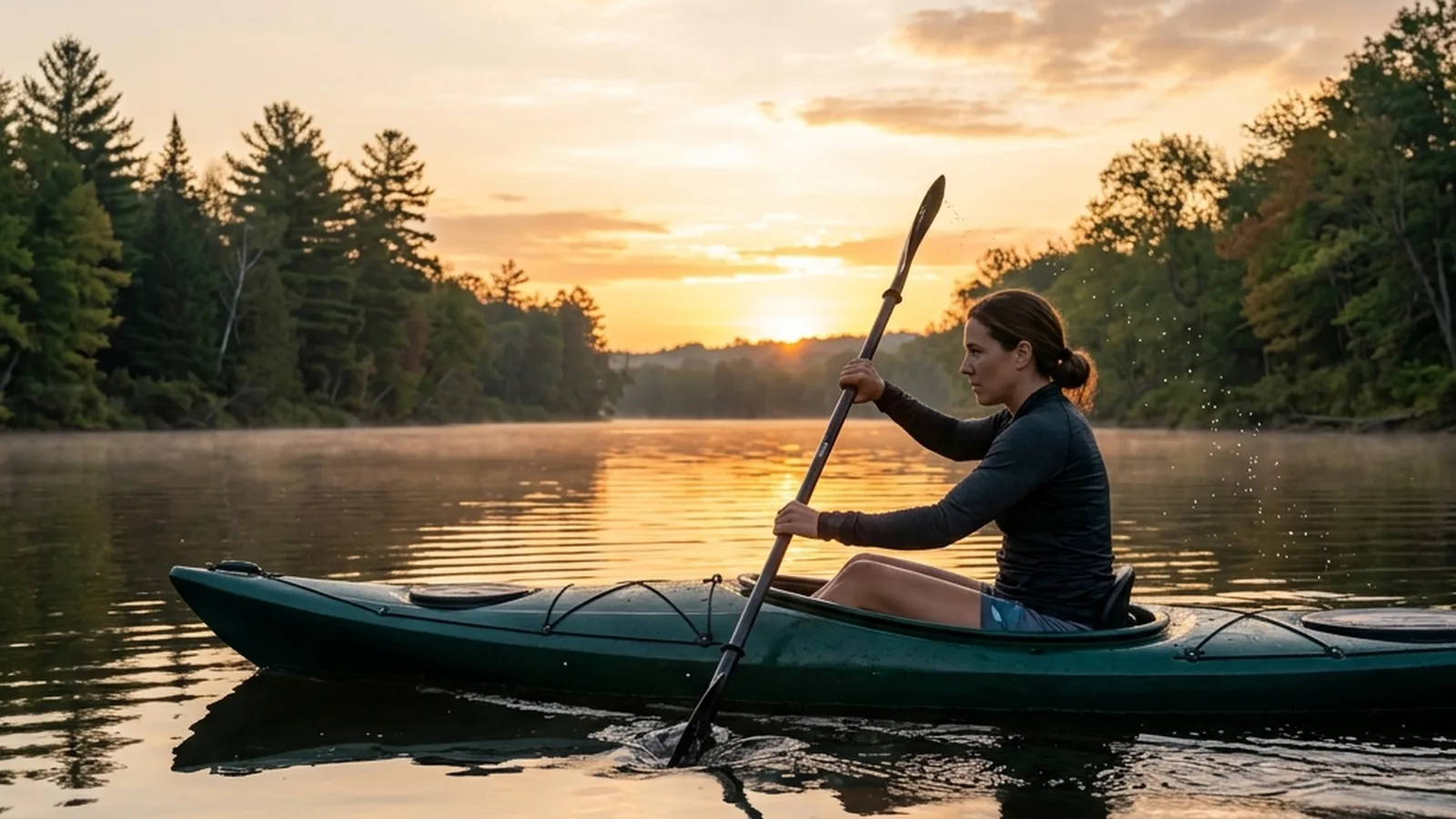
The single biggest technique fix for a new paddler is realizing the stroke isn't an arm exercise. Rotate through the torso — plant the blade near your feet, rotate your shoulders and hips together as you pull, and let your core do the work if your arms are sore after twenty minutes. Arm-only paddling is both less efficient and the more direct path to the shoulder strains that show up so often in the calm-water injury data cited above Isorna-Folgar 2021. A loose, relaxed grip on the shaft rather than a white-knuckle hold, a slightly bent top-arm elbow instead of a locked one, and a blade angle close to vertical at the catch all reduce the repetitive strain that accumulates over a multi-hour session.
Build in rest before you need it, not after: a two-minute pause every 20 to 30 minutes to shake out your forearms and roll your shoulders costs almost nothing in overall pace and measurably reduces the late-session fatigue window where paddling injuries cluster. Take the stretching finding from that same injury study seriously, too — a simple post-paddle routine covering the shoulders, forearms, and lower back, done consistently rather than occasionally, was linked to meaningfully fewer reported injuries in that cohort Isorna-Folgar 2021.
The case for paddling as training
Paddling qualifies as legitimate aerobic exercise, not just a scenic outing that happens to burn some calories. Global physical activity guidelines call for at least 150 to 300 minutes of moderate-intensity aerobic activity a week for adults, and sustained flatwater paddling at a pace where you can still talk in short sentences sits squarely in that moderate-intensity range Bull 2020. What paddling adds that walking and cycling don't is a genuine upper-body and core component — the torso rotation that drives an efficient forward stroke recruits the lats, obliques, and forearms in a way most lower-body cardio never touches, which is part of why it pairs well as cross-training alongside the walking-based routines in our beach walking versus treadmill guide. There's a mental-health case too: time spent exercising in natural, green or blue-space settings has been associated with measurably larger mood and self-esteem benefits than the same exercise done indoors, with the largest measured gains appearing after as little as five minutes outdoors Barton 2010 — and the Minesing Wetlands, once you're experienced enough to be there, is about as green-space as this region gets.
Gear, PFDs, and cold-water rules before you launch
None of this is optional and none of it is complicated. Transport Canada requires every canoe and kayak to carry, per person, a Canadian-approved personal flotation device or lifejacket sized correctly for the wearer, plus a buoyant heaving line at least 15 metres long, a bailer or manual pump, and a sound-signalling device such as a whistle; a watertight flashlight is required if you're on the water near dawn, dusk, or after dark Transport Canada. Wear the PFD — don't just carry it clipped to the deck — for the entire time you're on moving water, including the calm Angus stretch.
The bigger seasonal hazard on this river isn't the current, it's the water temperature. Georgian Bay's watershed runs cold well into late spring, and sudden immersion in cold water triggers an involuntary gasp-and-hyperventilation reflex known as cold shock that can incapacitate even a strong swimmer in the first minute, independent of how fit or experienced they are Tipton 2017. If you're paddling before the water has properly warmed, dress for immersion, not for the air temperature on shore — the same principle covered in more depth in our cold-water acclimatization guide. Once you're off the water and heading through the Minesing Wetlands trailheads or portage points, the wetland margins are also known tick habitat, so the precautions in our tick prevention guide are worth a read before a Minesing-stretch trip, not after.
Fueling and pacing a longer session
Once a session runs 90 minutes or more, treat it like the sustained aerobic effort it is, not a short errand on the water. Bring more water than feels necessary — a wide-mouth bottle secured to a deck bungee is easy to reach mid-stroke without pausing the session — and start drinking before you're thirsty, since thirst is a lagging signal on a warm afternoon, with wind and sun adding fluid loss you won't necessarily feel over open water. A small, dry-bagged snack you can eat one-handed matters more on the Angus-to-Edenvale stretch, where there's no quick take-out if you bonk partway through the Minesing Wetlands.
Pace conservatively on the outbound leg of any out-and-back trip. It's tempting to paddle hard with fresh arms and a following current, then discover the return leg, against that same current with tired shoulders, takes far longer than the trip out. A simple rule that works on this river: if you can't comfortably hold a conversation at your outbound pace, you're paddling too hard for a multi-hour day — the same conversational-pace threshold that makes paddling count as real moderate-intensity aerobic training in the first place Bull 2020.
Related reading
For the paddling context this route sits inside, our Nottawasaga River SUP launch points guide covers several of the same access points from a stand-up paddleboard angle, useful if you're deciding between craft. If you want the structured training-intensity framework behind the progression above, Zone 2 vs. HIIT explains why easy, sustainable effort builds the aerobic base that later lets you handle a longer or more technical paddle. And if cold water is your main hesitation about an early-season trip, the cold-water acclimatization guide walks through how to build tolerance safely rather than avoiding the river until July.
Frequently asked questions
Do I need paddling experience before trying the upper Nottawasaga?
For the calm water around the Angus launch and the Nicolston-to-Angus stretch, basic paddling competence and a few practice sessions are enough. The Angus-to-Edenvale run through the Minesing Wetlands is different - the NVCA advises against it for anyone with little to no paddling experience, and its log jams require confident portaging over slippery banks.
What's the safest section for a first-time paddler?
The calm water directly around the Essa Township canoe and kayak launch at Angus Community Park. It's free, accessible, and calm enough to focus on stroke technique before you add current, distance, or a shuttle trip.
Is the river mouth at Wasaga Beach a good place to learn to kayak?
No. Where the Nottawasaga meets Georgian Bay, current funnels through a narrow channel against lake chop and creates real undertow risk unrelated to tides (Georgian Bay is freshwater and has none). It is not part of the NVCA's documented upper-river paddling route and is a poor place to build paddling fitness.
What safety gear does Transport Canada require for a canoe or kayak?
Every paddler needs a properly sized, Canadian-approved PFD or lifejacket. The craft itself must also carry a buoyant heaving line of at least 15 metres, a bailer or manual pump, and a sound-signalling device such as a whistle. A watertight flashlight is required if you're paddling near dawn, dusk, or after dark.
When is the water too cold to paddle safely?
Georgian Bay's watershed stays cold well into late spring, and sudden immersion in cold water can trigger a gasp-and-hyperventilation reflex called cold shock, even in strong, fit swimmers. Dress for immersion rather than for the air temperature on shore until the water has properly warmed for the season.
References
Bull 2020Bull FC, Al-Ansari SS, Biddle S, et al. World Health Organization 2020 guidelines on physical activity and sedentary behaviour. British Journal of Sports Medicine. 2020;54(24):1451-1462. View source →Isorna-Folgar 2021Isorna-Folgar M, Leirós-Rodríguez R, Paz-Dobarro R, García-Soidán JL. Injuries Associated with the Practice of Calm Water Kayaking in the Canoeing Modality. Journal of Clinical Medicine. 2021;10(5):902. View source →Tipton 2017Tipton MJ, Collier N, Massey H, Corbett J, Harper M. Cold water immersion: kill or cure? Experimental Physiology. 2017;102(11):1335-1355. View source →Barton 2010Barton J, Pretty J. What is the best dose of nature and green exercise for improving mental health? A multi-study analysis. Environmental Science & Technology. 2010;44(10):3947-3955. View source →Transport CanadaTransport Canada. Operating a Human-Powered Craft. Government of Canada. View source →NVCA Canoe RouteNottawasaga Valley Conservation Authority. Canoeing the Nottawasaga. View source →NVCA SafetyNottawasaga Valley Conservation Authority. Hiking & Paddling Safety. View source →NVCA EdenvaleNottawasaga Valley Conservation Authority. Edenvale Conservation Area. View source →Essa TownshipTownship of Essa. Boat Launch. View source →CollingwoodToday 2021CollingwoodToday. OPP helicopter deployed to rescue paddlers from Minesing Wetlands. June 2021. View source →