The 60-second version
An active adult who wants to build muscle should aim for roughly 1.6 to 2.2 grams of protein per kilogram of body weight, every day — about 110–150 g for most people. A beach day doesn’t need a cooler full of meal-prep; 2–3 portable protein servings will keep you on target.
The number comes from a large 2018 meta-analysis of 49 randomised trials — that’s the dose beyond which extra protein stopped producing additional muscle and strength growth Morton 2018. For a 70 kg adult, 110–150 g a day works out to roughly four chicken breasts — or three eggs plus yogurt plus a fish dinner.
Two extra findings worth knowing:
- Protein keeps you fuller than the same number of calories from carbs or fat Westerterp-Plantenga 2012.
- Spreading the protein across 3–4 meals of 25–30 g works better than dumping it all in dinner Layman 2015.
Watch the sugar trade-off on bars: 18 g protein with 22 g sugar fills you for less time than 18 g protein with 6 g sugar. Same protein, very different staying power.
Educational journalism, not medical advice. Every claim here is checked against its cited sources by editor Timothy Bunce — a health writer, not a physician. It isn’t specific to your situation: for health decisions, talk to your own clinician. How we work →
Some links in this article are affiliate links. If you buy through one, The Beachside Reader earns a commission at no extra cost to you. It never changes which products we pick, or what we say about them. Full affiliate disclosure →
What the protein-target evidence actually shows
Morton’s 2018 systematic review, meta-analysis and meta-regression pooled 49 randomised trials with 1,863 subjects and found that protein supplementation significantly enhanced resistance-training-induced gains in muscle mass, with the dose-response relationship plateauing at about 1.6 g/kg/day (95% CI 1.0–2.2) — intakes above that point produced no further benefit in the pooled data Morton 2018. The effect size on lean mass was modest in absolute terms (a mean difference of about 0.3 kg, 95% CI 0.09–0.52) but reliably positive across the included trials.
Layman 2015 added the per-meal distribution argument. The leucine threshold for maximal muscle-protein-synthesis stimulation is around 2.5–3 g per meal, which corresponds to roughly 25–30 g of high-quality animal protein or 35–40 g of plant blends Layman 2015. A 75 kg (165 lbs) active adult targeting 2 g/kg lands at 150 g daily — readily achievable as 4 feeds of 35–40 g.
The translation for a beach day: if breakfast and dinner cover 60–70 g, the midday and afternoon protein needs to come from portable sources. That’s the practical problem the bar-and-jerky aisle exists to solve, with widely varying success.
The satiety question: why protein is different
Westerterp-Plantenga’s 2012 review of protein’s thermogenic and satiety effects synthesised four decades of feeding-trial data. Per matched calorie, protein produced 20–30% greater post-meal satiety than carbohydrate and 50–100% greater than fat in most studies Westerterp-Plantenga 2012. The mechanism involves both gut peptide signalling (GLP-1, peptide YY) and a higher thermic effect of feeding (20–30% of protein calories burn during digestion vs 5–15% for carb and 0–3% for fat).
For beach days specifically, the satiety advantage matters because food storage is constrained and re-supply may be a 30-minute drive. A 200-calorie protein-forward snack that holds satiety for 3–4 hours is operationally different from a 200-calorie carb-heavy snack that holds for 90 minutes — the latter triggers earlier hunger and the temptation of beach-stand fries.
The catch is that commercial “protein bars” vary wildly. A 200-calorie bar with 20 g protein and 5 g sugar performs near pure-protein satiety. A 250-calorie bar with 12 g protein and 25 g sugar performs close to a candy bar with a protein dusting. The label is the difference, not the marketing.
What protein-bar labels actually show
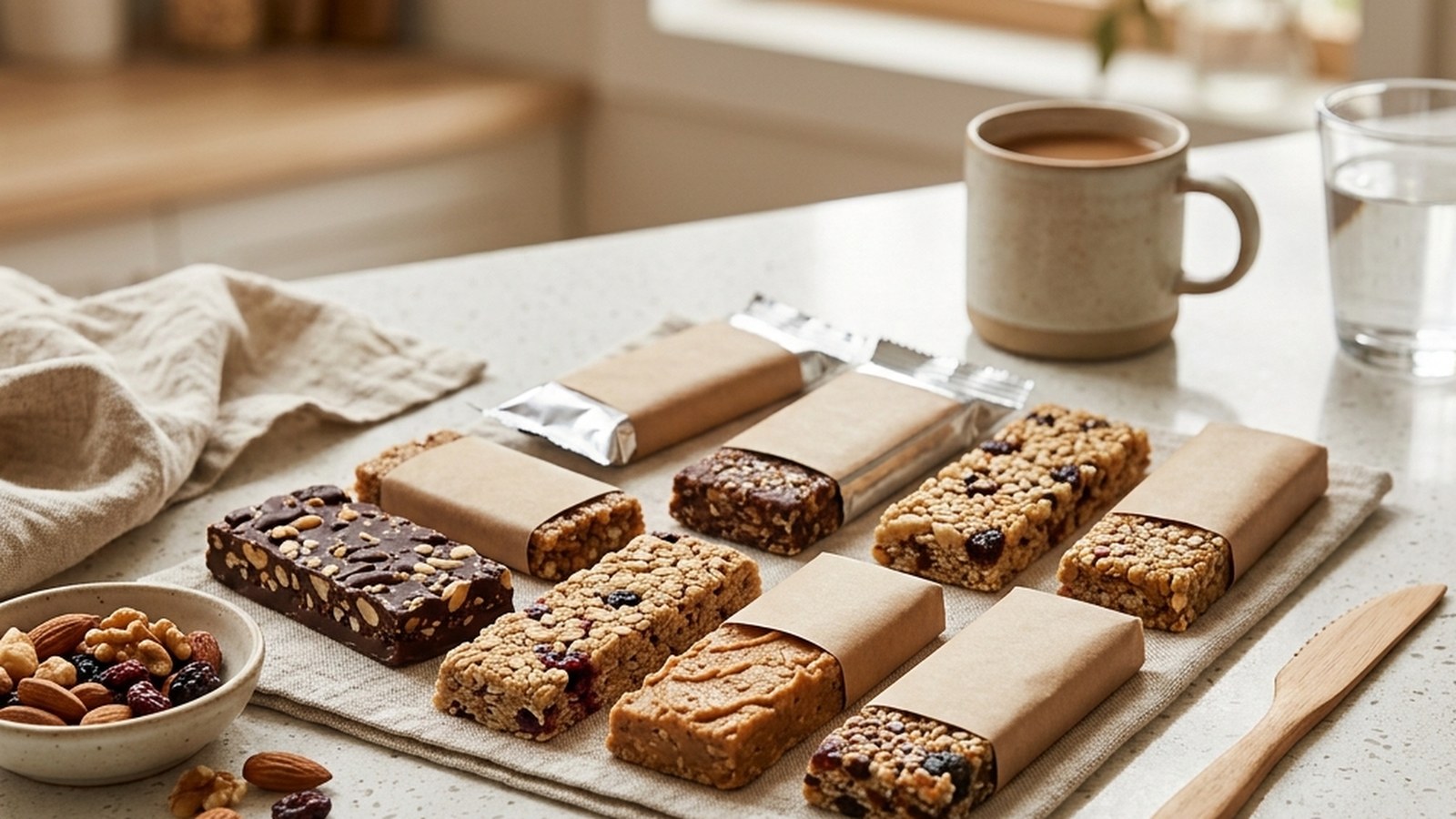
Reading labels across a typical grocery aisle bears out the same pattern already described above: protein density and added-sugar content vary enormously bar to bar, with no reliable link between price or a “protein” front-of-pack claim and actual nutritional quality. A useful working threshold is 12–15 g protein per 100 kcal to count as “genuinely protein-forward” — a meaningful share of shelf bars fall well short of it, and carry enough added sugar to functionally resemble a candy bar with a protein dusting.
The honest read: only a minority of bars on a typical Canadian grocery shelf meet a defensible “portable protein” standard (12+ g protein per 100 kcal, under 10 g sugar, recognisable ingredients). Most sit on a continuum from “sweetened protein-fortified snack” to “chocolate bar with marketing.”
For readers, the practical filter is: turn the bar over, check protein-to-sugar ratio (target 2:1 or better), and check the first three ingredients (whey, milk, or nut should appear; corn syrup, glycerin, or sugar should not lead). Chocolate-coated bars run hotter on the sugar side; nut-based and crisped-rice bars run cleaner.
The jerky question: dense protein, dense sodium
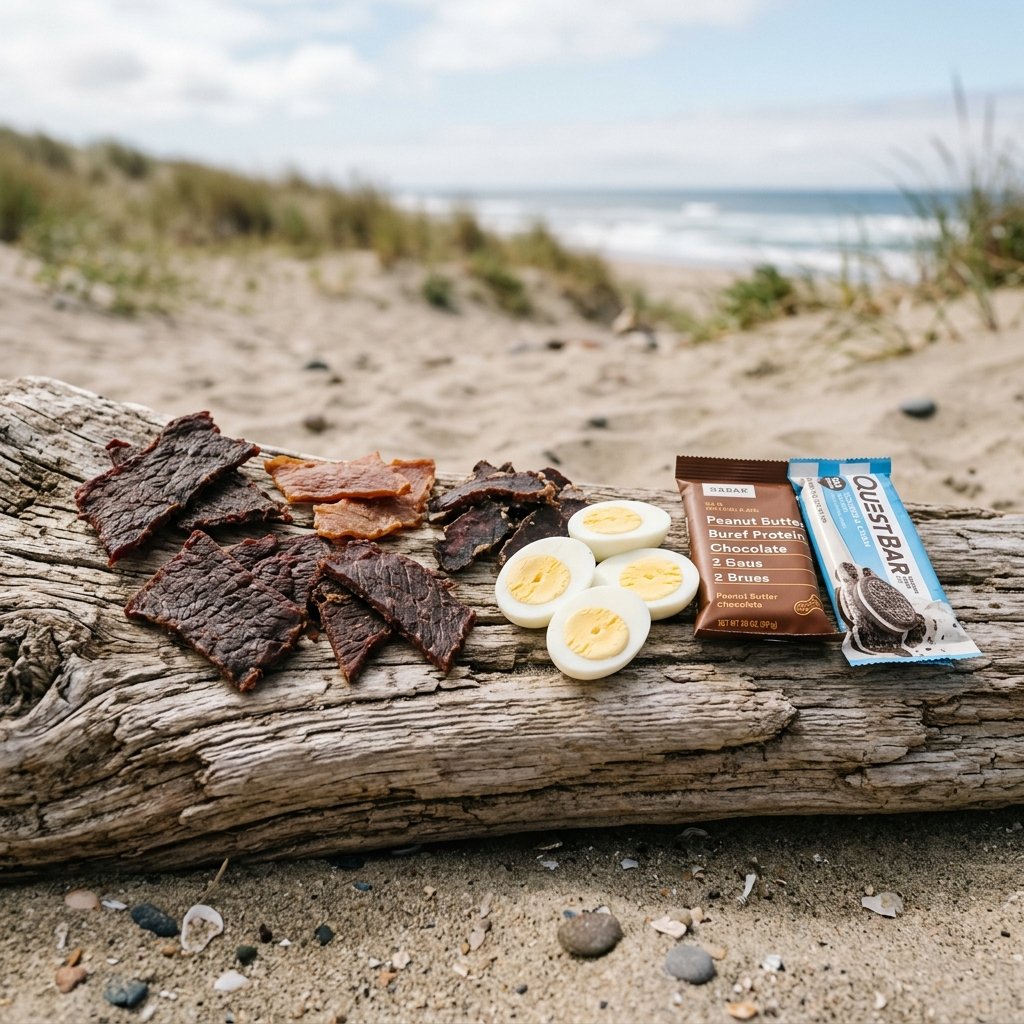
Beef and turkey jerky run 9–13 g protein per 28 g serving with negligible sugar in unsweetened varieties, and tolerate 25°C ambient temperature for 4–6 hours without food-safety concern (vs the 2-hour USDA limit on perishable meats). For beach-day protein density, jerky is the operationally simplest source.
The catch is sodium. A typical 28 g jerky serving carries 350–700 mg sodium — 15–30% of the 2,300 mg daily upper limit Health Canada publishes. For an active adult sweating heavily on a hot beach day, that sodium load is functionally desirable; the article on electrolyte timing covers the same logic. For a sedentary or sodium-restricted reader, the fit is poorer.
Practical filter: pick low-sodium jerky variants (under 350 mg per serving) for sedentary days, regular variants for active sweat-heavy days. Avoid the teriyaki and honey-glazed lines — those re-introduce 8–15 g of sugar that defeats the satiety advantage.
Hard-boiled eggs and cheese: the no-package options
Two hard-boiled eggs deliver 12–14 g protein for about 140 kcal, hold safely in an insulated cooler for 2–3 hours at beach-bag temperatures, and avoid the added-sugar tradeoff entirely. The DIAAS protein-quality score on whole egg sits at 113 — near the top of any food source. They’re messier than a wrapped bar but operationally clean.
String cheese and individually-wrapped cheese sticks deliver 6–8 g protein per serving with similar shelf-life characteristics in a cooler. Calcium load is a bonus; saturated-fat content is the consideration for readers managing cardiovascular markers, though the AHA 2017 advisory noted whole-food dairy isn’t the same risk as added-saturated-fat sources.
For a 6-hour beach day, a credible portable protein pattern is: 2 hard-boiled eggs (mid-morning) + 1 jerky serving (afternoon) + 1 cheese stick (late afternoon). Total: 30–40 g protein across the day-portion, no added sugar, and tested-tolerable in a soft cooler with one ice-pack.
Plant-based portable options: where they hold up
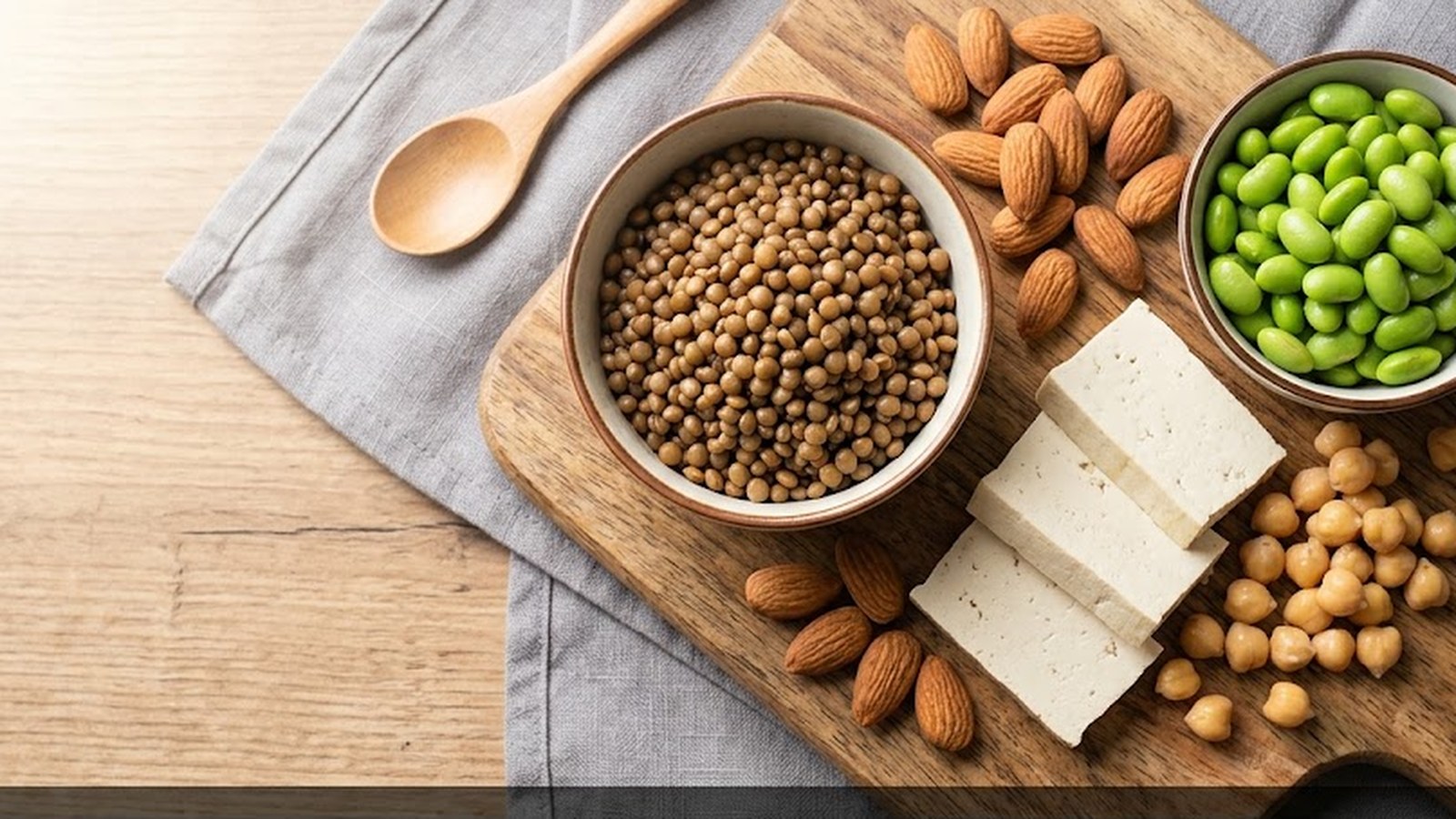
Roasted chickpeas, edamame snacks, and pumpkin seeds carry 8–12 g protein per 30 g serving with the satiety advantage of fibre attached. Pea-protein bars and brown-rice-based bars run 10–15 g protein per 100 kcal, comparable to mid-tier dairy bars. Hevia-Larrain’s 2021 12-week trial showed plant-protein-matched diets produced equivalent muscle and strength gains to whey at matched per-meal protein doses.
The fit issue is that plant-protein bars often add more sugar to compensate for lower amino-acid density — check the same protein-to-sugar ratio (2:1 target). Roasted-chickpea snacks and edamame are typically the cleanest plant-portable options, hitting the satiety target without the added-sugar tradeoff.
The amino-acid completeness consideration matters less for one snack and more for the daily total. If breakfast and dinner are mixed-source (eggs, dairy, meat, fish), the midday plant-protein snack is amino-acid-redundant rather than limiting.
A practical beach-day eating pattern
Combining the Morton 2018 daily target, the Layman 2015 distribution argument, and the Westerterp-Plantenga 2012 satiety framework, a defensible beach-day pattern for a 70–80 kg (176 lbs) active adult is: breakfast 30–40 g (eggs/dairy/oats), 9–10 AM portable protein 1 (bar or jerky, 15–20 g), early-afternoon portable 2 (cheese or eggs, 10–15 g), late-afternoon portable 3 (yogurt cup or another bar, 15–20 g), dinner 30–40 g. Total: 100–135 g protein for the day, distributed across 5 feeds, satisfying the 1.6–2.0 g/kg target and the per-meal leucine threshold.
For lighter activity days — reading on the beach, family supervision, no swim or paddle workout — the same pattern works at the lower end (80–100 g daily). For heavier activity (morning swim, paddleboard session, beach run), push toward the higher end and add a fourth portable feed.
The cooler storage requirement is modest: 4–5 portable items in a 6 L soft cooler with one freezer pack maintains under 4°C for 5–6 hours, which covers the food-safety floor on the perishable items (eggs, cheese, yogurt). Jerky, roasted chickpeas, and most bars are shelf-stable and don’t need the cooler.
Where commercial-bar marketing overreaches
Three claims worth flagging. First, “keto-friendly” on bars labelled with under 5 g net carbs is technically accurate but operationally misleading — many use sugar alcohols (maltitol, erythritol) that produce GI distress in 15–25% of consumers and don’t deliver the satiety advantage of true low-carb food. Second, “clean ingredients” framing without a defined standard is marketing language; the protein-to-sugar ratio and ingredient list are the verifiable signals. Third, the “meal replacement” framing on 250–300 calorie bars is a stretch — full meals in the protein literature deliver 400–600 calories with 30+ g protein, fibre, and meaningful micronutrient content; bars are snacks.
The honest editorial position is that portable-protein products have improved measurably over the last decade. The mid-1990s “protein bar” was effectively a candy bar with a protein dusting; the mid-2020s shelf includes genuinely protein-forward options. Reading labels remains the price of admission — the “protein bar” category as a whole is not what it appears to be.
For Canadian readers, the practical filter is simple: protein density (12+ g per 100 kcal), sugar restraint (under 10 g, ideally under 6 g), recognisable ingredients (whey, milk, nut, oat), no sugar-alcohol GI distress for those susceptible. Apply the filter once at the grocery store; the daily decision becomes routine.
Seasonal context and shelf-stability
Wasaga summer beach temperatures regularly reach 28–32°C ambient with sun-exposed surfaces touching 50°C+. Most commercial protein bars carry “may melt above 25°C” warnings on the chocolate-coated lines, which translates to a misshapen but still-safe product. The food-safety question is for the perishable items in the cooler, not the shelf-stable bars and jerky.
USDA FSIS 2020 sets a 2-hour rule for perishable foods at normal temperatures, tightening to just 1 hour once ambient temperature climbs above 32°C (cheese, eggs, dairy snacks, sliced meats) USDA FSIS 2020. The cooler-engineering article in this series covers the timing math; the practical translation here is that perishable portable proteins want a cooler with one freezer pack, jerky and bars don’t need one.
For winter beach reading or off-season Wasaga shoreline walks, the storage problem inverts — freezing a soft bar to brittle and cold-cracking a hard-boiled egg make some options operationally tough. The shelf-stable jerky and roasted-chickpea options become the dominant pick.
Bottom line: what fits a beach-day eating pattern
The bottom line for active Canadian adults: the protein-target evidence (Morton 2018) and the per-meal distribution argument (Layman 2015) make portable protein a real practical problem on outdoor days. The satiety advantage of protein over carb at matched calories (Westerterp-Plantenga 2012) makes the right portable-protein choice operationally different from a sweetened-snack alternative — not a marginal difference, but a several-hours-of-hunger-resistance difference. Reading the label before buying is what separates a genuinely protein-forward bar from a sweetened snack wearing a protein claim.
Practical translation: pre-build a 2–3 item portable-protein kit (1 bar, 1 jerky pack, 2 hard-boiled eggs in the cooler) sized to 30–50 g protein across the beach-day window. Filter bars by the 12 g per 100 kcal protein-density and 2:1 protein-to-sugar ratio. Carry the cooler-engineering article’s 2-hour-rule awareness for perishable items. The system is unspectacular and works; the alternative is the all-too-common 3 PM low-protein hunger spike that ends in a beach-stand fries decision.
For the editorial honesty layer: this is one piece of a broader nutrition portfolio (sleep, hydration, total daily protein, total daily calories, food quality at home). It is not a transformational intervention — the evidence-supported daily protein target works whether the midday feed comes from a bar or a salmon poke bowl. The beach-day kit is the convenience layer that lets the daily target survive the logistics of a 6-hour outdoor day.
Practical takeaways
- Daily protein target 1.6–2.0 g/kg is the working number. Morton 2018 meta-analysis pooled 49 RCTs and put the best range here for active adults.
- Distribute across 4–5 feeds of 25–30 g. Layman 2015 per-meal leucine-threshold argument: each feed needs ~2.5 g leucine to maximally stimulate muscle-protein synthesis.
- Protein satiety beats carb satiety at matched calories. Westerterp-Plantenga 2012 reviewed the evidence: 20–30% greater satiety per calorie vs carbohydrate.
- Filter bars by 12+ g protein per 100 kcal and 2:1 protein-to-sugar. Reading the label is the only reliable way to tell a genuinely protein-forward bar from a sweetened snack marketed as one.
- A 2–3 item portable kit covers a 6-hour beach day. Bar + jerky + 2 hard-boiled eggs delivers 30–50 g across the outdoor window.
- Soft cooler with 1 freezer pack handles perishable picks. USDA FSIS 2020 2-hour rule applies; the cooler-engineering math covers the timing.
Frequently asked questions
Is a protein bar as good as real food for an active day?
For one snack, yes — if the bar meets the 12+ g protein per 100 kcal density and stays under 10 g sugar. For a daily pattern, real food (eggs, fish, dairy, lean meat) carries fibre and micronutrient density that bars don’t replicate.
How many grams of protein do I really need on a beach day?
1.6–2.0 g/kg (for a 70 kg / 154 lb adult, that's about 140 g)/day is the Morton 2018 evidence-supported range for active adults. For 70–80 kg (176 lbs) that’s 110–160 g, distributed across 4–5 feeds.
Why do some protein bars give me GI distress?
Sugar alcohols (maltitol, erythritol) cause bloating, gas, or diarrhoea in 15–25% of consumers. Switch to bars that use stevia or a small amount of real sugar instead.
Does jerky have too much sodium?
A 28 g serving runs 350–700 mg sodium — a meaningful chunk of the 2,300 mg daily upper limit. For sweat-heavy active days, the sodium load is desirable. For sedentary or sodium-restricted readers, pick low-sodium variants.
Can plant-based bars match whey-based bars?
Hevia-Larrain 2021 found a high-protein vegan diet supplemented with soy protein matched a protein-matched omnivorous diet supplemented with whey for muscle-and-strength outcomes over a 12-week resistance-training program — no pea or rice blend was tested. Plant protein sources in general can match whey when total daily protein is adequate; plant bars often add more sugar, so the protein-to-sugar filter applies the same way.
Do hard-boiled eggs need a cooler on the beach?
Yes — USDA FSIS 2020 recommends perishable food not sit out more than 2 hours at normal temperatures, dropping to just 1 hour once the air temperature is above 32°C. A small soft cooler with one freezer pack covers the timing math for a 6-hour beach day.
Is the ‘keto-friendly’ label meaningful?
Operationally, not very. Many keto-labelled bars use sugar alcohols that don’t deliver the satiety advantage and trigger GI distress. The protein-to-sugar ratio and protein-per-kcal density are the verifiable signals.
References
Phillips 2016Phillips SM. The impact of protein quality on the promotion of resistance exercise-induced changes in muscle mass. Nutrition & Metabolism. 2016;13:64. View source →Morton 2018Morton RW, Murphy KT, McKellar SR, et al. A systematic review, meta-analysis and meta-regression of the effect of protein supplementation on resistance training-induced gains in muscle mass and strength in healthy adults. British Journal of Sports Medicine. 2018;52(6):376-384. View source →Westerterp-Plantenga 2012Westerterp-Plantenga MS, Lemmens SG, Westerterp KR. Dietary protein — its role in satiety, energetics, weight loss and health. British Journal of Nutrition. 2012;108(S2):S105-S112. View source →Layman 2015Layman DK, Anthony TG, Rasmussen BB, et al. Defining meal requirements for protein to optimize metabolic roles of amino acids. American Journal of Clinical Nutrition. 2015;101(6):1330S-1338S. View source →USDA FSIS 2020United States Department of Agriculture, Food Safety and Inspection Service. Keep food safe! Food safety basics. 2020. (Two-hour rule for perishable foods at normal temperatures; tightens to a one-hour rule above 32°C ambient.) View source →Plantenga 2012Westerterp-Plantenga MS, Lemmens SG, Westerterp KR. (2012) Dietary protein - its role in satiety, energetics, weight loss and health. Br J Nutr. 108 Suppl 2:S105-S112. View source →Larrain 2021Hevia-Larrain V, Gualano B, Longobardi I, et al. (2021) High-protein plant-based diet versus a protein-matched omnivorous diet to support resistance training adaptations. Sports Med. 51(6):1317-1330. View source →