The 60-second version
Resistance bands aren’t a poor cousin to free weights — they build strength just as well for almost everything except setting personal-best maximum lifts. They’re also perfect for the beach: they fit in a pocket and don’t care about sand or salt water.
The biggest review of the science (combining many trials) found no real difference in strength gains between band training and traditional weight training across most muscle groups Lopes 2019. Bands actually have a built-in feature: the resistance gets harder as you stretch the band, which matches the way most exercises naturally feel hardest at the top of the movement — and muscle-activation testing confirms bands recruit muscle comparably to weights despite that different resistance profile Aboodarda 2016. An 8-week training trial found bands produced statistically equivalent strength gains to weight machines and free weights across squat, row, and back-extension exercises Colado 2010.
The beach win is concrete: a full kit fits in a backpack pocket, the gear survives sand and salt water better than metal, and the workout quality is genuinely comparable for the roughly 80% of training where you’re not chasing a one-rep max.
Educational journalism, not medical advice. Every claim here is checked against its cited sources by editor Timothy Bunce — a health writer, not a physician. It isn’t specific to your situation: for health decisions, talk to your own clinician. How we work →
Some links in this article are affiliate links. If you buy through one, The Beachside Reader earns a commission at no extra cost to you. It never changes which products we pick, or what we say about them. Full affiliate disclosure →
The strength-equivalence evidence
The question of whether elastic-resistance training produces strength gains comparable to free-weight or machine training was contested for years before the comparative trials accumulated to the point where a clear answer emerged. Lopes and colleagues’ 2019 systematic review in SAGE Open Medicine pooled eight trials comparing elastic-resistance training to conventional resistance training across diverse populations including healthy adults, older adults, and clinical populations Lopes 2019. The pooled effect on strength outcomes — measured across multiple test types (1RM, isokinetic, isometric) and across multiple muscle groups — showed no statistically meaningful (unlikely to be chance) difference between the two modalities.
The clinical interpretation is that for most strength-training applications, bands and free weights produce comparable adaptations. The trials included beginners, intermediates, and a handful of advanced trainees; the equivalence held across experience levels with one exception — absolute maximum-load work (testing 1RM in well-trained powerlifters) is constrained by the maximum tension a band can provide, which falls short of what a barbell can deliver. For the 80 percent of training applications that don’t involve testing the limits of human strength, the equivalence applies.
The applied implication is that the choice between bands and weights is no longer about whether bands ‘work’ for strength — that question has been answered. The choice is between portability, cost, joint-loading characteristics, and the specific exercise selection each modality supports best. For beach training, the portability and environmental-resistance advantages of bands tip the calculus decisively in their favour for most users.
The elastic-tension-curve advantage
The mechanical characteristic that distinguishes band training from constant-load weight training is the ascending tension curve: as an elastic band stretches, the resistance it provides increases — roughly linearly for moderate stretches, with non-linear acceleration at the extremes. Aboodarda and colleagues’ 2016 meta-analysis notes this linear increase in resistance as the reason elastic training’s ability to adequately load muscle had been questioned, then pooled the electromyography evidence and found no significant difference in prime-mover, antagonist, or stabilizer muscle activation between elastic and isoinertial (free-weight) resistance Aboodarda 2016.
This characteristic is not a defect — it is an advantage for many compound exercises. The natural strength curve of a squat, a press, or a row is also ascending: the human body is mechanically weaker at the bottom of these movements (deep knee flexion in the squat, full shoulder flexion in the press) and stronger at the top (near lockout). A constant-load weight challenges the strong portion of the range minimally and the weak portion of the range maximally; a band tracks the body’s strength curve more closely, providing more challenge in the strong range where the body can handle it and less in the weak range where injury risk is higher.
The implication for exercise selection is that movements where the natural strength curve is ascending — squats, presses, rows, pulls — are well-served by band resistance. Movements where the natural strength curve is descending or flat (some isolation work, certain Olympic lift positions) are less well-served. For a beach-gym setup focused on compound movements that train multiple muscle groups simultaneously, the band match is excellent. For an athlete wanting to build maximum lockout strength on a specific lift, bands are a complement rather than a substitute.
Trial confirmation: bands build comparable strength
The Lopes 2019 strength-outcome equivalence raises a practical question: does an elastic-tubing training program actually deliver strength gains as reliably as a conventional weight-machine program, or does the pooled average mask real differences? Colado and colleagues’ 2010 controlled trial in the International Journal of Sports Medicine addressed this directly, randomizing 42 fit young women to an 8-week Thera-Band elastic-tubing program, a weight-machine/free-weight program, or a non-training control group Colado 2010.
Maximum isometric voluntary contraction (tested with a load cell) improved significantly in both training groups across all three exercises, while the control group showed no meaningful change. Gains were statistically indistinguishable between the elastic-tubing and weight-machine groups on the vertical row (19.9% vs 19.8%) and back extension (14.4% vs 14.0%); the weight-machine group edged ahead on the squat (28.9% vs 14.1%). Read exercise by exercise, the pattern still supports the same headline conclusion as the pooled meta-analysis: an elastic-tubing program is a legitimate strength-training tool, not a compromise substitute.
The combined Lopes/Colado evidence makes the practical case clean. A single controlled training trial and a systematic review pooling many others reach the same conclusion: elastic-tubing training builds strength on par with conventional weight training for most applications. The equivalence is not a clever interpretation of mediocre data — it is the consensus reading of a large body of evidence.
The beach-specific environmental advantages
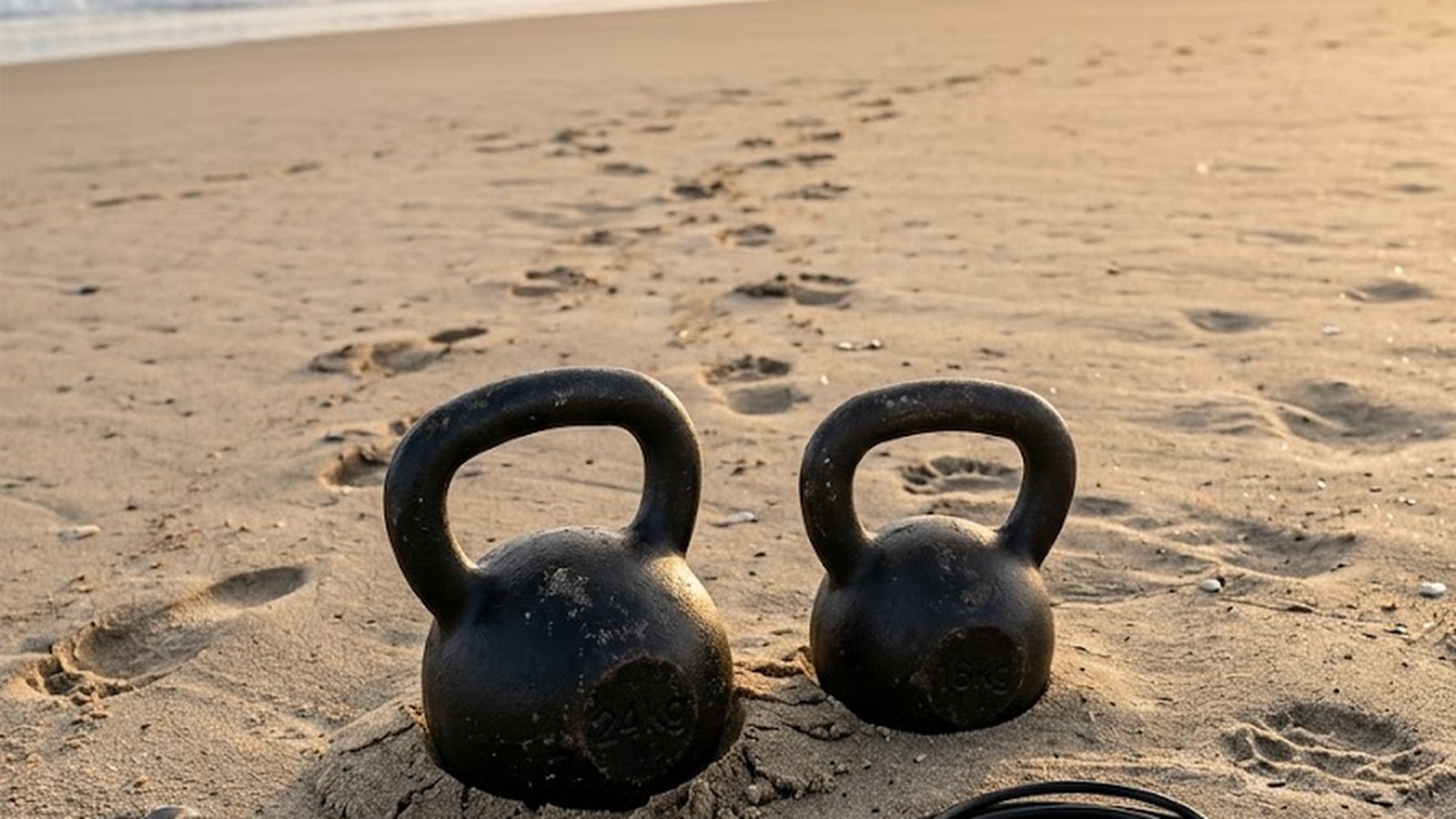
The setup considerations that distinguish a beach gym from a home or commercial gym favour bands strongly. Sand exposure is hostile to metal equipment in three ways: the abrasive effect of sand on bearings and moving parts, the corrosive effect of salt-water aerosol on metal surfaces, and the insertion of sand into screw threads and adjustment mechanisms. Adjustable dumbbells, kettlebells with mechanical handles, and barbell collars all degrade noticeably faster in beach environments than in indoor gyms.
Bands have none of these vulnerabilities. The latex or synthetic-elastomer construction does not corrode, contains no bearings or moving parts, and sand does not stick to the surface in problematic ways. A band kit lives in the same backpack as the rest of the beach kit (sunscreen, water bottle, towel) and weighs perhaps 1-2 pounds for a full set covering 5-50 lb (23 kg) of resistance equivalent. The portability comparison with even a single 25-lb dumbbell is not close.
Anchor-point flexibility is the third beach-specific advantage. Bands can be anchored to fixed points (a tree, a fence post, a deck-railing) for cable-style movements, looped under the foot for press-out work, or held in both hands for symmetric movements. The variability lets a single kit cover the same exercise selection that would require multiple weight implements. For a 45-minute beach workout covering all major movement patterns, a single band kit handles 15-20 exercises without setup overhead.
Material choice: latex vs TPE vs fabric-covered
Three main band-construction families dominate the market, with different beach-survivability profiles. Pure latex bands (the classic flat-loop or tube design) are the cheapest and most common. They have the cleanest tension curve and the longest history of strength-training use. Their weakness is environmental degradation: UV exposure breaks down the latex polymer over months, and salt-water exposure accelerates the process. A latex band used regularly on the beach will typically need replacement after 6-9 months of summer use.
Thermoplastic elastomer (TPE) bands are a synthetic alternative that resists UV and salt better than latex. The tension curves are similar but slightly less linear at extreme stretches. The cost is moderately higher (typically 30-50 percent more than latex). For a once-or-twice-weekly beach user, the durability premium is usually worth paying. For a several-times-weekly beach user, it’s clearly worth paying.
Fabric-covered bands (a fabric sleeve over an internal latex or rubber core) are the most durable beach option. The fabric protects the elastic core from UV and abrasion; the band-on-skin contact is more comfortable than bare latex (which can pinch or grab leg or arm hair). The cost is higher still (roughly double the equivalent latex band). For a frequent beach user or for hip-thrust and squat work where the band sits across bare skin, the fabric-covered upgrade is the sensible choice. For occasional use, latex with planned replacement is fine.
A beach-workout template using band kit only
The 45-minute full-body band workout that covers all major movement patterns is straightforward to construct. Movement pattern one: squat. Stand on a heavy band, hold the loops at shoulder height, perform 3 sets of 10-15 reps. Movement pattern two: hinge. Stand on a heavy band with feet hip-width, hinge at the hips while pulling the band toward the chest (band Romanian deadlift). 3 sets of 10-12. Movement pattern three: vertical push. Anchor the band low (foot or low fixed point), press overhead from shoulder height. 3 sets of 8-12. Movement pattern four: vertical pull. Anchor band high (overhead branch or fixed point), pull down to the chest. 3 sets of 8-12.
Movement pattern five: horizontal push. Anchor band behind the user at chest height, press the loops forward. 3 sets of 10-12. Movement pattern six: horizontal pull. Anchor band in front at chest height, pull the loops back to the chest. 3 sets of 10-12. Movement pattern seven: rotation. Anchor band at chest height, rotate trunk while pulling the band across the body. 3 sets of 8-10 per side. Movement pattern eight: anti-rotation. Anchor band at chest height, hold both hands at the chest and resist trunk rotation. 3 sets of 8-10 per side.
The 8-pattern template covers the full range of human movement (squat, hinge, push and pull in two planes, rotation, anti-rotation) in roughly 45 minutes. Weekly volume of 2-3 sessions of this template approximates the strength-training stimulus that the trial literature treats as effective. For a summer-long programme on the beach, this is enough to maintain or build strength comparably to a gym programme of similar volume — without the equipment overhead and with the additional benefit of being outdoors.
Practical takeaways
- Bands produce strength gains comparable to free weights for most applications. Lopes 2019 meta-analysis of eight trials found no meaningful difference across modalities.
- The ascending tension curve matches the natural strength curve of compound movements. Bands provide more challenge where the body is strong, less where it’s weak.
- A controlled training trial confirms comparable strength gains, not just pooled averages. Colado 2010 found elastic tubing and weight machines produced statistically equivalent isometric-strength gains over 8 weeks.
- Beach environments favour bands strongly: no corrosion, no sand-in-bearings, full kit fits in a backpack. The portability comparison with even a single dumbbell is not close.
- Material choice matters: TPE or fabric-covered for frequent beach use, latex for occasional with planned replacement. Sun and salt break down latex in 6-9 months of summer use.
- An 8-pattern, 45-minute band-only workout covers all major movement patterns. Weekly volume of 2-3 sessions matches gym-equivalent training stimulus.
Frequently asked questions
Do resistance bands actually build strength comparable to dumbbells?
Yes, broadly. Lopes' 2019 systematic review and meta-analysis in SAGE Open Medicine pooled trials comparing elastic-resistance and conventional-resistance training and found no significant difference in strength outcomes across most muscle groups. The bands won on portability and lost on absolute peak load; for most beach-training applications, the equivalence holds.
What's the advantage of bands over dumbbells specifically on a beach?
Three things: portability (a full kit fits in a backpack pocket), sand resistance (no metal corrosion or sand-in-bearings issues), and the ascending tension curve (bands match the strength curve of most exercises better than constant-load weights). The beach-specific advantage is meaningful.
How thick a band do I need?
Most adults benefit from a kit covering roughly 5-50 lb (23 kg) resistance equivalents (light, medium, heavy, extra-heavy). Single bands force compromise; kits with 4-5 different tensions allow appropriate progression for different exercises and over time as strength develops.
Will bands rot from salt and sun?
Latex bands degrade fastest in sun and salt water. TPE (thermoplastic elastomer) and fabric-covered bands are more resistant. For beach use specifically, fabric-covered bands or non-latex synthetic alternatives are worth the small premium.
References
Additional sources reviewed for this article: Mikesky 1994.
Lopes 2019Lopes JSS, Machado AF, Micheletti JK, de Almeida AC, Cavina AP, Pastre CM. Effects of training with elastic resistance versus conventional resistance on muscular strength: a systematic review and meta-analysis. SAGE Open Medicine. 2019;7:2050312119831116. View source →Aboodarda 2016Aboodarda SJ, Page PA, Behm DG. Muscle activation comparisons between elastic and isoinertial resistance: a meta-analysis. Clinical Biomechanics. 2016;39:52-61. View source →Colado 2010Colado JC, Garcia-Masso X, Pellicer M, Alakhdar Y, Benavent J, Cabeza-Ruiz R. A comparison of elastic tubing and isotonic resistance exercises. International Journal of Sports Medicine. 2010;31(11):810-817. View source →Mikesky 1994Mikesky AE, Topp R, Wigglesworth JK, Harsha DM, Edwards JE. Efficacy of a home-based training program for older adults using elastic tubing. European Journal of Applied Physiology and Occupational Physiology. 1994;69(4):316-320. View source →