The 60-second version
Schoonertown isn’t a wetland preserve — it’s a War of 1812 naval heritage site on the Nottawasaga River, and today its real draw for walkers is the town-mapped Schoonertown Trail, a 5.8 km moderate route through pine-oak dune forest at this end of Wasaga Beach. "Forest bathing," or shinrin-yoku, is simply slow, sensory walking among trees rather than exercise-paced hiking, and a real body of research links it to lower stress-hormone readings and calmer autonomic nervous system activity — though the strongest studies are short, small, and hard to blind, so the science is promising, not proven. Used honestly, a walk here is a legitimate, low-cost way to decompress along a genuinely historic stretch of river.
Most write-ups of "forest bathing near Wasaga Beach" describe a place that doesn’t exist: a wetland preserve with a marked conservation loop. There is no such preserve at Schoonertown, and no acreage figure attached to the site. What’s actually there is better documented, and arguably more interesting — a former Royal Navy base abandoned in 1817, now a quiet riverside parkette that happens to sit at the start of one of the town’s better tree-covered trails.
Educational journalism, not medical advice. Every claim here is checked against its cited sources by editor Timothy Bunce — a health writer, not a physician. It isn’t specific to your situation: for health decisions, talk to your own clinician. How we work →
Some links in this article are affiliate links. If you buy through one, The Beachside Reader earns a commission at no extra cost to you. It never changes which products we pick, or what we say about them. Full affiliate disclosure →
What Schoonertown actually is today
In October 1815, Commodore Sir Edward Owen picked a site roughly four miles up the Nottawasaga River from Georgian Bay as a "temporary naval establishment on Lake Huron." Crews from HM Schooner Confiance built the base that fall to repair vessels, construct supply boats, and guard the commissary stores near the river mouth — part of the British supply line that mattered during the War of 1812. It didn’t last long: an exposed anchorage, shifting sandbars, and poor dockyard facilities convinced the Navy to relocate to Penetanguishene, and by late 1817 Schooner Town was abandoned Ontario Heritage Trust.
The base’s actual origin was messier than a single naval order. After Royal Navy forces captured American vessels on Lake Huron in September 1814, Lieutenant Miller Worsley established winter quarters at the site later that year — quarters that burned down before the base was even a year old. It was only after that fire that Commodore Owen formally designated the location a "temporary naval establishment on Lake Huron" in October 1815, placing Captain P.S. Hambly in command. Even under Hambly, the site never won over the officers stationed there: one, writing home, put it plainly — "One summer was sufficient to convince us that this was not the most eligible situation for a naval Establishment." An unsheltered bay, strong prevailing winds, and a shifting sand bar meant boats couldn’t be reliably docked or stored, and by 1816 the Navy had begun shifting operations to the better-protected harbour at Penetanguishene. The 1817 Rush-Bagot agreement, which demilitarized the Great Lakes between Britain and the United States, made the move permanent — the Lake Huron Naval Squadron was disbanded, and Schooner Town sat empty by that July Wasaga Beach Provincial Park.
Today the site is preserved as Schooner Town Parkette, at River Road West and Oxbow Park Drive, on the Nottawasaga River just south of the bridge Wasaga Beach Provincial Park. An Ontario Heritage Trust plaque and a pair of historical markers cover the naval history there. There is no interpretive wetland boardwalk, no signed "conservation loop," and no protected-hectares figure attached to the site — it is a small heritage parkette and trailhead, not a nature reserve, and it shouldn’t be described as one.
The walk: Schoonertown Trail
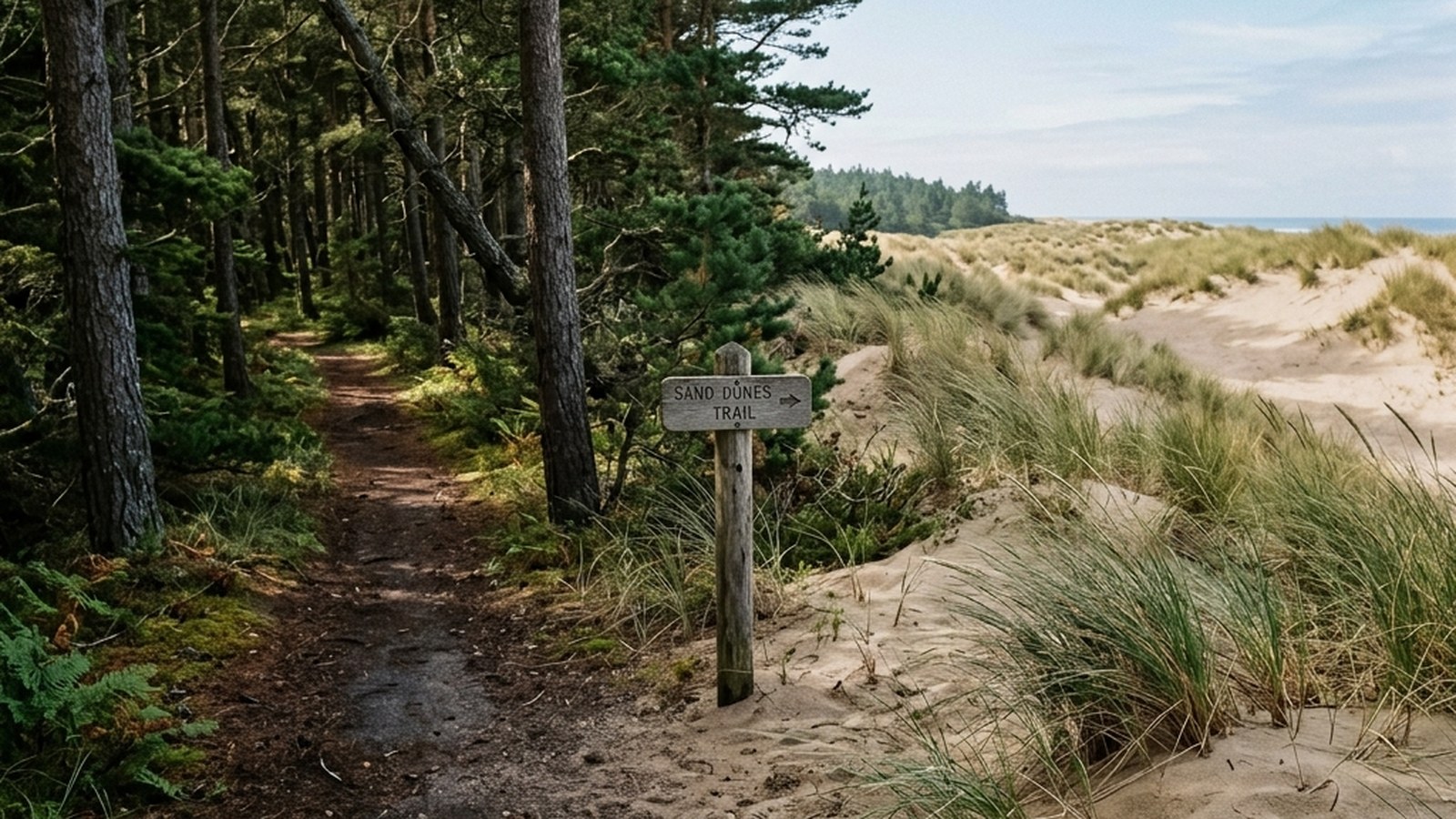
The trail that actually carries Schoonertown’s name is the Town of Wasaga Beach’s Schoonertown Trail: about 5.8 km, rated moderate, with a trailhead near Sunset Court on the south side of the river Explore Wasaga Beach. It runs through the mixed pine-oak dune forest that covers this stretch of the Nottawasaga corridor — the same globally rare pine-oak savanna ecosystem the provincial park is known for, though this particular section is town-maintained parkland rather than park land proper. A short walk from the parkette also connects toward the Harold Culham Memorial Bicycle Trail (about 6.3 km), which enters the Dunes Area of Wasaga Beach Provincial Park a little farther along — useful if you want to extend a walk into a longer loop, or simply turn back at the parkette for a short one.
None of this is technical hiking. It is flat-to-gently-rolling parkland trail, shared with cyclists on some sections, and close enough to River Road West that you are never more than a few minutes from a parked car. That is exactly what makes it a realistic forest-bathing spot rather than a backcountry pilgrimage: you can do twenty unhurried minutes here on an ordinary Tuesday, not just on a planned day trip.
What "forest bathing" actually means
Shinrin-yoku — literally "forest bath" — is a term Japan’s Forestry Agency coined in 1982 to describe unhurried, sensory time among trees: walking slowly, noticing smell and sound and changing light, with no distance or pace target. It is not hiking, and it is not a guided meditation with a script; it is closer to a deliberately aimless walk. The idea spread internationally over the following two decades, and a real, if uneven, research literature grew up around it — separate from, though sometimes confused with, general "time outdoors" or "green exercise" research.
What the evidence actually shows
The most-cited physiological study sent nearly 300 adults on matched walks in 24 Japanese forests and in nearby cities, then measured them before and after: the forest walks were associated with lower cortisol, lower sympathetic nervous system activity, and higher parasympathetic (rest-and-digest) activity than the city walks Park 2010. A separate Stanford study found something similar for mood: a 90-minute walk in a natural setting, compared with a walk along a busy urban road, reduced self-reported rumination and lowered activity in a brain region tied to dwelling on negative thoughts Bratman 2015.
A widely cited state-of-the-art review of the shinrin-yoku literature found a genuine, repeated pattern of lower blood pressure, lower cortisol, and improved mood after forest exposure — but flagged that most trials are small, short (single sessions to a few days), impossible to properly blind, and concentrated in Japan and Korea, which limits how confidently the effect sizes generalize to a casual walk on a Wasaga Beach trail Hansen 2017. Larger population studies point the same direction at a coarser level: a UK survey of nearly 20,000 people found that roughly 120 minutes a week of nature contact, in any combination, was associated with better self-reported health and wellbeing, with little added benefit past that point White 2019, and a meta-analysis pooling greenspace-exposure studies linked higher greenspace exposure to lower cortisol, lower cardiovascular disease incidence, and lower all-cause mortality Twohig-Bennett 2018.
The honest caveat applies to all of it: these are observational or small-sample experimental designs, not blinded drug trials, and "more nature contact" correlates with plenty of things — income, mobility, existing health — that also predict better health on their own. Nobody has run a randomized controlled trial proving that a specific walk on a specific Wasaga Beach trail lowers anyone’s blood pressure. What the literature actually supports is a modest, plausible, mechanistically coherent claim: unhurried time among trees measurably calms the stress-response system in the short term, on average, across the studies that have looked.
How to actually do it on this trail
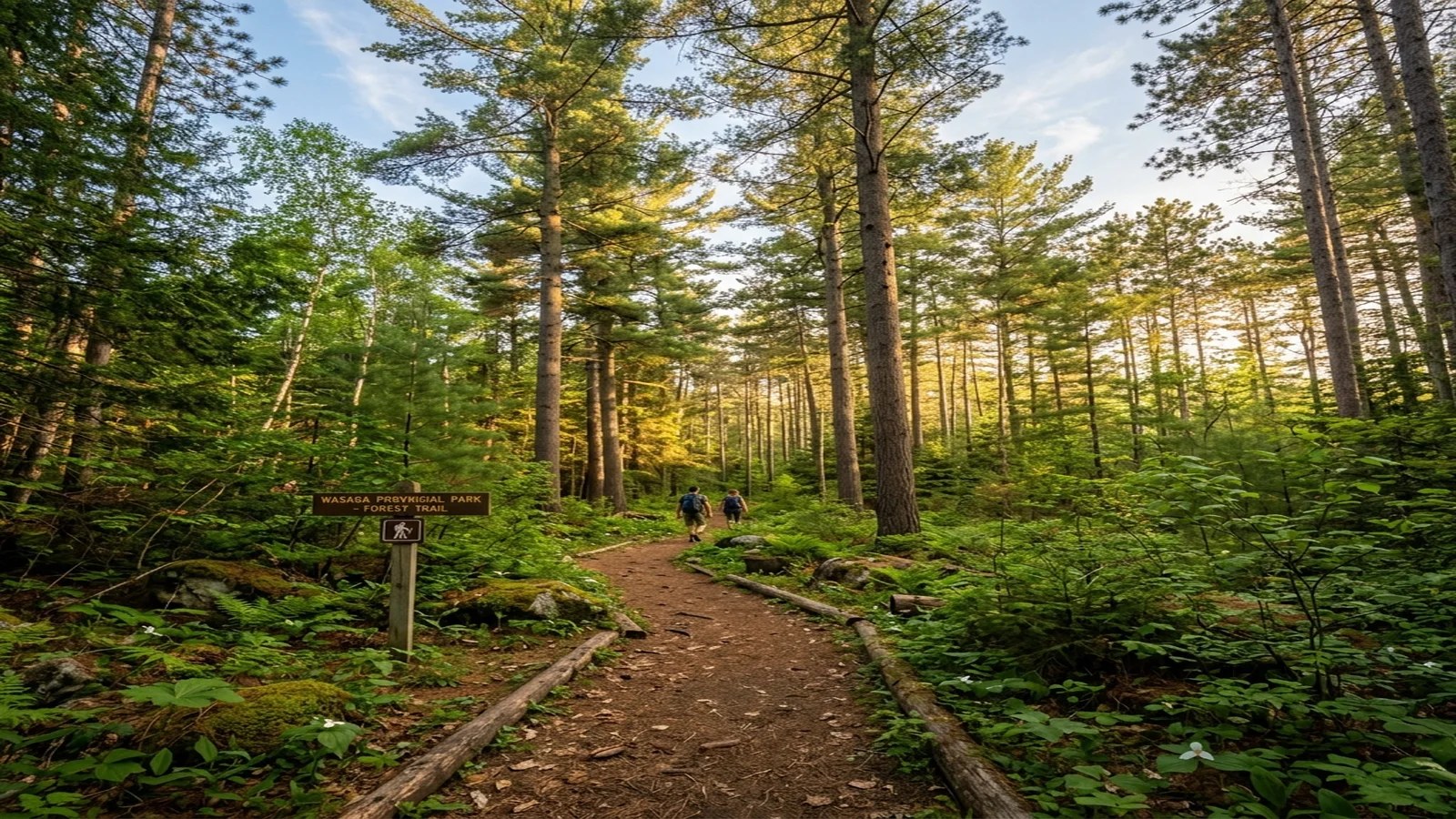
Forest bathing has no equipment list, but it does have a method, and the method is the opposite of most fitness advice: slow down on purpose. Walk at roughly half your normal pace. Leave the phone in the car, or at least in a pocket you don’t check. Pick a few minutes to stand still and just listen — wind through the pine-oak canopy, the river somewhere off to one side, birds. Notice temperature and light shift as the trail moves between open and shaded sections. There is no distance target to hit; the parkette-to-parkette out-and-back can be fifteen minutes, or you can follow the fuller 5.8 km route.
If you also want a training-effect walk the same afternoon, do the slow, sensory portion first and save any brisker walking for a second loop — mixing "notice everything" with "hit a pace" tends to collapse into the latter. For a longer, more structured forested walking option in the same town, see our guide to Wasaga's Nordic Centre trail network, which suits longer sessions and off-season use better than this shorter riverside trail.
A single session doesn’t need to be long to register as a session. Ten unhurried minutes near the parkette, done with actual attention, will do more for the nervous system than forty minutes walked at a normal clip while thinking about something else — the slowing down is the intervention, not the distance covered. Seasonal timing changes the experience more than it changes the method: spring brings more birdsong and softer light through bare canopy, midsummer brings fuller shade and more insect activity worth planning around, and a quiet weekday morning will generally offer fewer interruptions than a summer weekend afternoon, when the trail shares more traffic with cyclists. None of that changes what to actually do once you’re there — slow down, drop the phone, and let the walk take as long as it takes.
What it won’t do
Forest bathing is not a substitute for treatment of diagnosed anxiety, depression, or cardiovascular disease, and none of the studies above claim otherwise — they measure short-term physiological markers and self-reported mood, not disease outcomes over years. It is also not a form of exercise: if cardiovascular fitness is the goal, a brisk walk or a structured zone 2 session will do more for the heart and lungs than a slow amble through the dunes. The two are not competitors — a slow walk earns its place as a stress-management habit, not a fitness one, and it is worth doing for that reason alone.
Safety and practical notes
The Schoonertown Trail runs through wooded parkland, so standard trail precautions apply: check yourself for ticks after walking through longer grass or brush at the trail edges, especially between spring and fall — see our guide to tick prevention on Wasaga trails for what to actually check and how. The trail itself sits well upstream of the Nottawasaga’s mouth at Georgian Bay, where the river meets the open lake; that stretch, not this one, is where the dangerous currents covered in our Georgian Bay swim-safety guide apply. If you would rather experience the same river from the water instead of the bank, our roundup of Nottawasaga River paddling launch points covers nearby put-ins.
Parking is roadside near River Road West and Oxbow Park Drive, or at the Sunset Court trailhead a short distance south. The route is flat enough, and short enough in its parkette-to-parkette form, to work for a wide range of mobility levels — readers building a walking habit later in life may also find our senior fitness walking guidance useful for pacing a longer outing.
Related reading
For a longer, more structured forested walk in Wasaga Beach, see the Wasaga Nordic Centre trail network. If ticks are a concern on any wooded trail this season, read tick prevention on Wasaga trails. And to compare a slow forest walk against a structured cardio session, our zone 2 vs. HIIT breakdown lays out what each actually trains.
Frequently asked questions
Is Schoonertown a wetland preserve or nature reserve?
No. Schoonertown is a historic War of 1812 naval heritage site (Schooner Town Parkette) on the Nottawasaga River. There is no formally protected wetland preserve or signed conservation loop there, and no official acreage figure attached to the site.
How long is the Schoonertown Trail, and how hard is it?
The Town of Wasaga Beach lists the Schoonertown Trail at about 5.8 km, rated moderate, with a trailhead near Sunset Court on the south side of the Nottawasaga River. It is flat-to-gently-rolling parkland trail, not technical hiking.
What does forest bathing actually involve?
Shinrin-yoku, or forest bathing, means walking slowly and without a distance or pace goal through a wooded area, deliberately paying attention to sound, smell, and light rather than covering ground. It is not a workout and has no required equipment or technique.
Does the research on forest bathing actually hold up?
Partly. Controlled studies link forest walks to lower cortisol and calmer nervous-system readings compared with urban walks, and population surveys link more nature contact to better self-reported wellbeing. But most trials are small, short, hard to blind, and concentrated in Japan and Korea, so treat the evidence as suggestive rather than definitive.
Is the water near the Schoonertown Trail dangerous to swim in?
The trail follows an inland stretch of the Nottawasaga River well upstream of where it meets Georgian Bay. The dangerous currents documented for this river apply at its mouth near the beach, not along this walking trail.
References
Park 2010Park BJ, Tsunetsugu Y, Kasetani T, Kagawa T, Miyazaki Y. The physiological effects of Shinrin-yoku (taking in the forest atmosphere or forest bathing): evidence from field experiments in 24 forests across Japan. Environmental Health and Preventive Medicine. 2010;15(1):18-26. View source →Bratman 2015Bratman GN, Hamilton JP, Hahn KS, Daily GC, Gross JJ. Nature experience reduces rumination and subgenual prefrontal cortex activation. Proceedings of the National Academy of Sciences. 2015;112(28):8567-8572. View source →Hansen 2017Hansen MM, Jones R, Tocchini K. Shinrin-Yoku (Forest Bathing) and Nature Therapy: A State-of-the-Art Review. International Journal of Environmental Research and Public Health. 2017;14(8):851. View source →White 2019White MP, Alcock I, Grellier J, et al. Spending at least 120 minutes a week in nature is associated with good health and wellbeing. Scientific Reports. 2019;9:7730. View source →Twohig-Bennett 2018Twohig-Bennett C, Jones A. The health benefits of the great outdoors: A systematic review and meta-analysis of greenspace exposure and health outcomes. Environmental Research. 2018;166:628-637. View source →Ontario Heritage TrustOntario Heritage Trust. Schooner Town (provincial historical plaque and background). View source →Wasaga Beach Provincial ParkFriends of Nancy Island / Wasaga Beach Provincial Park. Schooner Town: history and site information. View source →Explore Wasaga BeachTown of Wasaga Beach (Explore Wasaga Beach). Trails listing: Schoonertown Trail, 5.8 km, moderate. View source →